Biofuel, Hydrogen Push Reflects India’s Energy Shift: Hardeep Singh Puri
Concerns about biofuels harming engines are exaggerated; with auto and energy firms aligned, the shift to cleaner energy—biofuels, CBG, green hydrogen—is imperative, he says
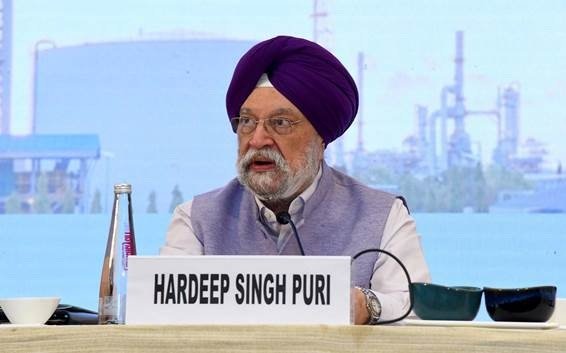
“Much of the noise about biofuels harming engines is exaggerated. Automobile and energy companies are aligned, and while isolated complaints exist, the shift to cleaner energy—biofuels, CBG, green hydrogen—is the imperative of our time,” said Hardeep Singh Puri, Minister of Petroleum & Natural Gas, at KPMG ENRich 2025.
The minister said, “We are committed not only to availability, affordability, and sustainability, but also to ensuring we can transition from the present to the sustainable. Our biofuel journey tells that story well. In 2014, when the Prime Minister took office, biofuel blending stood at just 1.4%. We set a 10% target for November 2022 and achieved it five months early. Our 20% target, initially set for 2030, was reached six years ahead of schedule.”
He added that the government will now pause and assess the next steps, allowing the ecosystem time to absorb changes. India, he noted, is among the few G20 countries to have met its climate targets. “But while we plan for the future, we must also ensure present-day energy security. Whatever the weather, there must be no shortage of energy anywhere in the country. I have seen colleagues deliver cylinders on their shoulders through floods to keep homes running.”
Highlighting recent milestones, Puri said, “In Numaligarh, Assam, the Prime Minister inaugurated India’s first bioethanol refinery making ethanol from bamboo. Earlier, in Panipat, we opened another refinery using agricultural waste. Our refining capacity already makes India the world’s fourth-largest refiner. From 260–270 million tonnes per annum, we are expanding to 320 MTPA, with plans to use that additional capacity for petrochemicals, where local production still lags behind demand.”
On green hydrogen, the minister said that he is proud of India’s progress. “Two years ago, when the Prime Minister launched the National Green Hydrogen Mission, the global price was around $5.5 per kilo. We were determined to beat that. IOCL floated a tender, won by L&T, that brought the price below $4. HPCL’s tender has pushed it down further. With PLI schemes and coordinated government efforts, India is positioning itself as a competitive producer of green hydrogen.”
He pointed out that prices have already fallen further. “We’ve brought the price of green hydrogen down to around $3.50 per kilogram, even lower in some cases. I’m confident that as these tenders are replicated and scaled up, the price will fall below $3. And once it reaches $2.5 per kilogram, given that we spend $150 million on energy imports, you will see a massive shift to green hydrogen. After all, the only byproduct it produces is water vapour.”
Acknowledging the challenges, the minister said, “The journey hasn’t been easy. When I was in Margherita, Assam, recently, people said we had lost time here and there. But that’s part of the learning curve. You can’t leap to green hydrogen overnight—it takes steps, adjustments, and persistence.”
He also commended the role of start-ups. “The progress is remarkable. I’d encourage you to create a compendium of their contributions. Even if some companies may not want to share proprietary details, many would be happy to be part of such a digital knowledge base. It would add real value to the ecosystem.”
Referring to broader advances, Puri said, “Across sectors—exploration and production, transition, sustainability, and new technologies—the advances are significant. Some I can’t disclose, but they would surprise you with their potential. And on 15 August 2025, the Prime Minister announced the Deep Water Mission. This isn’t just about oil and gas—it’s about tapping into resources critical for the new economy, waiting to be harnessed.”
On global challenges, he noted, “Of course, we live in turbulent times, and I say that mildly. But we are more resilient today, able to navigate global uncertainty. This resilience comes partly from the availability of oil and gas in world markets, particularly with increased supply from the western hemisphere.”
“There are 26 or 27 such cases where supply is available, but no matter what you do, you can’t fully control it,” he explained. “Ultimately, the investor who has put money in must produce, because if the transition overtakes them, they will be left with stranded assets underground. That is the real challenge.”
What's Your Reaction?