India is generating more e-waste, but much of its value is slipping out of the country due to weak recycling systems
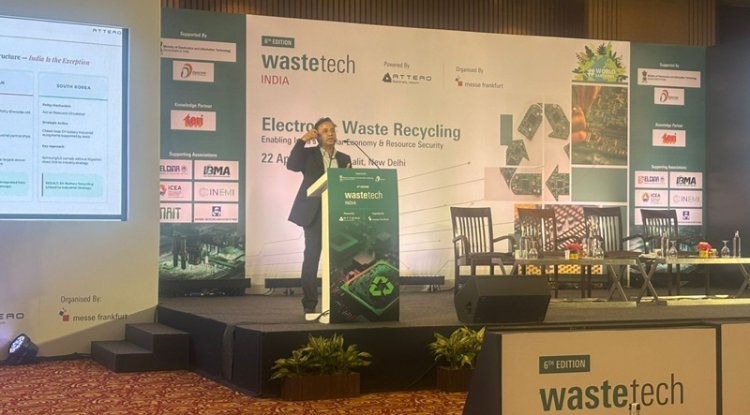
At the WasteTech India Forum 2026, organised by Messe Frankfurt Trade Fairs India and powered by Attero, Abhinav Mathur did not mince words. India’s recycling system, he said, is leaking value at every step.
Mathur, Advisor to the Board at Attero, pointed to a cycle that has become all too familiar. Electronic and battery waste moves through the informal sector, where only easy metals like gold or copper are recovered. What remains, often richer in critical materials, is either dumped or shipped out to countries like China and South Korea. There, it is refined, turned into high-value inputs, and sold back into global supply chains.
“Value created here is leaving the country and coming back as finished material,” he said. “That is the real loss.”
India generates about six million tonnes of e-waste each year, making it the world’s third largest producer. The material value alone runs into tens of billions of dollars. If downstream industries are counted, the opportunity is far larger. But much of this value is slipping away.
Mathur’s core argument was simple. Recycling in India is still treated as a compliance issue. It needs to be seen as a strategic industry.
He laid out three ways countries typically secure critical minerals. Mining at home. Buying mines abroad. Or “urban mining”, which is recycling. Of the three, recycling offers the fastest turnaround, lower capital needs, and minimal geopolitical risk. A recycling plant can start producing within a year. A mine can take over a decade.
Yet India’s policy focus, he argued, is still scattered. Responsibilities are split across ministries, from environment to electronics to mining to urban affairs. “There is no single command centre,” he said. “It is a divided house.”
This fragmentation shows up on the ground. The informal sector dominates collection. Material passes through multiple layers of aggregators. Each layer extracts some value, often inefficiently, before the rest is lost or exported.
The result is a weak formal ecosystem. Advanced recyclers, who can extract lithium, cobalt or rare earths using technologies like hydrometallurgy, struggle to access quality feedstock. What reaches them is often stripped of value.
Mathur argued for a shift. Strengthen formal players. Enable direct collection from consumers. Keep high-value material within the country. “If we do not control the input, we cannot control the output,” he said.
He also pointed to a gap in how recyclers are classified. Today, all recyclers are treated alike. But there is a clear difference between basic dismantlers and advanced facilities that can recover critical minerals at high purity.
“What matters is not just recycling, but what you recover and how well you recover it,” he said.
Without that distinction, the system rewards volume, not value. Materials that could go back into defence, EV batteries or renewable systems end up being downcycled into low-end uses.
Policy support, he said, is also spread too thin. India’s incentives are divided into small allocations across many players. In contrast, countries like the United States back a few firms with large, targeted investments, building national champions.
“There is merit in backing capability, not just capacity,” Mathur said.
Finance remains another bottleneck. Even where funds are allocated, a large portion remains unused due to design gaps in schemes. At the same time, recycling infrastructure is not keeping pace with rising waste volumes. E-waste has doubled in recent years and is expected to keep growing.
The stakes are rising because critical minerals sit at the centre of India’s industrial ambitions. Semiconductors, electric vehicles, batteries, renewable energy, defence systems and data centres all depend on them.
“If we remain vulnerable on these materials, many of our national missions will struggle,” he said.
Mathur ended with a call for a rethink. Recycling, he said, should be treated as part of national security, not just environmental compliance. That means clearer policy ownership, better enforcement, and targeted support for advanced recyclers.
It also means fixing the basics. Stronger audit systems. Clear standards on recovery efficiency and purity. And a system that rewards those who can bring materials back into high-value use.
India, he said, has the raw material within its own waste. The question is whether it can hold on to it.
What's Your Reaction?