A newly analysed Alpine ice core has revealed more than 1,500 years of climate, wildfire, volcanic and human pollution history, while highlighting the urgent need to preserve rapidly melting glaciers.
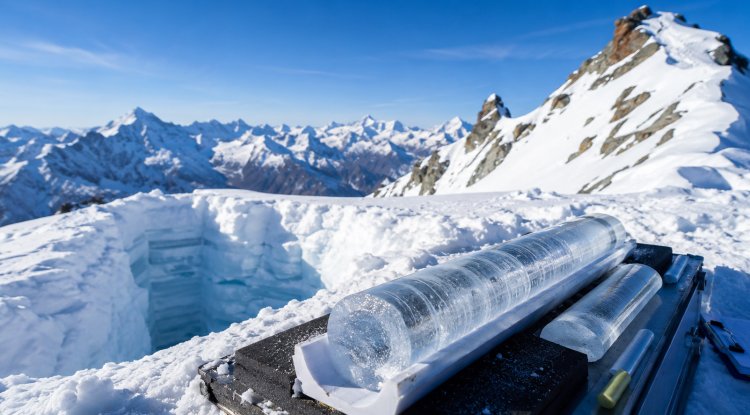
Researchers dug 33 feet into the Weißseespitze glacier in the eastern Alps and uncovered a capsule of frozen atmospheric history, including some of the oldest atmospheric measurement records available. The core was taken from the summit ice cap at about 11,480 feet above sea level, which functions as a high-elevation “mailbox” where the wind deposits dust, salts, smoke and metal particles that are covered by snow over centuries.
Lead author Azzurra Spagnesi (Ca' Foscari University of Venice) explained, “These amazing climate archives act like a history book, in the sense that they show the climate's history.” This is an Alpine core, in which fallen airborne particles are trapped; in deep polar ice cores, air bubbles are preserved.
The research, published in Frontiers in Earth Science, covers the period from Roman times (c. 128) to 1641. The top part of the core contains the remains of ancient metal smelting, smoke from forest fires, mineral dust and distant volcanic eruptions in compressed layers of snow.
The core was analysed for 18 trace elements, organic acids, microscopic charcoal and levoglucosan, a chemical compound formed during the combustion of wood and plant material. Statistical analysis enabled the team to distinguish between pollution and natural sources like wind-blown rock dust and sea salts. About seven percent of the core was made up of human emissions, while 93 percent came from natural materials, providing scientists with a clean sheet of paper to see how European air behaved before factories, heavy coal burning and car exhaust changed the atmosphere.
The use of metals was clearly reflected in the record. The amount of metal remained low for most of the Middle Ages (700–1200), but there was a strong peak in lead, copper, silver and arsenic beginning about 950, corresponding to the period when silver and copper were being mined in the Italian Alps, the adjacent Alpine valleys, and the Harz Mountains of Germany, where metal ores were smelted, releasing toxic metals into the air.
The ice also recorded fires of the past. The researchers found that levoglucosan concentrations were highest from 902 to 1280, and an independent peat core from another 12-mile-distant bog near the site showed a corresponding increase in microscopic charcoal from 822 to 1092. This overlap is indicative of fires spreading throughout the region, rather than a single local fire. Climate conditions from 950 to 1040 created a warm, dry period that dried out alpine vegetation, making it more susceptible to fire, while population expansion encroached on forests, turning them into agricultural areas through fire.
The glacier also preserved a record of events from across the sea. Volcanic eruptions in 1235 and 1580 were identified by a combination of chemical anomalies and elevated rare metal levels, representing fine particles carried in the air and deposited with snowfall on the Alps. The 1235 signal is consistent with records of major volcanic eruptions preserved in ice cores from Greenland and Antarctica.
But this mountain archive is being lost due to rapid warming. Measurements indicate that the thickness of ice over the drilling site has decreased by 15 ft from 2019 to 2025, from 33 ft to 18 ft. A study on the companion glacier estimated that the total glacier cover could disappear within 10–20 years if the current rate of glacier loss continues. Even the surface ice collected in 2019 was found to be 400 years old, indicating that the ice layers from modern times, such as the industrial era, had already melted away. However, a separate dating study found that the deeper ice samples from the site dated back about 6,000 years, and other chemical and climate signals remained readable despite the melting of surface ice, according to research published in 2023.
As glacier ice turns to water, science is losing more than water; it is losing the chemical particles, the trapped gases and the climate clues, and they are gone forever. It's about “preserving the memory of the Earth's climate,” Spagnesi explained. Now, scientists have to rush to recover and store cores from endangered mountain glaciers so that future laboratories, equipped with instruments that have yet to be developed, can examine the cores and learn how land use, drought, fire, dust and volcanoes once shared the same airspace.
What's Your Reaction?