Dr. Jyothsna Tirunagari—National Spokesperson, TDP, former Telangana Telugu Mahila President, and President of the Samskara Foundation—speaks about the vision of Chief Minister N. Chandrababu Naidu for his home constituency, Kuppam, and the broader roadmap for AP
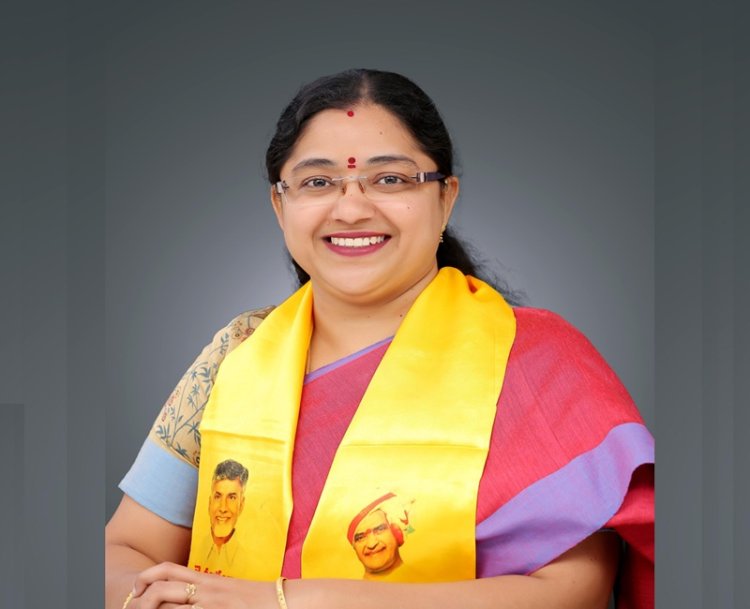
In a candid conversation with Responsible Us, Dr. Jyothsna Tirunagari—National Spokesperson of the Telugu Desam Party (TDP), former Telangana Telugu Mahila President, and President of the Samskara Foundation—spoke about the vision of Chief Minister N. Chandrababu Naidu (CBN) for his home constituency, Kuppam, and the broader roadmap for Andhra Pradesh.
Kuppam, often referred to as the Chief Minister’s “home turf,” has elected Naidu for the eighth time, a testament to the deep bond he shares with the people. Once considered a backward constituency, Kuppam witnessed transformative changes under his leadership—most notably in the dairy sector, where households were supported with cattle through heavy subsidies. That single intervention laid the foundation for today’s thriving dairy economy, largely run by women, underscoring Naidu’s long-standing commitment to women’s entrepreneurship and empowerment.
Now, in his fourth term as Chief Minister, Naidu has set a more ambitious goal—making Kuppam a model net-zero constituency. Through the Kuppam Area Development Authority, efforts are underway across waste management, water management, the circular economy, and green energy. A complete shift to electric vehicles by 2029 is already in motion, with government and public transport vehicles leading the way. Drainage systems have been revamped, renewable energy initiatives strengthened, and policies designed to balance the needs of both investors and citizens.
Dr. Jyothsna highlighted how Andhra Pradesh today offers some of the highest EV subsidies in the country, along with single-window clearances for investors. Combined with concessions like SDST waivers for select industries, these measures have positioned the state as one of the most attractive destinations for investment in green growth. What steps has the Andhra Pradesh government taken to promote green energy and support struggling industries?
We offer subsidies for developing solar panels, and alongside this, an ecosystem is being established. This is a crude example and illustrates our thought process. It is not manipulated but manifested, because unless you show the benefit to the beneficiary, they will not adopt it.
From the government, we provide subsidies—200 units free, 300 units free—to certain communities. In the handloom industry, we give 200 units free, and in some other industries, 300 units free. These sectors are in dire need, and the handloom industry, especially, is struggling; we must extend that hand-holding. That is why we came up with this concept. At the same time, the state cannot run into losses, so we are trying to balance both.
Apart from this, the state has policies on green energy, hydrogen energy, and new developments in the energy sector. What the world thinks tomorrow, CBN thinks today—he is known for that. Back in 2014–19, in the newly divided Andhra Pradesh, he introduced the green energy concept. It was not just about introducing it but going the extra mile to make it a reality, and he has been on the ground to ensure that.
To create an impact, every day is a learning experience for us. I have also learnt about green energy, solar energy, EVs—because he is involved in all of it.
How does your state government work on free schemes?
If our concept was for the downtrodden, we had to think carefully. Let’s assume we have 100 buses—how many of those are used by women who travel frequently, especially in rural and semi-urban areas, or in local urban transport, where they incur most of the expenditure. It took us time to identify all this, but we did not budge. We also could not push APSRTC into losses, because in other states where this was implemented, it failed.
Of the 100% buses, we took around 74–75%, which constitutes the maximum women travellers. Using those buses, women are gaining today. Before the scheme, around 40% of women used public transport. We expected this to rise up to 67%, so we were prepared for that 27% increase. We didn’t just blindly jump in.
How is Andhra Pradesh leveraging its resources to shape energy policy and attract investors?
It is based on the same (Free Shakti Scheme) concept we are introducing and following up on in energy as well. Our state has abundant natural resources—we have the longest coastline, rich minerals, and strong human resources. We are trying to optimise each of these to arrive at the best possible solution for both the state and the people.
We have come up with the best energy policy and the most effective incentive and subsidy policy any state has introduced. This was possible because of deep thought and brainstorming. Of course, there may still be one or two hiccups, but we have a leader like Nara Chandrababu Naidu, the brand image of AP, who acts as a troubleshooter. So even if an investor faces an issue tomorrow, he will ensure a solution. Our final thought process is simple—people should benefit, the state should benefit, and the investor should feel confident investing here.
What are the state’s key initiatives in water and waste management?
On waste management, we are not limiting ourselves to conventional methods. We are working on the concept of “9-0,” which focuses on turning waste into a valuable resource.
We have come up with the idea of turning waste into gold and diamonds—figuratively, by creating wealth from it. The state is rolling out strong initiatives in this direction, and in the near future, you will see results. For Chandrababu Naidu, nothing is waste; everything is a raw material for something else. That is why industries here are adopting the concept of turning waste into raw material for other industries. Even household waste is being segregated and converted into energy, including CBG gas. You name it, and we are working on it.
How has Andhra Pradesh transformed from a “black period” of stagnation to today’s phase of growth and innovation under Chandrababu Naidu’s leadership?
From 2019 to 2024, it was a black period for Andhra Pradesh—a time of destruction. Forget development, forget construction, forget moving forward—the state was literally pushed 20 to 30 years behind. The name of Andhra Pradesh was unheard of, no industries came in, and there were no new concepts or initiatives. But today, when you hear about AP, it’s AI, its growth, it’s quantum, it’s new ideas every day. We are investing in tourism, building the best facilities, introducing caravans and developing sought-after locations. We have also launched strong women empowerment schemes, including the ‘One Household, One Entrepreneur’ initiative under Chandrababu Naidu.
I am telling you this is because we have pulled the state out of that destructive phase and are trying to move forward. The pace may seem slow due to the setbacks of 2020–2024, but with a visionary like CBN, slow pace does not exist. He runs, and he makes us run. He hardly sleeps—maybe four or five hours a day—and works over 18 hours daily. Imagine the plight of ministers, MLAs, and officials. But that is what the state needs today.
Your state is hosting diverse events and initiatives across water, logistics, tourism, dairy, and even steel plants with a sustainability focus. How do you ensure that every sector—urban and rural—contributes to Andhra Pradesh’s revival?
In Visakhapatnam, Naidu was the chief guest at the Global Forum for Sustainable Transformation’s East Coast Maritime Logistics Summit, focusing on coastal logistics, a sector few states have thought of. Earlier, GFST hosted conferences on tourism, animal husbandry, and dairy development. No field is left behind, because my leader believes every sector—rural or urban—is pivotal for the state’s growth. Rural economy, especially waste management, is a huge sector for building the right ecosystem.
We are working on new initiatives across sectors. Even steel plants now being set up in the state are looking at green technologies. Sustainability is non-negotiable for every industry coming here.
We are also engaging women in a big way. For example, through biology projects, we are onboarding around 300 women from the diaspora. We are bringing together experts from different fields—Shubhi, a galvanising expert, and Anshida, an HE expert—to build something strong with women at the centre.
What's Your Reaction?