A flood has swept away the town of Dharali in India's Uttarakhand, likely caused by the collapse of a glacial lake due to accelerated melting and persistent rain, according to expert
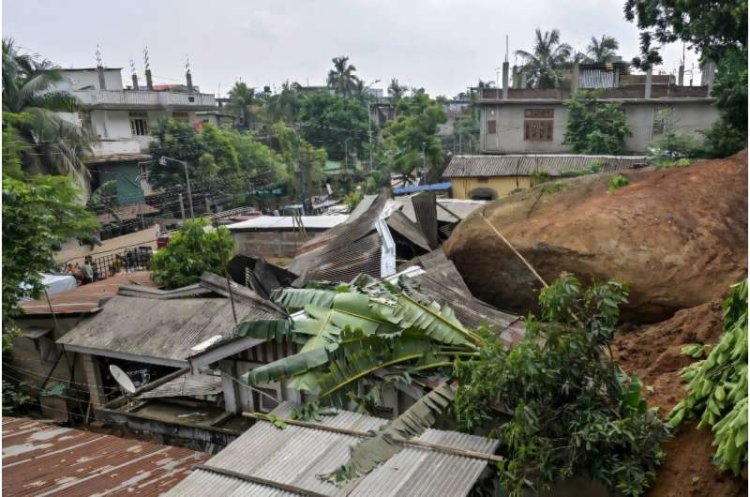
Earlier this week a major flood event in the Himalayan town of Dharali in the Indian state of Uttarakhand is thought to have been initiated by a collapse of a glacial lake, according to the first look reports from disaster management specialists and climate scientists. The until-recently stationary torrent of water, mud, and debris traveled down the narrow mountain valley at speed, destroying homes and infrastructure, and leading to dozens of missing persons.
The event happened on Tuesday when a freezing rush of muddy water surged downstream, destroying whole buildings and vehicles in its path. Eyewitnesses and video footage show residents running away a moments before they vanished under waves of sludge and debris. In all, four dead have been confirmed but more than 50 people are still missing. The death toll is likely to rise as civil search and rescue efforts continue in the area.
Originally, government officials blamed the disaster on a cloudburst - a rainstorm of high intensity and highly local scope. But researchers looking back on the events suggest that, while a cloudburst is probably a proper descriptor, it was just the last trigger, following several different factors building over a number of days. To be clear, there was rainfall that preceded such an extreme water release, which is postulated to have saturated the soil and weakened the terrain for that weather system.
Environmental researchers think that the primary source of instability originated from the collapse of a moraine - defined as a natural dam made from rock and debris - that was related to holding a glacial lake. Glacial lakes fill up with meltwater from glaciers declining due to increasing average global temperatures, but these lakes become more dangerous because they can fail suddenly if the moraine that held it collapsed (and it is more likely to collapse during a "heavy" rain event). In fact, specialists suspect the combination of heavy rain and rapid melting caused the accumulation of a significant amount of water behind such a moraine. When the moraine failed, it could only take minutes before a large volume of water was released in what would be classified as a high-energy flash flood.
The mountain topography above Dharali encompasses unstable sediment zones, which are systematically susceptible to movements when water accumulates or permafrost dissolves. With both intensified rainfall and glacial meltwater and increased pressure on the moraine, failure became imminent. The event can be classified as a glacial lake outburst flood (GLOF), and these events are occurring with greater frequency in high mountain regions ending with and under climate change.
Recent cloud cover and limitations for recent satellite images meant there was uncertainty about the source of flooding; however, experts on the destruction did make a strong case supporting the GLOF connection. Immediately prior to the disaster, the amount of rainfall was not exceptional for monsoon areas; it cemented the assertion that the major component of water was a collapsing lake rather than the direct rainfall.
Climate scientists have repeatedly cautioned that Himalayan glaciers are melting at an increasing pace due to global warming. The glaciers are a crucial freshwater resource for almost two billion people in South Asia, so the acceleration of glacier retreat evidently presents substantial new hazards. As ice melts and permafrost also thaws, mountainous terrain becomes subject to instability and a higher probability of landslides, avalanches, and glacier lake-outburst floods (GLOF). The future risk of these hazards will increase as more people develop properties where human settlement expands into floodplains and other risky areas.
There has been considerable recent expansion in Dharali and surrounding settlements, with public works and construction including roads, hotels, and other developments taking place very close to the riverbanks. Experts caution that development in areas of risk increases the threat from natural disasters because the water from floods and extreme weather events has less room to expand, and the result is greater devastation to human life and property. In the case of a disaster like that which occurred in Dharali this week, the density and placement of construction projects in the floodplain likely exacerbated both the velocity and severity of the destruction.
The hard-to-reach and rugged location has slowed rescue missions. Heavy machinery and relief material were transported via narrow mountain roads, some already damaged, and were further damaged, or blockaded by landslides, due to the same weather-related causes that contributed to the flooding. Rescue missions, army and disaster response teams, emergency teams, are clearing debris, rescuing people, and providing medical aid.
Authorities in disaster management are calling for caution across similar high-altitude communities for the rest of the monsoon season. Due to climate change, glaciers are continuing to melt, and the candidate weather is becoming more erratic and darker in the environment above the ground they have dug for safety. Further incidents are possible (if not unavoidable). Experts suggest continuous vigilance of vulnerable communities located close to glacial lakes using satellite imagery and on the ground sensors so they are aware of any swelling of lakes or instability of moraines.
Environmentalists attribute the disaster to manmade climate change and note it should serve as a warning of the need for adaptation in the Himalayas — this should include limiting construction in at-risk zones, funding early-warning systems for floods and landslides, and engaging the public with the dangers of a warming climate. Using early-warning systems, locals might have at least some time to evacuate if the dam was monitored and a collapse occurred (and presumably GLOFs cannot always be predicted).
Experts argue that a long-term solution must also address the ultimate cause of accelerated glacial thaw: the rise in global average temperature driven by greenhouse gas emissions. While local adaptation can mitigate immediate risks, the long-term response to retreating glaciers is to meet global climate targets. In the Himalayas, this represents perhaps the greatest stakes, which could be argued to be on par in importance to any CGA throughout the world, not only having vast populations depending on the resource but also significant cultural and ecological values.
The weather, the mountains, and the urgency of search and recovery are still at the forefront of concerns in Dharali, though families continue to watch and wait for news about their missing. Many of the locals have been displaced and continue to reside in temporary relief camps, where food and limited medical care have been made available. Officials have promised some financial support for victims, but for many who have lost their homes or livelihoods, finances will not replace what cannot be recovered in the short term.
This week's events highlight the more interconnected realities of environmental hazards in mountain ecosystems. Natural hazards never happen in a vacuum, and both climate change and unstable ground interacting with anthropogenic development in at-risk areas have the ability to take an unfortunate, localised incident and turn it into a full-on deadly disaster. For communities across the Himalaya dealing with compounded risks, the flood in Dharali may represent an important both warning and beautiful reminder, that without action similar disasters may occur with increasing frequency and deadliness.
What's Your Reaction?