India Records 76,000 Women-Led Startups, Growth Seen in Smaller Cities
India now has over 76,000 women-led start-ups, many based in Tier 2 and Tier 3 cities. Supported by national and state schemes, these ventures are reshaping the start-up landscape through economic inclusion, legal reform, and STEM-focused empowerment.
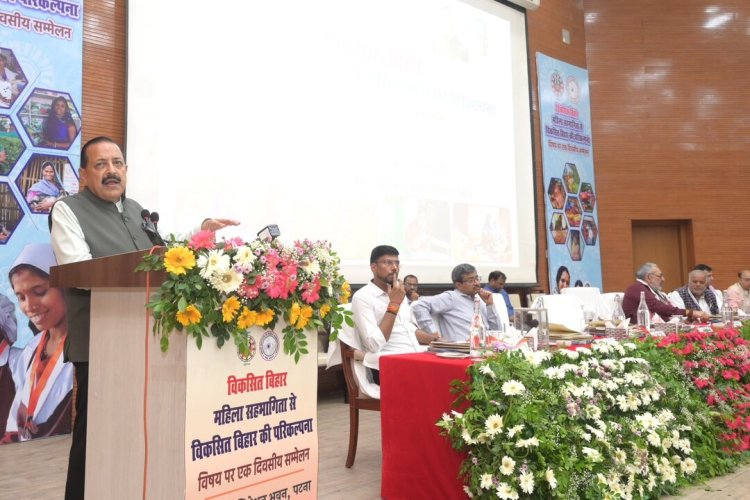
India boasts one more success in that there are more than 76,000 women-founded startups today, Union Minister Dr Jitendra Singh has told. Many of these operate from Tier 2 and Tier 3 cities, a change from the entrepreneurial culture of the country. All this aligns with India's broader vision of becoming a developed nation by 2047.
It was announced at the "Viksit Bihar: Envisioning a Developed Bihar through Women's Participation" conference in Patna. The conference emphasized women's growing leadership, innovation, and local government engagement with special emphasis on Bihar's local development and reforms.
Now, an estimated 1.7 lakh startups are currently functioning in India, and almost 76,000 of them are managed by female entrepreneurs. These companies have reportedly created more than 1.7 million employment opportunities in industries such as science, technology, innovation, and public services.
The policy of the government regarding women's development has four priority areas: maximizing inclusion and access, stimulating the growth of science and technology, facilitating economic and social development, and driving the reforms in the workplace rights and legal frameworks.
There have also been some national programs executed for the same. Programs like Women in Science and Engineering (WISE), Gender Advancement for Transforming Institutions (GATI), and Women Scientist Programme are executed for the improvement of women's participation in scientific studies and higher education. The above-mentioned programs are directed toward reducing the gender gap within the field of STEM.
Also, the government mentioned that more than 60 percent of Mudra loan recipients are women. The Mudra loans finance small-sized enterprise, particularly in the rural and semi-urban districts. Three crore rural women, also called "Lakhpati Didis," are becoming micro-entrepreneurs by way of central and state-funded self-help groups.
Educational and defence institutions have also been brought under the reform process. The Sainik Schools and the National Defence Academy are now available to girls, offering free career opportunities hitherto curbed by sex. Paid childcare leave, maternity benefits following stillbirths, and pension rights to dependent daughters implemented through law are other gains.
At the state level in Bihar, there have been several policies to support national initiatives. These include 50 percent reservation for women in panchayats and other local self-governance institutions, and 35 percent reservation in police and civil services. Bihar has also provided over three million women with economic schemes worth ₹5,000 crore ($580 million), enabling them to start self-employment and business activities.
At the event in Patna, the Minister also announced that Patna Women's College would be adopted under CURIE (Consolidation of University Research for Innovation and Excellence) programme. The proposal involves an investment in the science infrastructure of the college along with providing research opportunities to female students and teachers.
A new online initiative, the Jeevika E-Learning Management System App, was started to increase opportunities for women in rural areas to learn online. The system will provide affordable vocational and entrepreneurial training that meets community needs.
Another book, "Shashakt Mahila, Samriddh Bihar", was also opened for the meeting. It chronicles women's contribution to Bihar's development and has case studies from all sectors from agriculture, education, to panchayat administration and social welfare.
The programme also featured union ministers, state ministers, and members from the Indian Institute of Public Administration. They were engaged in discussions on how Bihar's policy model could serve as a model for other states to enhance gender equity and economic engagement.
The steady rise of women-led startups in small Indian towns indicates a broader shift in the country's development trend. Though metro cities have been the center of the startup community for long, recent figures indicate the rising importance of inclusive and decentralised economic growth. Boosted by government initiatives and policy reforms, many first-generation women entrepreneurs are now running businesses in industries such as technology, manufacturing, services, and rural enterprise.
India's drive for women-led development is a calculated shift in direction toward leveraging untapped human resources. With more women taking on leadership positions in business and research, their output is poised to become key in determining the country's long-term social and economic direction.
Source:
Nirmal Menon's exclusive reporting
What's Your Reaction?