Tier-2 Cities Outpace Metros in Rooftop Solar Installations
Tier-2 cities record faster rooftop solar adoption as household demand links closely to electricity tariffs.
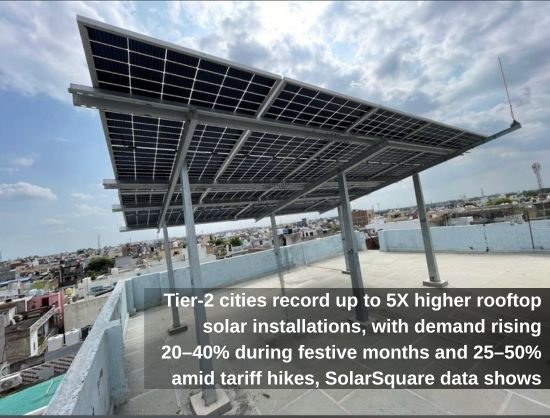
The rooftop solar market in India is undergoing a structural transformation with Tier-2 cities emerging as more rapidly adapting than metropolitan areas. According to SolarSquare, cities like Akola, Amravati and Bhopal account for significant share of new installations, while seasonal and tariff cycle demand patterns continue to become more predictable. Overall, a significant change appears to be taking place in how Indian households view energy investments.
Historically, rooftop solar installation activity in India has been subject to significant fluctuations in activity during the summer months, especially during the rains, when the majority of construction delays occurred, causing households to delay decisions on solar. According to the SolarSquare 2025 data, this phenomenon is diminishing. The installation volumes for June through August are approximately the same as for previous quarters, especially when compared to installations in Tier-2 markets. Evidence for improving planning, increased execution capabilities of the local market, and increased consumer confidence in rooftop solar systems is also reflected in these market trends.
The Tier-2 markets are significantly outpacing metro markets in the amount of residential rooftop solar installed. Data from SolarSquare show installation volumes in cities like Aurangabad, Amravati and Bhopal to be from two to five times greater than in some of the traditional metro markets, like Bengaluru. This trend represents the growing awareness and understanding of the benefits of solar, the growing availability of financing options and the growing level of economic confidence from homeowners living outside of the major urban areas.
Aurangabad had 14,500 rooftop solar systems set up by 2025, and Amravati surpassed the threshold of 10,000 in that same year. This shows that Maharashtra is one of the fastest growing states for residential rooftop solar across India. The combination of increasing electricity prices, a supporting ecosystem, and a growing willingness of households to invest in long-term energy sources has been the driving force behind the rapid increase in adoption in the State.
Additionally, the impact of the festive season on the sale of rooftop solar systems has increased. SolarSquare noted over 20% to almost 40% growth in installations during October-November in all areas where the company operates. Typically, major purchases for homes have historically been made during the low-intent time (October-November) and thus families did not plan for large purchases during this time frame, however this year, as evident in the increasing number of installations during this time frame, this time period is becoming more of a time frame for families to consider solar rooftop systems.
This change demonstrates a shift in the priorities of households regarding their finances, as families are starting to allocate part of their festive budget for investing into long-term energy sources rather than short-term uses. Rooftop solar systems are now seen as a stable investment providing predictable cost-saving opportunities while offering financial protection from the increase in electricity prices rather than just a luxury item to consider.
The correlation between changes to electricity tariffs and the adoption or installation of rooftop solar systems has been shown to be large. Electric tariffs have had a major impact on the installations of SolarSquare’s Results across the markets, with an increase of between 25-50% during the period of tariff increases (from September through November). This indicates that as electricity prices have increased, more households have moved to using solar as a method of cost control over their electricity bills for the long term.
As electricity prices have continued to rise across all of India, the increased relationship between electricity tariff cycles and the adoption of residential rooftop solar indicates that the installation of residential rooftop solar systems are being driven by economic factors that impact the technology and not just by an environmental viewpoint.
As a result of this data, the residential rooftop solar sector in India is transitioning to a more stable and diverse geographical operating environment driven by economic factors. The reduced seasonality of residential rooftop solar installations, the increased participation of urban Tier-2 cities and the impact of tariffs on household decision-making regarding the adoption of solar energy are causing a significant change in which solar energy is installed and used by Indian households. As a result of these changing dynamics, it is anticipated that the residential rooftop solar sector will continue to grow in a more predictable growth pattern going forward.
Founded in 2015, SolarSquare is a roofing solar provider, provides design, installation, financing and maintenance services for residential rooftops. The company has supplied electricity to over 20,000 homes across India with the support of various institutional investors; it also has received recognition outside India for its contribution to advancing residential solar adoption.
Rooftop solar adoption is still on the rise, and Tier-2 cities will likely be critical in scaling rooftop solar adoption in the next growth phase. There are evolving demand patterns that indicate that residential solar is becoming a common household energy asset in India.
What's Your Reaction?