Delhi’s Air Quality: Why the Capital Chokes Every Winter
Delhi’s air quality worsens every winter due to weather conditions, stubble burning, vehicle and industrial emissions, and construction dust,requiring long-term action for cleaner air.
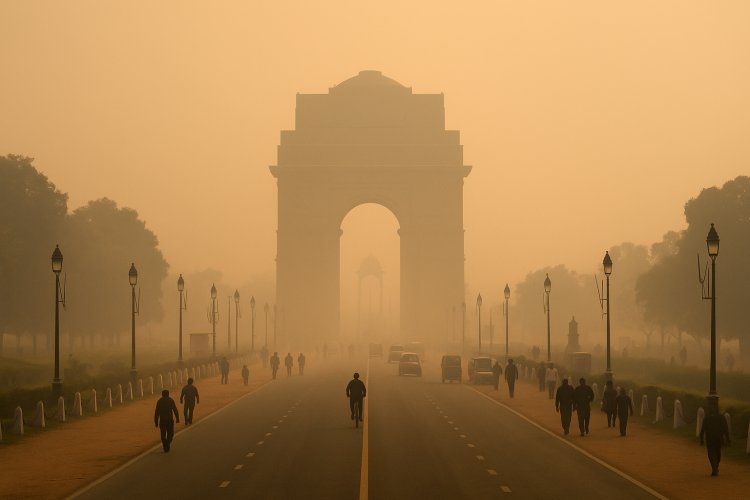
As the winter season starts in Delhi-NCR, the city gets covered with thick layer of smog. Even though Delhi had its cleanest air in the last 8 years earlier in 2025 till October, the air quality has suddenly worsened after the arrival of winter. This happens almost every year, pollution level rise and quality of air goes down.
The big question is why does Delhi’s air become so toxic every winter, and what can be done to stop this from happening again and again?
Why Delhi’s Air Quality Gets Worse Every Winter
Delhi’s pollution is not caused due to single source but it’s the result of several reason. Let’s find out the reason below.
1. Meteorological Traps
During the summer and monsoon seasons, strong winds help blow away dust and pollution and keeps air clean. But when winter arrives, the air becomes colder and weak which traps the pollution near the ground and turn city into a pollution bowl. In short, what goes up, stays up longer.
2. Crop Stubble Burning
Every year farmers in Punjab, Haryana, and western Uttar Pradesh burn crop stubble which are left during October and November to clear fields for the next crop. The smoke from these fires carries tiny harmful particulate matter (PM2.5 and PM10) and gases travel long distance with wind and reach Delhi. When these combine with Delhi’s own pollution from vehicles and factories, it turns into thick unhealthy smog. During the peak burning season, this smoke can add about 30-40% of Delhi’s total air pollution, according to SAFAR.
3. Vehicular and Industrial Emissions
Delhi has more than 1.2 crore registered vehicles, and everyday thousands of vehicles comes from nearby states. Even though many people use CNG and BS-VI petrol/diesel pollution is still high because of traffic jams and old diesel vehicles that releases harmful gases into the air. At the same time industries and brick kilns in Delhi NCR also give off a lot of smoke and pollutants especially during winter when emission usually exceeds the limit.
4. Construction Dust
Large construction and real estate projects across NCR create a lot of dust. In winter, when the wind becomes weak, this dust doesn’t blow away and stays in the air for a long time, worsening PM10 levels. Although the Commission for Air Quality Management (CAQM) sometimes bans or limits construction work when pollution level goes high, these rules are not always strictly follows and it continues to add dust in the air.
5. Biomass and Domestic Burning
Many people still use coal, wood, and waste in under developing areas for cooking and heating instead of using LPG and electricity, they pollute both the air inside and outside homes. Breathing this smoke can be very dangerous because it affects people’s lungs and heart and increases the risk of diseases.
How Bad Is It Really?
Despite an overall improvement in Delhi’s air quality in 2025, with the average AQI between January and October at 170, the lowest in 8 years, the arrival of winter has reversed the trend.
Pollution levels often jump to ‘Very Poor’ or ‘Severe’ categories, where breathing outdoors becomes harmful even for healthy individuals. Hospitals typically report a surge in asthma, bronchitis, and eye irritation cases during these weeks.
Scientists compare Delhi’s winter air to a “chemical soup,” because it contains harmful gases such as nitrogen oxides, ammonia, sulphur dioxide, and volatile organic compounds which are released from the vehicles, factories and waste burning. When these gases react under sunlight, they form secondary aerosols, which are small and invisible but dangerous that can enter deep into lungs and cause serious problems even though we can’t see them.
Steps Taken by the Government
Over the years, both the Delhi and the Central government have taken several steps under the Graded Response Action Plan (GRAP) to prevent air pollution. These steps include banning on construction and waste burning when pollution levels exceed the limit, restrictions on diesel vehicles and generators, using of BS-VI fuel, expanding CNG and electric buses, installing smog towers and anti-smog guns in busy areas to clean the air. Experts say these are temporary solution; they do not solve the main reason behind the pollution
The Permanent Solution
Delhi’s air pollution issue cannot be fixed by only working on city level, but it requires national level focus. It permanent and long-term plan that involves technology, policy reform, and behavioural change. Farmers must adopt sustainable methods and stop stubble burning. Residents must switch to electric vehicles, expand public transport connectivity. Construction sites should control dust through better monitoring. Industries should start using PNG or electricity and follow strict emission standards. Majorly affected states like Delhi, Haryana, Punjab, and Uttar Pradesh must work together to find the solution to curb air pollution. More importantly, citizens play an important role in making air clean by avoiding waste burning, maintaining vehicles to save energy, and planting trees.
If India wants cleaner and breathable air in the future, it needs to focus on long term solution instead of temporary fixes. Only when everyone like government, businesses and citizens works together to prevent air pollution, soon Delhi’s winter morning will feel fresh and cool again soon, instead of being covered with smoke and pollution.
What's Your Reaction?