Baisakhi celebrates harvest and faith, while also highlighting the growing challenges faced by farmers and the environment.
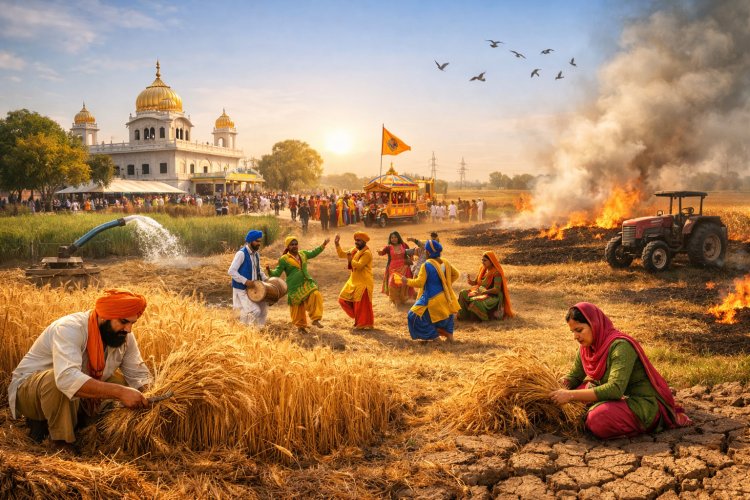
Every year, when spring season is at its peak and golden crops are ready in the fields, then there comes the festival of Baisakhi with joy and excitement. Baisakhi is celebrated mainly in Punjab and the other parts of North India where people come together in a festive and spiritual mood.
Baisakhi is celebrated usually in the month of April either on the 13th or the 14th, which is when crops like wheat are ready to harvested. For farmers this is the time when crops are finally ready to be cut and their hard work shows result. It is the time when farmers feel happy and thankful to the nature. It is the time when lands which are planted with seeds turns into golden crop in the sun. This brings the great joy in the air of North India to which people celebrate it with fullest. This is not just the festival but it has deeper connection with the environment as well.
Farming totally relies upon natural systems like the quality of the soil, availability of water, and weather conditions. In areas such as Punjab and Haryana where Baisakhi is observed with more vigor, farming for many years is a source of worry for the environment. The excessive consumption of groundwater for irrigating crops has lowered the water table, whereas depending too much on chemical fertilizers has had an adverse effect on the fertility of the soil.
But Baisakhi does not means just farming. However, it also carries great religious importance for the Sikhs. The festival marked the formation of the Khalsa Panth by the tenth Guru of the Sikhs, Guru Gobind Singh, on April 13, 1699, at Anandpur Sahib. The event has played a critical role in shaping the character of the Sikh religion, which espouses virtues such as bravery, equality, and selfless service.
Celebrations start at dawn as people pay visits to Gurudwaras and pray there while singing kirtan. Langars, or community kitchens, prepare meals for everyone for free, signifying equality. People take part in a procession, called Nagar Kirtan, in the streets, singing religious hymns and performing martial arts.
Baisakhi is celebrated in villages and small towns with the same spirit and enthusiasm. Farmers, who have had a good crop this year, perform dances such as bhangra and gidda, accompanied by the sounds of the dhol. Cultural fairs are held wherein people eat traditional food and enjoy music and dance. This festival is also an occasion where people come together and make new friends. But for the modern farmer, there is a lot of anxiety too due to increasing production costs and changing weather patterns.
However, in the last few years, due to changes in climatic factors, there have been impacts on the farming process. There are fluctuations in temperature, unexpected rainfall, and heat waves which are causing effects on the quality and yield of crops. The once predictable agriculture system is turning unpredictable, and hence, the festival of Baisakhi is not only a festivity, but an alert too.
On the other hand, when crops are harvested, farmers burn the leftover straw to rapidly clear farm fields, but it has severe impact on the environment as they cause air pollution and spread all over North India. To solve the problem of air pollution, experts are now trying to find better way to grow crops which are less harmful for the soil and the air such as crop diversification and organic farming.
While Punjab remains the heart of Baisakhi celebrations, there are other places where this festival is celebrated including Delhi, Haryana, as well as among Sikhs abroad in nations such as Canada, UK, and America. However, whether it is celebrated in India or elsewhere, the spirit of Baisakhi remains the same, and this includes life, labor, and devotion.
In essence, Baisakhi is all about fresh starts. Apart from appreciating what we already have, Baisakhi helps us understand the relationship that exists between farmers, agriculture, and nature. The very essence of wheat bears marks of the earth as well as people who toil to cultivate it. In the dynamic modern era, Baisakhi can be perceived as a way of celebration and admonishment at the same time.
What's Your Reaction?