India and Japan are expected to sign an LNG supply agreement to strengthen energy security, improve supply chain resilience, and expand cooperation in strategic sectors.
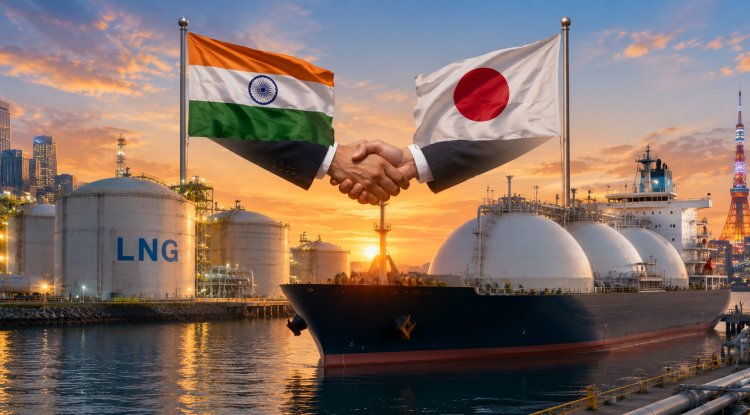
India and Japan are expected to strengthen their energy partnership by signing a Liquefied Natural Gas (LNG) supply agreement during the upcoming summit between Prime Minister Narendra Modi and Japanese Prime Minister Sanae Takaichi. The proposed agreement aims to strengthen energy security and improve preparedness against future disruptions in global fuel supplies.
The deal comes at a time when there is uncertainty in global energy markets due to tensions and volatility in the markets and supply chains. With the help of collaboration, both countries will be able to ensure that they have access to LNG, which plays an important role in power generation and industrialisation.
Joint Task Force to Focus on LNG Stockpiling
Under the agreement, both countries intend to set up a joint task force that would deal with issues related to LNG stockpiling, exchange of information, and coordination during any disruption in supply. This task force would allow both countries to exchange intelligence regarding the market and work out plans for improving energy security.
Reducing Risks from Global Supply Disruptions
The proposed partnership comes after recent fluctuations in the oil and gas market globally, especially during the West Asia crisis, which brought out the fragility in the energy supply chain in the international market.
India imports a large share of its LNG from West Asia, whereas Japan is also a major importer, but only imports about 10 percent of its total LNG imports from the region.
Energy Cooperation Expands Beyond LNG
The LNG deal would be one of many agreements that could come out of the upcoming 16th India-Japan Annual Summit. In addition to the agreement on the LNG deal, there are other agreements that are likely to be signed during the summit, including those related to critical minerals, semiconductors, AI, and other advanced technologies.
The officials from the two countries feel that collaboration in these strategic areas would be helpful for developing resilient supply chains and reducing dependency on finite resources.
Japanese Investment in India to Grow
Japan’s Prime Minister Sanae Takaichi is making her first official visit to India following her assumption of office, with a sizable business delegation that includes representatives of Japanese corporations such as Suzuki Motor, Itochu, and Toyota Tsusho. Economic discussions will take place between businesspersons of both nations as part of the visit.
Japan has planned to make investments of ¥10 trillion (approximately ₹5.9 lakh crore) into India through the private sector over the next decade during the upcoming visit.
Strengthening a Long-Term Strategic Partnership
In recent years, both the nations have been cooperating closely with each other in areas such as energy, infrastructure, commerce, defence, technology, and clean energy. Taking into consideration the efforts of both the nations to make their supply chains more resilient and robust, the suggested deal involving liquefied natural gas would also be an important step in this process.
The above mentioned deal would help in cooperation not only in securing energy sources but also in development and transition.
What's Your Reaction?