India’s semiconductor market is projected to reach $100–110 billion by 2030, driven by the India Semiconductor Mission and ₹1.55 lakh crore in private investments from Tata, Micron, and others.
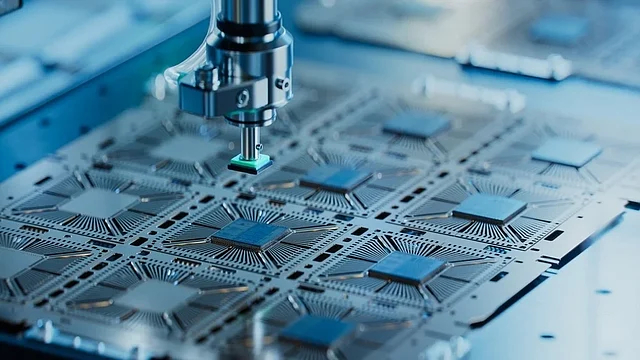
India’s semiconductor market is projected to grow from $45–50 billion in 2024–25 to $100–110 billion by 2030, driven by government initiatives and private investments.
India’s semiconductor market, valued at $38 billion in 2023, reached $45–50 billion in 2024–25 and is expected to hit $100–110 billion by 2030, according to industry estimates. This growth, at a compound annual growth rate (CAGR) of 13.76–24%, outpaces the global semiconductor market’s 8.6% CAGR. The India Semiconductor Mission (ISM), launched in December 2021 with a ₹76,000 crore ($10 billion) outlay, has attracted over ₹1.55 lakh crore in private investments, positioning India as a trusted global hub amid supply chain diversification efforts.
The global semiconductor market, projected to reach $1 trillion by 2030, is dominated by Taiwan (60% of production), South Korea, Japan, China, and the US. India, contributing less than 2% to global production, faces risks from reliance on imports, as seen during the COVID-19 pandemic when automotive backorders hit 500,000 units. The ISM aims to reduce this dependency through incentives like the Production Linked Incentive (PLI) scheme, offering 50% subsidies for fabrication (fabs) and assembly, testing, marking, and packaging (ATMP) units, plus 20–25% state-level support. Major players like Tata Electronics, Micron, and the HCL-Foxconn joint venture have committed significant funds.
Tata Electronics, in partnership with Taiwan’s Powerchip Semiconductor Manufacturing Corporation (PSMC), is investing ₹91,000 crore in a Dholera, Gujarat, fab with a capacity of 50,000 wafers per month, expected to create 20,000 jobs by 2026. Another ₹27,000 crore ATMP facility in Assam will produce 48 million chips daily. Micron’s ₹22,516 crore Sanand, Gujarat, ATMP plant and CG Power’s ₹7,600 crore facility with Renesas and Stars are among five approved units. These projects target automotive, telecom, and AI sectors, with integrated circuits holding a 61.5% market share in 2024.
India’s strengths include a robust MSME base for equipment components, abundant chemicals and minerals, and a talent pool of 35,000 engineers (20% of global chip design workforce). The “Chips to Startup” programme, collaborating with 400 universities, aims to train 85,000 professionals by 2030. However, challenges persist: high capital costs ($20 billion per fab), infrastructure gaps, and import reliance for advanced equipment. Partnerships with global firms like Tokyo Electron and Lam Research, investing $25 million in a Karnataka lab, aim to bridge these gaps.
Public sentiment on X reflects optimism about India’s chip revolution, with posts highlighting 3nm chip design hubs in Noida and Bengaluru and investments from Tata, Micron, and Kaynes. The Semicon India 2025 event, set for 2–4 September in Delhi, will showcase India’s growing role. Critics, however, urge faster policy action to compete with the US and EU, which are investing heavily via the CHIPS Act and Digital Compass Plan. India’s electronics market, valued at $118 billion in 2024, is set to double by 2028, boosting semiconductor demand.
In conclusion, India’s semiconductor market is poised for transformative growth, supported by the ISM and private investments. Overcoming infrastructural and technological hurdles will be key to capturing 10% of global demand by 2030, ensuring economic and strategic self-reliance.
Source: Outlook Business
What's Your Reaction?