Scientists are exploring a new way to recycle plastic waste by converting discarded plastic bottles into graphite, a key material used in lithium-ion batteries.
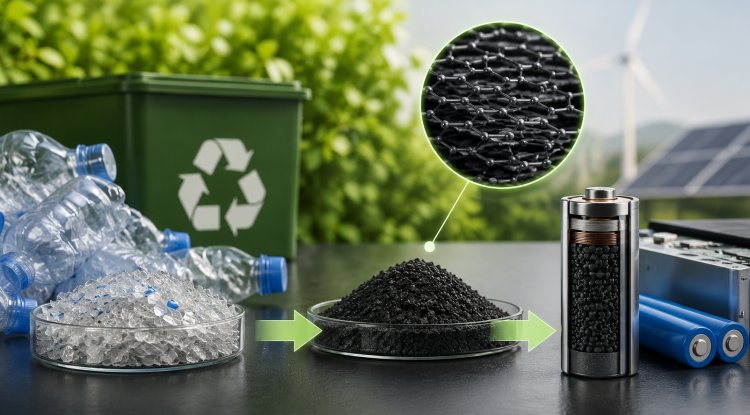
Discarded plastic bottles, often considered a major environmental challenge, could soon find a new purpose as a source of valuable materials for battery manufacturing. Researchers are exploring methods to convert polyethylene terephthalate (PET), the plastic commonly used in beverage bottles, into graphite which is a critical component used in lithium-ion batteries.
This technology might provide a new direction for dealing with plastic waste along with the increasing demand for the manufacture of battery components to meet the demands of EVs, renewable energy storage solutions, and electronic devices.
Graphite is one of the key components used in lithium-ion batteries as the anode material, comprising around 95 percent of the anode in existing batteries. Yet the global production of graphite is highly dependent on mining and power-consuming production processes, with China being the leading producer of natural and artificial graphite. As the demand for batteries increases, scientists try to find new alternatives to graphite.
According to the International Energy Agency (IEA), global demand for graphite could increase several-times by 2035 as electric vehicle adoption accelerates worldwide. The search for recycled and waste-based alternatives is therefore becoming an important part of securing future battery supply chains.
The research concentrates on converting PET plastic waste into carbon materials using chemical and thermal processing methods. During the conversion process, the plastic polymer is decomposed in high temperatures in an oxygen-restricted environment to enable rearrangement of its carbon atoms into a graphite-like structure, which could be used as battery anodes.
The scientists point out that the method has two positive effects on the environment. First, it allows plastic waste to be diverted from landfills and the oceans; secondly, it provides a source of carbon material for batteries within the country.
"This project shows how circular economy thinking could be used to address two different environmental problems at once by using plastic waste to make batteries," researchers involved in the project explained.
Globally, more than 400 million tons of plastic waste are produced every year, says the UNEP (United Nations Environment Programme), and only a small amount is recycled efficiently. PET bottles are among the most commonly discarded plastic products but have significant recycling potential.
The method could also help in reducing the environmental impact of the extraction of graphite. The existing process of graphite extraction from ore involves mining, purification, and heating, all of which use a lot of energy and water.
However, researchers emphasise that some technical hurdles need to be addressed before the adoption of the technology. Further research is required to improve the quality, performance, efficiency, and manufacturability of graphite derived from PET in order to meet the high standards set for batteries.
"The objective is not only to recycle plastic but to upcycle it into a high-value material that supports the clean energy transition," the researchers said, adding that improving process scalability and cost competitiveness will be critical for commercial adoption.
The development is occurring amid growing efforts by both governments and industries to adopt circular economy practices aimed at minimizing waste generation and obtaining raw materials. With lithium-ion battery demand expected to rise in the coming years, innovations that convert common plastic waste into industrial materials could become increasingly important.
What's Your Reaction?