A newly developed material that stores energy and changes colour to show charge levels could reduce device complexity and improve sustainability.
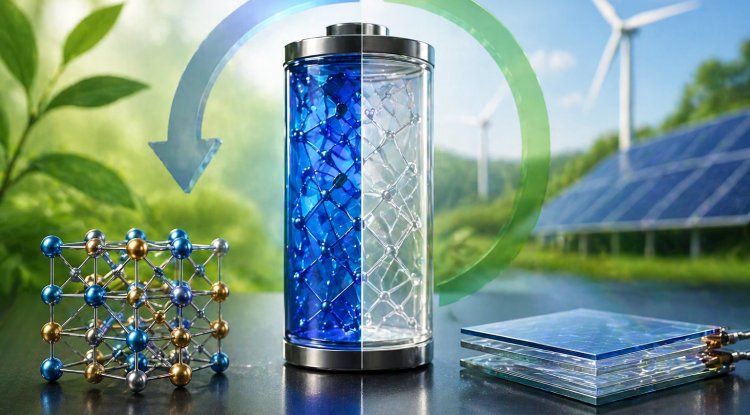
Scientists in India have developed a new smart material that can do something most batteries and energy devices cannot, it can store energy and visually show how much charge is left at the same time. This breakthrough could change how we interact with everything from small electronics to large energy systems.
In today’s world, most devices ranging from smartphones to even solar panels require some sort of energy storage system. But the catch here is, energy storage systems and display systems cannot be used together at the same time. While you may use one to store your energy, the other is required for showing you information or images.
Scientists at Centre for Nano and Soft Matter Sciences, which is an independent institute in the Department of Science and Technology, have now managed to do away with this inconvenience. The new material they have developed does not only act as a good storage unit, but it can change colour based on how much energy it has stored.
The material is an oxygen-deficient bimetallic oxide made from molybdenum and tungsten. In simple terms, the structure of the material has been intentionally designed with missing oxygen atoms. These “gaps” are not defects but functional features, they create extra space within the material, allowing ions to move more freely during charging and discharging.
As the ions flow, there is a transformation in the electronic arrangement of the substance, resulting in colour changes. At its highest charge, the compound has a deep blue colour, while as the compound becomes increasingly discharged, it takes on a more and more transparent appearance. In other words, one does not need to rely on any screen for gauging how much power there is left in the battery.
This particular project was undertaken by Dr. Ashutosh Kumar Singh and his colleagues using a solvothermal synthesis process.
In electrochromic devices—such as smart windows that adjust light transmission—the material showed strong performance. A prototype device of 5×5 cm² achieved an optical modulation of 43% at 700 nm, meaning it can effectively control how much light passes through. It also recorded a high colouration efficiency, indicating that it requires relatively low energy to operate.
As an energy storage device, the results were equally strong. When used as a supercapacitor electrode, the material demonstrated a high specific capacitance and maintained stability over 10,000 charge-discharge cycles. This level of durability is critical for real-world applications, where long-term reliability is essential.
In addition, the team tested the material under realistic conditions as well. Despite being folded or placed in diverse environmental conditions, the material did not lose its effectiveness, and therefore, can possibly be used in the creation of flexible electronic products. As shown in demonstrations, the device was capable of powering an LCD clock as well as lighting up an LED, proving that the product is a real-life invention and not only a laboratory idea.
By being able to store energy while at the same time acting as a visual indicator, this dual functionality might make it easier to design electronics in the future.
The results reported in Materials Chemistry A represent the latest step in the changing dynamics of material science research where scientists have started designing materials that incorporate different functionalities into one component rather than enhancing the efficacy alone.
The development has the potential to bring changes within various industries such as consumer electronics, renewable energy systems, smart infrastructure, and intelligent building materials. The future may see batteries showing up in various colors to indicate their charge level without looking at the screen for a percentage.
What's Your Reaction?