


The Aravalli Hills are facing serious threats from mining and construction, and while the Supreme Court has ordered strong protection, the future of the region depends on how well these rules are followed on the ground.
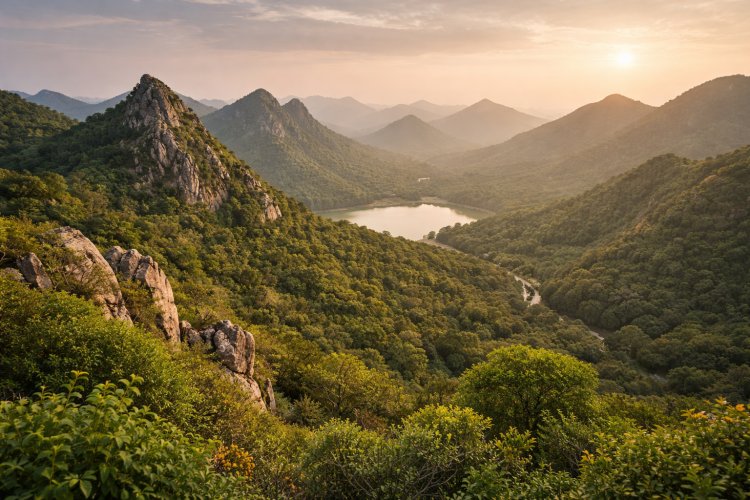
The Aravalli Hills are among the oldest mountain ranges in the world, stretching from the state of Gujarat to Haryana and extending up to the NCR in the Delhi region. From an ecologically balanced perspective, the Aravalli Hills are crucial to the survival of northern India, helping to prevent the expansion of the Thar Desert.
Despite their importance, the Aravalli Hills have been facing serious damage due to mining, expansion of cities, and heavy construction work, especially in Haryana and Rajasthan. These have put pressure on the Aravalli Hills. Let’s further understand the core problem.
What Is the Main Problem?
The problem is not new mining approvals alone. The deeper issue lies in how the Aravallis are legally defined and protected.
Large portions of the Aravalli landscape are not officially recorded as “forest” land in revenue records, even though they function ecologically as forests. Due to some parts of the Aravalli Hills which were not officially marked as “forest land” in government records, both private and government companies used this loophole to say that these areas did not need environmental protection. This enabling mining, hill cutting, and construction. Over time, this led to serious damage. Large amounts of stone and quartzite were mined, hill ranges were flattened, groundwater went down, and forests were destroyed. Public concern grew after they examined the damage to the environment and its impact on water and the climate.
What the Supreme Court Has Said Over the Years
Alarmed by large-scale destruction, the Supreme Court of India intervened through multiple orders beginning in the 1990s and early 2000s.
The Court banned mining in ecologically sensitive parts of the Aravalli range, particularly in Haryana and Rajasthan, ruled that environmental protection cannot depend only on land records, stating that areas with forest characteristics must be protected even if not officially notified, directed state governments to stop illegal mining and construction and take steps to restore damaged areas and warned authorities that failure to enforce these orders could amount to contempt of court
Importantly, the Court made it clear that economic development cannot override ecological survival in the Aravalli region.
The Current Controversy: Redefining the Aravalli Hills
The current controversy started when the Centre supported a revised, scientifically mapped definition of the Aravalli Hills that was prepared using satellite images and scientific data. The government said that this was done to clearly map the hills more accurately. On the other hand, opposition parties and environmental groups claim that this new definition makes the Aravalli hills look smaller on paper. According to them, once areas are excluded on paper, it becomes easier in the future to allow mining, construction, or real estate projects.
Critics also warned that this could change the decades of judicial protection and make it easier to exploit the land for mining and development in the future.
What the Centre Is Saying Now
The Centre has categorically rejected these allegations.
It has told the Supreme Court that more than 90% of the Aravalli landscape remains protected under existing forest, wildlife, and environmental laws. No new mining leases can be granted across the Aravalli region, and mining is frozen under a Supreme Court–approved framework until a detailed regional management and conservation plan is prepared. According to the government, the revised definition does not override court orders, does not weaken legal protections, and does not automatically permit mining or construction. The Centre maintains that environmental clearances and court oversight remain mandatory.
Where the Supreme Court Stands Now
At present, the Supreme Court’s earlier directions continue to govern the region:
- Mining remains prohibited without court approval
- No new leases can be issued until the management plan is finalised
- States are bound to protect ecologically sensitive areas regardless of technical land classifications
The Court has not lifted its restrictions and continues to monitor compliance.
The Larger Reality
The problem of the Aravalli is not only about mining, but it is mainly about the gap between what the law intends and what happens on the ground. Legally, the Aravalli Hills are one of the most protected landscapes in the country. But practically they are at risk due to weak enforcement, land records are manipulated, and strong pressure to build the develop land near Delhi NCR.
The Supreme Court has drawn clear red lines. The Centre insists those lines remain intact. The opposition fears they may be blurred in the future.
At present, mining in the Aravalli Hills is banned, and any further activities are left to the discretion of the court-mandated plan to manage the area. The question is not being asked in the present scenario, but in the future that can unfold based on the enforcement of the laws being interpreted in the correct manner.
What will happen to the Aravalli ranges will depend not on distinctions, but on whether governments elect to prefer long-term survivability to ecology rather than short-term financial benefit.
What's Your Reaction?










Leave a Comment







