The Future of Automotive: Are India's Auto Workers Ready for the EV Revolution?
India’s shift to electric vehicles threatens millions of auto jobs due to reduced labour needs, with MSMEs facing challenges and a 40–45% skill gap hindering reskilling efforts.
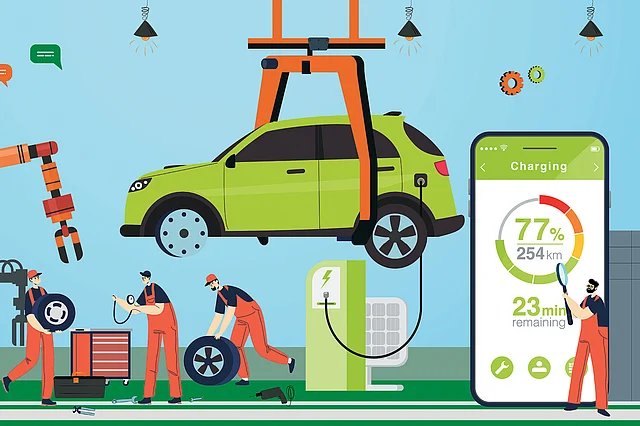
India’s shift to electric vehicles (EVs) is reshaping the automotive sector, but millions of workers face job losses due to reduced labour needs in EV manufacturing compared to traditional vehicles.
The automotive industry in India employs 3.7 million people and contributes 7.1% to GDP, with 49% of manufacturing GDP. The transition to EVs, driven by India’s 2070 net-zero target, is critical as the transport sector accounts for 13% of energy-related carbon emissions. Over the past decade, the government has allocated £71,000 crore for EV promotion schemes, including incentives for manufacturing and adoption. Major companies like Tata Motors and Mahindra & Mahindra are investing £35,000 crore and £16,000 crore, respectively, to expand EV production between 2021 and 2030.
EV production requires fewer parts—20–25 in drivetrains compared to over 2,000 in internal combustion engine (ICE) vehicles—reducing labour needs by 30–40%. A 2020 study found that ICE powertrain manufacturing creates 1.59 jobs per £1 crore of output, while EV powertrains create only 0.35 jobs. This shift threatens workers in labour-intensive roles, particularly in micro, small, and medium enterprises (MSMEs), which employ nearly half the sector’s workforce and produce ICE-specific components like clutches and gearboxes.
MSMEs face challenges adapting to EV technology due to limited capital and automation. The rise of electric three-wheelers, which accounted for 57% of sales in 2025, has already halved some businesses’ revenue. The government’s push for electrified trucks under the £500 crore PM EDrive scheme further pressures these firms. Reskilling is essential, with an estimated 2,00,000 skilled professionals needed by 2030 to meet the 30% EV adoption target. However, the industry faces a 40–45% skill gap, with training programmes by companies like Tata and MG Motor insufficient to reach millions.
New job opportunities in battery technology and vehicle software are emerging, but transitioning requires significant investment in education. MSMEs struggle to integrate into EV supply chains, which demand advanced engineering. Collaborative efforts between industry, government, and academia are needed to scale reskilling and support small businesses.
In conclusion, India’s EV transition offers environmental benefits but risks significant job losses in the auto sector. Without large-scale reskilling and support for MSMEs, millions of workers could be left behind, necessitating urgent action to balance sustainability and employment.
Source: Outlook Business
What's Your Reaction?