Trump Plants 'MAGAnolia' Sapling to Replace Historic White House Tree
The historic Jackson Magnolia tree, planted by President Andrew Jackson and present for most U.S. presidencies, has been removed from the White House South Lawn due to safety concerns. A new sapling, a descendant of the original, has been planted in its place.
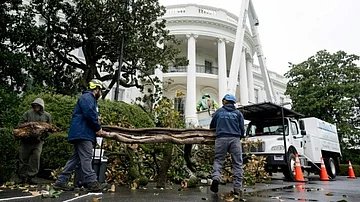
The Jackson Magnolia tree, a landmark on the White House’s South Lawn and one of the oldest trees on the property, has been removed due to safety concerns. Believed to have been planted by President Andrew Jackson in the 19th century, the tree had long been a symbol of presidential history and tradition. Its removal marks the end of a historic era in the White House gardens.
The tree had been in declining health for years, particularly after an incident in 1994 when a small aircraft crashed into it on the South Lawn. The accident killed the pilot and left the tree structurally compromised. Despite efforts to preserve it, arborists concluded that the tree posed a safety risk due to its weakened condition and the potential for structural failure.
In March, former President Donald Trump announced that the tree would have to be removed, citing the potential danger it posed at the entrance of the White House. The decision came after an assessment by professional arborists, who confirmed that the magnolia's condition had deteriorated beyond recovery.
To continue the legacy of the Jackson Magnolia, a new sapling was planted in its place. The 12-year-old replacement is a direct descendant of the original tree. Though reporters were not allowed to witness the planting ceremony, the White House released a video on social media showing Trump assisting in the planting process with a gold-plated shovel, alongside a gardener.
The original Jackson Magnolia was reportedly brought from Andrew Jackson’s home in Tennessee. It was planted in memory of his wife, who passed away shortly before he took office in 1829. Over time, the tree became a historic fixture on the South Lawn, shading the South Portico through numerous presidencies.
According to the National Park Service, the Jackson Magnolia was the oldest tree on the White House grounds. It predated a long-standing tradition, beginning in the 1870s, where presidents began planting their own commemorative trees within the garden areas.
Parts of the original magnolia tree are expected to be preserved. The wood from the tree may be repurposed for future commemorative uses, continuing its presence in another form.
This removal is part of a broader reworking of the White House gardens. Earlier this year, Trump proposed a controversial plan to pave over parts of the Rose Garden lawn to give it a patio-like look similar to his Mar-a-Lago estate in Florida. The plan received widespread attention and criticism from historians and landscape experts, many of whom have expressed concern over altering the traditional design of the iconic gardens.
The Jackson Magnolia has not only held aesthetic and historical value but also served as a botanical link to the past. Its replacement by a descendant sapling aims to preserve that connection while ensuring the safety of those on the White House premises.
The White House grounds, managed by the National Park Service, include several other trees planted by past presidents. These trees are carefully maintained to preserve both their environmental and historical significance. The removal of the Jackson Magnolia, while significant, is not unprecedented, as changes to the landscape are periodically required for safety and conservation.
In conclusion, while the original Jackson Magnolia has been removed due to safety concerns, its legacy will continue through the new sapling and preserved wood. The change signifies both the end of a historical chapter and the beginning of a new one in the ongoing evolution of the White House grounds.
Source: White House communications, National Park Service
What's Your Reaction?