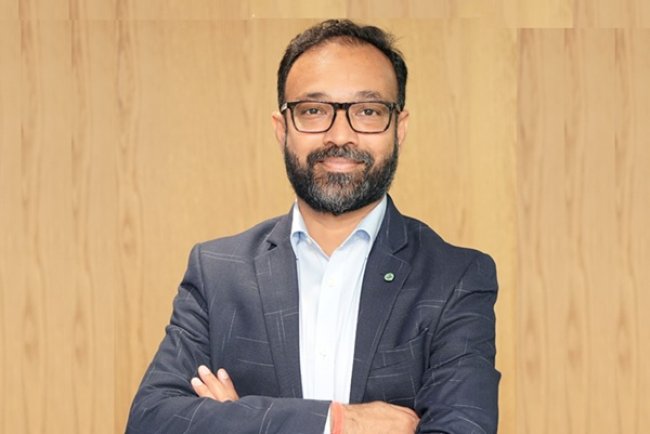
Tejpreet S. Chopra, President & CEO of Bharat Light & Power, believes the next great race won’t just be for data or innovation — it will be for energy
Artificial Intelligence may be redefining how the world works — but it’s also reshaping how much power the world will need. Tejpreet S. Chopra, President & CEO of Bharat Light & Power, believes the next great race won’t just be for data or innovation — it will be for energy.
In this wide-ranging conversation, Chopra explains why AI could drive global power demand to four times today’s levels, how countries with the cheapest electricity will dominate the technological future, and why storage, smart manufacturing, and resilient energy infrastructure are at the heart of this new era. From India’s renewable push to the global energy race between China and the US, he outlines both the promise and the pressure of powering the AI age.
Excerpts:
Given your position in the energy sector, what do you see as the single biggest opportunity and the most significant challenge for companies over the next decade—or perhaps the next three to five years?
One of the biggest opportunities over the next 10–15 years lies in the energy sector. The reason is simple — we’re entering an AI arms race, and the country that will win is the one with the cheapest power. Electricity will drive AI globally, though I don’t think its full importance is yet understood.
The demand for power for AI alone will be about four times higher than what we consume now. By 2040, 1.5 billion more people will live in cities, needing about 2 billion air conditioners. The number of planes worldwide will also double from 25,000 to 50,000.. All of this means massive growth in energy demand.
We’ll need every form of energy — coal, gas, LNG, renewables like wind, solar, hydro, and emerging green molecules. This is not just an energy transition; it’s an energy addition.
Three critical factors will drive this transition. First, a balanced mix of molecules and electrons. Second, global infrastructure upgrades — existing systems must become far more resilient. Third, capital. Around USD 4 trillion annually will be needed to finance this addition. The capital exists, but it will only go to projects that promise fair returns. So the real challenge is: how do we design projects that attract this capital?
Europe faces unique challenges. High energy costs will limit its competitiveness in the AI-driven future. In contrast, regions like the Middle East — with abundant, affordable energy — could take the lead.
Battery storage has become a major talking point. How do you see the sector evolving?
Battery storage is non-negotiable. For AI, for renewables, for a stable power supply — we need it. Whether for distributed power or large plants, 24x7 power is critical.
Many players entering the sector today are not true manufacturers; they source components from China and assemble locally. That’s a challenge but also an opportunity for localisation.
Under initiatives like Viksit Bharat, India must develop its own capabilities. However, global supply chains are complex, and many key minerals aren’t available domestically. Developing extraction, refining, and processing capabilities takes years. So, for now, we must balance between global dependence and local capacity building.
Another challenge is financing. Many storage companies struggle to raise capital. Banks and investors are cautious about new technologies. As with solar and wind in their early stages, there’s uncertainty about cost and scalability. Governments can help by creating a regulatory comfort zone for lenders and by offering incentives to de-risk investments.
What kind of new technologies or innovations are being developed in your group?
Two key areas excite me — storage and AI. We have a company that applies AI to the physical world — machines, turbines, motors, and industrial systems. Everyone talks about generative AI, but the real revolution will come when AI makes machines communicate and work smarter.
Factories today have many machines that don’t talk to each other. The challenge is to make them communicate, convert their data into intelligence, and use AI agents to act on that data. These three steps — communication, intelligence, and action — drive four key outcomes: higher productivity, safer workplaces, better quality, and greater energy efficiency.
We can now connect systems across sectors — hotels, hospitals, factories, schools — and manage HVAC, chillers, motors, and drives remotely. This technology allows us to control energy systems from anywhere in the world. What we couldn’t do eight weeks ago, we can do now. That’s how fast AI is advancing.
We’ve already implemented vision-based AI systems — for instance, an airport now runs entirely on visual AI, using over 500 cameras. This kind of technology can transform manufacturing, ports, automotive, steel, cement — any sector.
How is AI being used to improve efficiency in data centres, given their massive energy use?
In data centres, the key to winning is energy efficiency. The facility that consumes the least energy wins. AI helps optimise energy use by managing cooling systems and equipment performance. Some are experimenting with immersion cooling — submerging systems in liquids to reduce heat.
We focus on developing algorithms and AI agents that optimise how machines consume energy and control their output. But there’s also a safety angle — with AI’s power to act on human commands, we must build strong guardrails. We can now communicate with machines in any language — English, Hindi, French — but imagine if someone said, “Shut down the energy system.” The consequences could be serious. That’s why built-in safety and ethical design are crucial.
Someone said, “Those who have energy at the minimum cost will rule the world.” Which countries are best placed to lead?
China and the United States will likely dominate. China, because of its massive scale and cost advantage, and the US, because of its abundant low-cost gas.
India also has a tremendous opportunity. We are among the lowest-cost producers of wind and solar energy globally, and our government has done well to stabilise prices and ensure coal availability. The challenge is our dependence on imported oil. Reducing that will strengthen our energy security.
Even though data centres have cheap energy costs, the lengthy regulatory process is a problem in the US. Energy prices are low in the Middle East, but they are high in Europe, particularly after nuclear units were shut down and Russian gas was cut off.
Europe will struggle with competitiveness in such a scenario. China, meanwhile, added over 100 GW/year in the last 10 years. In 2024, they added 373 GW, and in 2023, they added 290 GW. In one year, they added more capacity than the entire renewable capacity in India
So, the global contest will revolve around three things: energy, who makes the best chips, and how technology is applied to drive productivity and efficiency. That’s where the future race will be won.
What's Your Reaction?