A student entrepreneur is using AI to help teachers identify children who need learning support while building digital platforms that reduce loneliness and improve social connections among senior citizens
At the age of 17, Palakpreet Kaur Bhullar thought she had it all figured out. A full scholarship to the University of Houston, a fresh start abroad, a plan she'd spent all of Class 12 working toward. Then it fell apart, almost overnight. "When I first learned that I wouldn't be able to go to the University of Houston despite receiving a full scholarship, I was completely heartbroken," she says. "It wasn't something I had prepared myself for."
She'd already stopped preparing for entrance exams months earlier, having bet everything on the US move. So when the scholarship fell through, she was staring down competitive exams with nothing but board-exam prep to fall back on. "At that point, it didn't feel like a redirection at all — it genuinely felt like life had fallen apart," she says. One of the lowest phases of her life, in her own words.
There was no backup plan waiting in the wings. What got her through was her family. Her friends, understandably, were buried in their own exam prep. Her father, though, quietly started digging into every option available in India — talking to mentors, colleagues, anyone who might know something — until he came across Newton School of Technology. "He believed in possibilities even when I couldn't see them myself," she says. Her mother and sister kept telling her, in their own ways, that one setback wasn't going to define her.
 Now Founder and CEO of Silver Bullets, Bhullar looks back and says staying in India worked out to be one of the best things that ever happened to her — even if she couldn't see it at 17. "Earlier, I believed success was about following a perfectly planned path. Today, I believe success is about making the best of the path life gives you," she says. "Sometimes our greatest opportunities arrive disguised as disappointments."
A three-year-old who changed how she thinks about education
Before college even started, Bhullar spent time working with children — including specially-abled kids — at a primary school. One boy has stuck with her ever since: a three-year-old who couldn't sit still, kept interrupting lessons, and had quietly been written off by teachers as "mischievous."
"After spending some time watching him, I saw that his actions didn't appear like typical juvenile mischief," she says. "Instead of being a decision, it seemed to be a pattern." After observing his behaviour, she suggested that his family seek a professional developmental assessment. It proved to be the right step, as the child was later diagnosed with ADHD, which helped him to be groomed appropriately.
It changed how she saw classrooms altogether. "A child can be called 'lazy,' 'rebellious' or 'problematic' long before anyone asks, 'What might this child actually be going through?'" she says. Teachers with fifty or sixty kids in a room, she points out, often don't have the bandwidth to notice who's quietly struggling — not because they don't care, but because there simply isn't time. "Before trying to solve a problem, we must first understand the human being behind it."
It's a belief that later shaped the AI tools she helped build — tools meant to help teachers catch behavioural and learning patterns they might otherwise miss, not replace their judgment. "AI is only as good as the understanding behind it," she says. "That's why we didn't begin by building algorithms. We began by observing classrooms."
Working with children's data wasn't something she took lightly. She says the organisation followed strict role-based access, with much of the sensitive information anonymised. But the real discipline, she insists, wasn't technical — it was in how you think about the child in front of you. "AI should never be used to label or define a child. A behavioural pattern is not an identity."
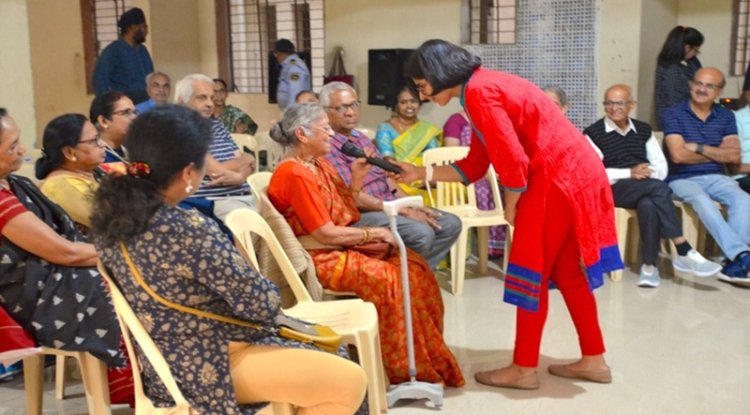
Silver Bullets began small — community gatherings, birthday celebrations — then grew into technology support sessions, teaching seniors to use smartphones, make secure payments, join video calls, spot online fraud. Somewhere along the way, the people it served stopped being beneficiaries and started becoming mentors themselves, leading conversations with younger volunteers about culture and life.
Impact isn't easy to measure here, Bhullar admits. There's no clean number for loneliness. So the team tracks what it can — repeat attendance, feedback from families, before-and-after surveys on things like social connectedness and comfort with technology — but she's quick to say the numbers don't capture everything. “It’s moments when a senior citizen tells you that they don’t hesitate anymore to video call their grandkids because they finally figured out their phone,” she says. “Sometimes impact is just about making lives feel a little less lonely because someone decided to care.”That mission led to Agemates, a digital platform where seniors can connect and schedule time with each other. Building it meant Bhullar had to rethink a lot of what she’d learned as an engineer. “As young people, we often assume that a product with tons of features is automatically better. But it’s not that simple.”
Working with older adults taught me the exact opposite. For them, confidence matters far more than complexity," she says. The team cut features, made buttons bigger, simplified navigation — and learned more from watching seniors struggle silently with the app than from asking them what they thought of it.
She isn't in a hurry to take Silver Bullets national. "A programme that works in Pune cannot simply be copied and pasted into another city," she says. Instead, the plan is a network of locally-run chapters, with her sister now helping build out the expansion. "I don't measure success by the number of cities we operate in," she says. "I measure it by whether an elderly person feels less alone because of something we've built."
Bhullar's team also built Pedestal, a gamified financial-learning platform that ended up beating over a thousand teams in a hackathon. The turning point wasn't the idea, she says — it was the decision to actually build a working simulated stock market instead of just describing one. "During the demonstrations, we noticed that judges stopped asking, 'What if this worked?' and instead began asking, 'How would you scale this?'" she recalls. "A great idea may capture attention, but a working product earns trust."
A different kind of surprise inside an AI lab
She's currently interning as an AI Training Content Developer at a US-based AI company, working closely with Claude Code and related training workflows. Going in, she assumed AI models got smarter mostly by eating more data. She was wrong, or at least it wasn't that simple. "Improving an AI model is often less about giving it more information and more about giving it better guidance," she says. A lot of the real work, she's found, happens not when a model gets something right, but when it gets something wrong. "I no longer see these systems as machines that simply 'know' things. I see them as systems that are constantly being shaped through careful evaluation, human feedback and responsible iteration."
She’s secured a 9.91 CGPA at Newton School of Technology, all while juggling when she was running Silver Bullets, interning, smashing hackathons, and mentoring her peers. But when you ask her what people don’t see behind that impressive resume, she’s honest — it’s not all smooth sailing. “Sometimes weekends turn into workdays, I spend late nights debugging after classes, and there are social events I skip because deadlines are looming,” she admits. What keeps her going isn’t just grinding non-stop. It’s about being intentional with her time and surrounding herself with people who challenge her.
“I actually enjoy what I do, so it rarely feels like forcing myself to work,” she says. She’s also started peer-learning groups at Newton for students who feel too shy to ask questions in class. “It’s often easier to say, ‘I don’t get this,’ to someone sitting next to you than to raise your hand in front of everyone,” she explains. On top of that, she mentors high schoolers struggling with the same doubts she once had about her future through REstart. Her advice is simple but powerful: “Don’t make big life choices based on what looks good on the outside.”
What's Your Reaction?