China is building 510 GW of solar and wind projects in 2025, accounting for three-quarters of global renewable capacity under construction. Despite leading in renewables, it continues investing in coal as backup. The findings are based on a Global Energy Monitor report and align with China’s carbon intensity reduction goals.
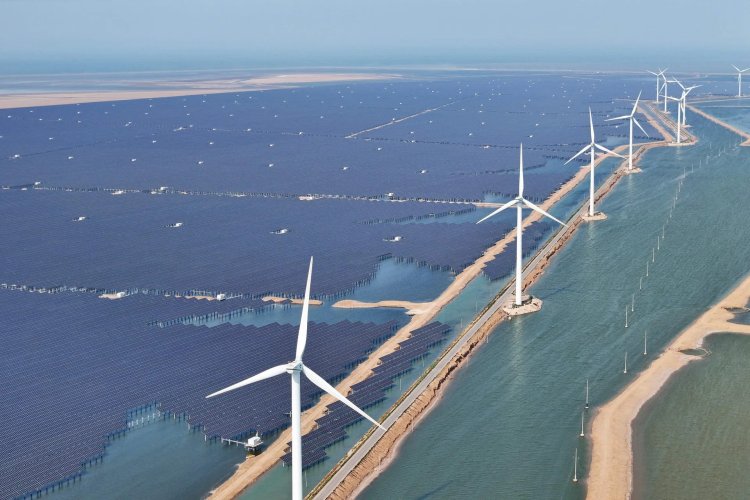
China is quickly growing its 2025 renewable energy capacity, with solar and wind power new installs well ahead of the rest of the world. China is building 510 gigawatts (GW) of utility-scale solar and wind farms—a 57 per cent rise from 2024, as per the US-based Global Energy Monitor (GEM) report. That represents approximately three-quarters of the total capacity that is being built globally in 2025.
The expansion falls within Beijing's global strategy to achieve a combined renewable energy output of 1.3 terawatts (TW) approximating the country's installed capacity of 1.4 TW. The figures are confirming China as a world leader in renewable energy development, even though the country remains the world's leading source of greenhouse gases. Although its past emissions are lower than those of industrialized countries, current emissions are more than twice that of the United States.
China's solitary under-construction wind power capacity was sufficient to power an estimated 120 million US homes based on the GEM report. The constructions come during increasing domestic power demand being met by increasingly renewable and nuclear fuels rather than fossil fuels. In the first quarter of 2025, scientists observed a decline in China's total emissions due to this shift in the energy mix.
The rise in China's deployment of renewables is embedded in a larger climate policy. It has committed to decreasing carbon intensity—defined as the emissions of carbon expressed as a percentage of gross domestic product—by 65 per cent below 2005 levels by 2030. China also this year committed to publishing new Nationally Determined Contributions (NDCs) before the COP30 climate conference in November 2025. These are likely to include all major greenhouse gases, not only carbon dioxide, as part of a more coherent effort to reduce emissions.
Even with these developments, China remains to invest in coal power facilities. In 2024, it started 94.5 GW of new coal power facilities, 93 percent of all the global total. Experts hold that much of this coal infrastructure is being constructed as a reserve or backup system for the nation's growing renewable energy network, seeking to provide assurance of energy reliability and grid stability.
The twin strategy—building renewables but keeping coal as a fallback—mirrors China's emphasis on energy security and decarbonization targets. Its leaders still call these steps part of the larger effort to be a global leader in climate action, even as other large economies back away from international climate cooperation.
The document calls attention to China's rate of renewable energy construction well exceeding peers around the world. Its efforts are central to global energy transition, particularly with the world struggling with rising heat, weather extremes, and intensifying pressure on achieving Paris Agreement targets. Although global criticism tends to be derailed by China's coal use, the build-out of renewables today offers a more nuanced snapshot of the nation's energy strategy.
China's increase in renewable energy infrastructure is part of a broader trend in expanding clean energy investment in Asia. Even so, China is still the region's leader, both by absolute figure and growth rate. As a result, its impact is bound to have a definitive role in determining global energy trends in the decade to come.
The Global Energy Monitor report indicates that if China continues to move in the current direction, it can be the tipping point to break the price of renewables, attract further investments in green technology, and convince other countries to change in a similar fashion. Its continued investment in coal, though, indicates that it requires strong policy guidance and global support from countries all over the world to shift completely to low-carbon energy systems.
As nations gear up for COP30 and long-term climate commitment negotiations, China's boosting of renewable energy would have a huge impact on global negotiations and expectations. Whether China can achieve both climate goals and domestic energy security will be under close scrutiny in the coming months.
Source:
Reuters, Global Energy Monitor. Published 9 July 2025. Data from Global Energy Monitor (GEM) and Centre for Research on Energy and Clean Air.
What's Your Reaction?