Earth's Mantle: The Hidden Link Between Asian and African Life
New research reveals how mantle convection helped form a land bridge between Asia and Africa 20 million years ago, enabling species migration and altering climate patterns, influencing the evolution of mammals including humans.
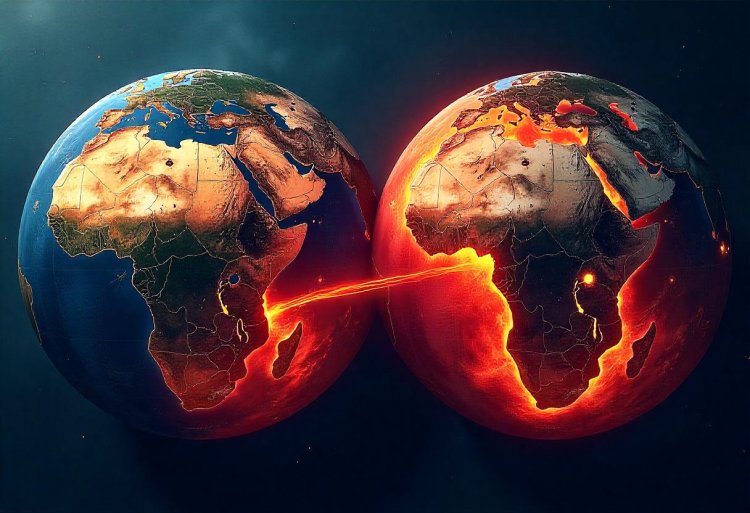
A recent Nature Reviews Earth & Environment article sheds light on the contribution of deep-Earth geology to the course of evolution and continental geography. Researchers at the University of Texas at Austin and others abroad have credited mantle convection dynamics for the development of a land bridge between Asia and Africa, which was at the heart of animal migration and climatic evolution eventually that set the course of modern mammal evolution, including human evolution.
The research discovers that a hot mantle rock plume from the Earth's interior, triggered by the 50–60 million year-old subducting tectonic slab, caused the Arabian Peninsula and surrounding areas to be uplifted gradually. The phenomenon, facilitated by tectonic collisions, closed the ancient Tethys Sea and allowed the creation of a continuous land bridge between Africa and Asia approximately 20 million years ago. This landmass creation enabled the terrestrial fauna, which were early ancestors of the elephants, giraffes, rhinoceroses, and primates, to migrate between the continents. Africa was previously separated from Eurasia for almost 75 million years, with limited mobility for land animals.
The study provides model-based modeling of dynamic topography and mantle convection, illustrating how the forces at the subsurface directly governed the surface landscapes and the migration paths. The study finds that the presence of this mantle plume accelerated the seaway closure between Asia and Africa, which can have affected the timeline and path of evolution of many species. Specifically, it explains how the primates had migrated from Asia to Africa before the complete development of the land bridge, and returned to Asia after diversifying on the African continent.
This geophysical alteration had wider environmental consequences. Uplifting of the Arabian Peninsula changed ocean currents, which resulted in extensive climatic change. With the heating of ocean waters alongside it, seasonally extreme temperature fluctuations emerged, resulting in enhanced aridity in most of Asia and Africa. Scientists believe that this change led to the development of the Sahara Desert and intensification of Southeast Asian monsoon systems, which had subsequent wetness there.
The authors combined geological, paleogeographical, and evolutionary information to track the extended effect of this land bridge construction, spotlighting the interaction between Earth interior processes and biological and climatic evolution. Describing simply how tectonic and mantle activity constructs topography, the article demonstrates ripple effects on ocean circulation, regional climatology, and evolutionary paths of life on Earth.
Timing was equally critical in such changes. Delays of only a few million years in land bridge construction would have changed species evolution and dispersal course. The paper illustrates the importance of deep-Earth dynamics as primary drivers of Earth's biological and environmental history and provides a conceptual framework for understanding how planetary systems interact.
This research connects evolutionary biology and paleoclimatology to geoscience, showing how a process that initiated far within the Earth facilitated the production of changes that influenced the emergence and dispersal of various species, including early hominins. The land bridge was a biogeographical corridor, and its timely formation permitted the back-and-forth migration of species whose impact continued to shape regional biodiversity.
It was done by Eivind Straume, who is the highest-ranking analyst that developed the analysis while employed in the Jackson School of Geosciences at the University of Texas at Austin. He is currently a postdoctoral fellow both at the NORCE Norwegian Research Center and the Bjerknes Center for Climate Research. The other contributing writers are paleogeography as well as geophysics scientists who collectively developed all the evidence there is and came up with new models to accompany the evidence in the study.
By linking geologic processes with environmental and biological consequences, the study sheds light on the ways that Earth's physical past has influenced life on Earth for tens of millions of years. It also introduces possible areas of research on how the ongoing alterations being made by Earth could impact ecosystems and biodiversity in the coming millennia.
Source/Credits:
Published by University of Texas at Austin | Published in Nature Reviews Earth & Environment (2025). DOI: 10.1038/s43017-025-00653-2
What's Your Reaction?