India Boosts Air Monitoring, Reduces Dependence on Imported Machines
India’s new National Environmental Standard Laboratory at CSIR–NPL will improve air pollution monitoring, reduce dependence on imports, and support sustainable environmental governance.

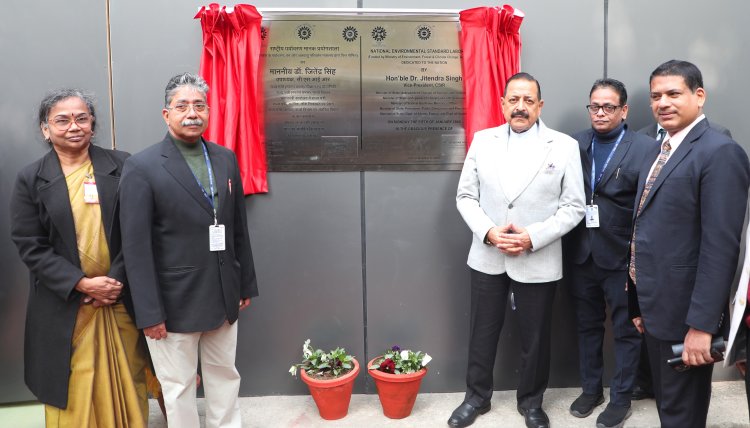
India has taken an important step in environmental governance by establishing the National Environmental Standard Laboratory at the CSIR–National Physical Laboratory (NPL) in New Delhi to improve how it monitors and manages the environment. Inaugurated by Union Science and Technology Minister Jitendra Singh during the 80th foundation day celebrations of CSIR‑NPL, the new laboratory is designed to test and calibrate air pollution monitoring equipment which makes sure that the instruments used in India give accurate readings for air pollution.
Until now, India has mostly used air pollution monitoring instruments that are imported. These are certified by international agencies whose standards are based on environmental conditions of the countries where they were made not India. Since India’s climate, weather condition, temperature, pollution are different, and these instruments may give less accurate readings over time. The new laboratory will help correct this mismatch and will provide more accurate, trustworthy and suitable for India’s climate which will later help authorities to take better decisions.
By reducing dependence on foreign certification systems, the facility is expected to save foreign exchange, shorten calibration turnaround times, and strengthen confidence among investors and stakeholders working in sectors like renewable energy and environmental monitoring. It will support regulatory bodies, industries and startups by making India’s pollution measurement ecosystem more robust and self‑reliant.
In addition to the environmental standard lab, Singh also inaugurated the National Primary Standard Facility for Solar Cell Calibration, placing India among a select group of countries to host a national level solar metrology facility. This parallel development underscores the country’s commitment to high‑precision measurement standards across both environmental and renewable energy sectors.
Addressing the occasion of the 80th foundation day celebrations of CSIR-NPL, minister Jitendra Singh said that India has become the world’s fifth country, after the USA, Germany, China and Japan, to have a Standard Facility for Solar Cell Calibration. Minister emphasised that in view of growing environmental concerns, the Environmental Standard Laboratory is the second largest in the world.
He added that it will enable highly accurate measurement of various environmental parameters and will provide services not only to government agencies but also to the non-government sector and even to other countries.
In addition, Singh also said that indigenous technologies, precision measurements and institutional excellence are key to translating research from the laboratory to the market and to delivering sustainable solutions for societal and economic growth.
Over time, the new laboratory is expected to boost domestic manufacturing of air quality monitoring systems and reduce reliance on imports, eventually positioning India as a potential exporter of calibrated environmental monitoring equipment to other developing nations.
What's Your Reaction?