India Turns Farm Waste into Roads: Bio-Bitumen Makes Commercial Debut
India has begun commercial production of bio-bitumen made from agricultural waste, aiming to cut pollution, reduce oil imports, and support farmers while building sustainable roads.
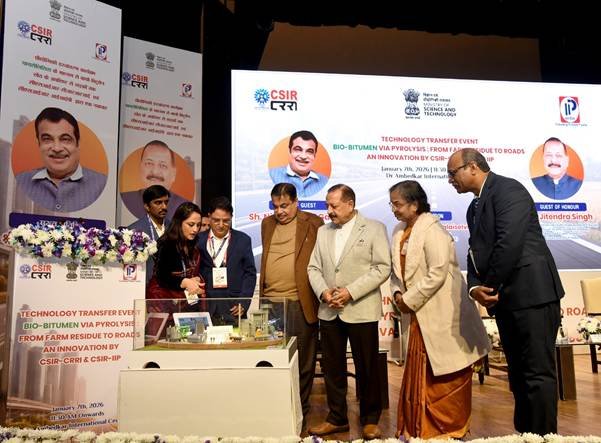
India has become the first country to commercially produce bio-bitumen, a sustainable road construction material derived from agricultural residue. The development was showcased at the CSIR Technology Transfer Ceremony titled “From Farm Residue to Road: Bio-Bitumen via Pyrolysis.” The Ministry of Road Transport and Highways, Nitin Gadkari highlighted how agricultural waste can be converted into a valuable national resource. He noted that bio-bitumen is a transformative step towards the vision of Viksit Bharat 2047. By utilising agro waste, it reduces pollution caused by crop burning and strengthens the circular economy. With 15% blending, India can save nearly ₹4,500 crore in foreign exchange and substantially reduce its dependence on imported crude oil.
Speaking at the ceremony, he says, “today marks a historic milestone in India’s road infrastructure, as the nation becomes the first in the world to commercially produce bio-bitumen”. He further noted that this innovation will empower farmers, generate rural livelihoods, and boost the rural economy.
Bio-bitumen is produced by heating farm waste like rice straw at high temperatures in a process called pyrolysis, a process that breaks the waste down into a liquid called bio-oil and some other materials. This bio-oil is then converted into a binder that can mixed with regular bitumen used for roads. Trials have already been conducted on the Jorabat–Shillong Expressway, where it performed well and met road quality requirements.
The initiative addresses two major problems at the same time. First is India depending heavily on imported petroleum bitumen, which accounts for nearly half of the country uses for road construction. By mixing bio-bitumen with regular bitumen, this dependence can be reduced. Second, large amount of crop waste is burned by farmers which causes air pollution. By using these farm waste to produce bio-bitumen gives it a useful purpose instead of burning. Blending about 15% bio-bitumen with conventional bitumen could save country’s money on imports and also help farmers earn extra income while supporting rural livelihoods.
Officials have indicated that the technology is compatible with existing road construction equipment and practices, making adoption feasible across the country. The initiative aligns with goals of sustainable infrastructure development, circular economy practices, and environmentally responsible growth.
What's Your Reaction?