TVS Motor and Bajaj Auto have surpassed Ola Electric to lead India’s electric two-wheeler market in 2025, capturing over 40% market share with their iQube and Chetak scooters, driven by affordability, expanded production, and government subsidies.TVS Motor and Bajaj Auto overtake Ola Electric in India’s electric two-wheeler market, leveraging iQube and Chetak scooters to capture 40% share in 2025.
Introduction
India’s electric two-wheeler market has witnessed intense competition, with TVS Motor and Bajaj Auto surpassing Ola Electric to claim leadership in 2025. This shift, driven by robust sales, expanded product portfolios, and strategic investments, underscores the growing importance of electric vehicles (EVs) in India’s transportation sector. As consumer demand for sustainable mobility rises, these traditional automakers are leveraging their established networks to outpace newer entrants.
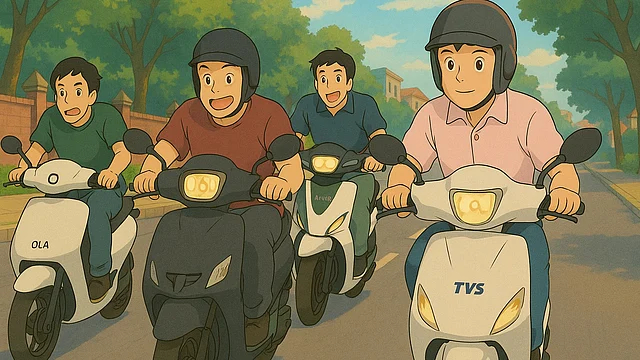
In the first quarter of 2025, TVS Motor and Bajaj Auto collectively secured over 40% of India’s electric two-wheeler market, compared to Ola Electric’s 35%. TVS Motor’s iQube electric scooter and Bajaj Auto’s Chetak have gained significant traction due to their affordability, reliability, and performance. The iQube, priced between ₹1.2 lakh and ₹1.5 lakh, offers a range of up to 100 km per charge, appealing to urban commuters. Bajaj Auto’s Chetak, with a range of 95–120 km and a price range of ₹1.15 lakh to ₹1.4 lakh, has capitalized on its brand legacy and modern design. Both companies have expanded their manufacturing capacities to meet rising demand. TVS Motor’s facility in Hosur, Tamil Nadu, now produces 10,000 units monthly, while Bajaj Auto’s plant in Pune has scaled up to 12,000 units per month. These expansions have addressed supply chain bottlenecks that previously constrained growth.
Ola Electric, which led the market in 2023, faced challenges in 2024 due to supply chain disruptions and limited service infrastructure. Its S1 series, while innovative, struggled with delivery delays and after-sales support, impacting consumer trust. In contrast, TVS and Bajaj benefit from extensive dealership networks, with over 2,000 outlets each across India, ensuring wider accessibility and faster service. The Indian government’s FAME III scheme, launched in 2024, has played a pivotal role in boosting EV adoption. The scheme offers subsidies of up to ₹15,000 per vehicle, reducing upfront costs for consumers. Additionally, state-level incentives in Maharashtra, Tamil Nadu, and Karnataka have further driven sales in urban centers, which account for 70% of electric two-wheeler purchases.
Battery technology advancements have also contributed to the success of TVS and Bajaj. TVS Motor has partnered with local battery manufacturers to develop lithium-ion cells with higher energy density, reducing costs by 10% since 2023. Bajaj Auto has invested ₹500 crore in a new battery production facility, aiming to localize 80% of its supply chain by 2027. These efforts align with India’s push for self-reliance in EV components, reducing dependence on imports from China. However, the industry faces significant hurdles. Charging infrastructure remains limited, with only 12,000 public charging stations nationwide as of 2025, compared to 1.2 million petrol pumps. Rural penetration is low, with less than 10% of sales coming from non-urban areas due to inadequate charging networks and higher upfront costs compared to petrol-powered two-wheelers.
The competitive landscape is evolving, with global players like Hero Electric and Ather Energy gaining ground. Hero Electric’s Optima series and Ather’s 450X are carving out niches in the premium and mid-range segments, respectively. Meanwhile, international brands such as Super Soco and Yamaha are entering India, attracted by the market’s projected growth to 5 million units annually by 2030. The government’s target of 30% EV penetration in the two-wheeler segment by 2030 hinges on infrastructure development and cost reductions. Industry analysts estimate that battery prices, which account for 40% of an EV’s cost, must fall by another 20% to achieve price parity with internal combustion engine (ICE) vehicles. TVS and Bajaj are also exploring vehicle-to-grid (V2G) technology to enable scooters to supply power to homes, a feature that could differentiate their offerings.
Consumer preferences are shifting toward sustainability, with 65% of urban buyers citing environmental concerns as a key purchase driver. Last-mile delivery services, particularly in e-commerce and food delivery, have fueled demand, with companies like Zomato and Swiggy transitioning their fleets to electric models. TVS and Bajaj have secured contracts to supply 50,000 units collectively to these firms in 2025. However, regulatory challenges, such as inconsistent state policies and delays in charger installation approvals, could slow growth. The industry also faces competition from ICE two-wheelers, which still dominate with a 96% market share due to their lower cost and widespread refueling infrastructure.
Conclusion
TVS Motor and Bajaj Auto’s rise to the top of India’s electric two-wheeler market reflects their strategic focus on affordability, scalability, and localization. While Ola Electric struggles with operational challenges, the success of iQube and Chetak highlights the strength of established brands in a competitive landscape. Expanding charging infrastructure and reducing battery costs will be critical to sustaining this growth and achieving India’s EV adoption targets. As the market evolves, TVS and Bajaj are well-positioned to lead the transition to sustainable mobility.
Source: Outlook Business,
What's Your Reaction?