Penguin Guano Contributes to Climate Cooling in Antarctica
A new study reveals penguin guano releases ammonia that helps form cooling clouds over Antarctica, playing a surprising role in climate regulation despite the region's growing vulnerability to global warming.
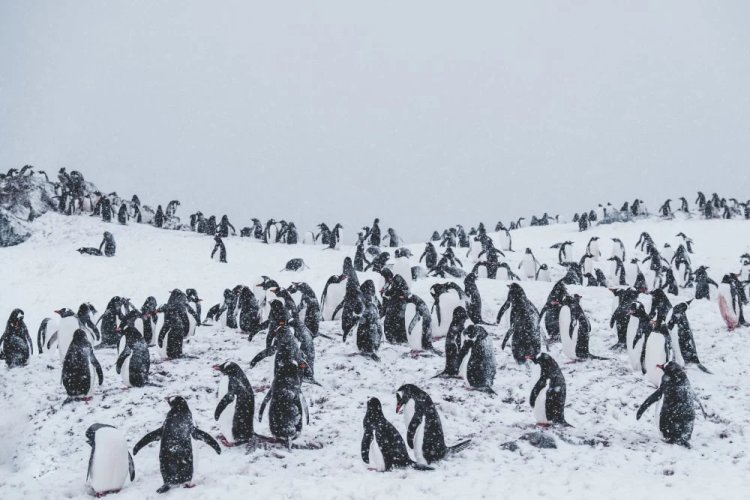
By cooling the environment, penguin droppings, or guano, are helping Antarctica become more climate resilient, according to a recent scientific research. Researchers examining a sizable colony of Adélie penguins discovered this surprising phenomena, suggesting that penguin colonies may be more involved in climate management than previously thought.
According to the study, which was published in Communications Earth & Environment, penguin guano emits large amounts of ammonia into the atmosphere. This ammonia is carried into the sky by wind, where it combines with gasses released by marine phytoplankton to create microscopic particles that aid in the creation of clouds. Because these clouds deflect sunlight, the region's surface temperatures drop and the amount of ice melt is constrained.
A two-month field investigation was carried out close to the penguin colony by researchers from the University of Helsinki. They saw that ammonia levels increased more than 1,000 times when the colony was exposed to wind. According to this research, the chemistry of the atmosphere and the climate-modulating capabilities of Antarctic clouds are both significantly and measurably impacted by the presence of penguin guano.
Because leftover guano keeps releasing ammonia, the process continues even after the penguins have departed the region. The continuous occurrence of these emissions contributes to the region's cloud cover and reflects sunlight, both of which are essential for preserving Antarctica's lower temperatures.
Although this finding emphasizes the importance of penguins to the environment, it also draws attention to a troubling paradox. As the climate catastrophe worsens, the same penguin colonies that help chill the region are becoming more and more vulnerable. Rapid warming in Antarctica is endangering biodiversity and upsetting the delicate balance of natural systems.
Antarctic warming reduces the efficiency of these natural cooling systems and has a direct influence on marine phytoplankton, which are important participants in the planet's carbon cycle. Sea levels might also rise sharply as a result of the breakdown of massive ice formations like the Thwaites Glacier. Sea levels might rise by up to three meters if this glacier completely collapses, putting coastal areas throughout the world in jeopardy.
This study highlights the interdependent roles that marine ecosystems and species play in controlling carbon levels and global temperatures. It emphasizes even more how urgent action is required to save these ecosystems and the animals that depend on them.
Because of its high surface reflectivity, impact on ocean currents, and significant potential to absorb carbon, Antarctica serves as an essential climatic buffer for the planet. However, given how quickly climate change brought on by humans is happening, its future is still uncertain. Reversing climate trends would be far more difficult if such natural defenses were lost.
Penguins play a crucial part in the larger ecological puzzle, even though their contribution to climate resilience may appear insignificant in comparison to industrial effects or global emissions. Long-term climatic stability depends on comprehending and protecting these natural contributions.
The broad use and expansion of existing climate technologies, according to scientists, is the most practical short-term solution. These developments can lessen emissions, save delicate habitats, and stop additional warming. The resilience offered by natural systems, such as penguin colonies, might not be enough to fight rising temperatures without such instruments.
The study reaffirms the need for coordinated initiatives that incorporate environmental and wildlife protection with technology development. Effectively combating climate change would need not only cutting emissions but also acknowledging and preserving the natural processes that help stabilise the Earth’s environment.
Source: euronews
What's Your Reaction?