Policy, Tech, Industry Converge At Bharat Electricity 2025 In Delhi
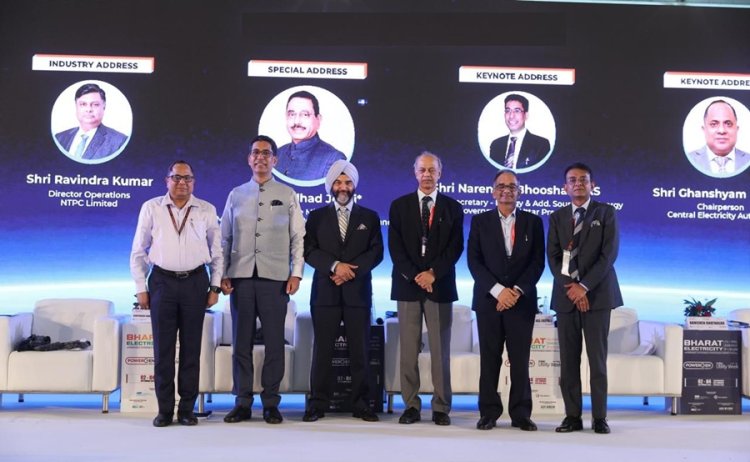
India’s energy future must be affordable, reliable, sustainable, and globally competitive, achievable through common ambition and collaborative action, industry experts expressed at the Bharat Electricity 2025 Global Summit in Delhi.
Bhupinder Singh Bhalla, IAS (Retd.), Former Secretary, MNRE, said that the occasion is not just confined to a meeting of industry persons but is indeed “a national canvas and a global stage” where energy transition takes form in sweeping strokes of ambition, innovation, and transformation. Further, he spoke about India’s path of responsible, self-reliant growth and stated, “In future, every megawatt we add is a promise fulfilled, and every policy we craft will move us closer to an energy future that is globally competitive, affordable, and scalable.”
While P.K. Pujari, IAS (Retd.), Former Chairperson, CERC & Former Power Secretary, described the platform as “India’s electricity Davos,” where flexibility, markets, and citizens must be placed at the heart of the transition. He further emphasized, “The event will enable global players to exchange ideas, explore partnerships, and nurture growth.”
Narendra Bhooshan, Narendra Bhooshan, IAS, Additional Chief Secretary Energy & Additional Sources of Energy, Government of Uttar Pradesh, highlighted Uttar Pradesh’s ambitious vision, as the state has set a bold target of becoming a $1 trillion economy within five years. “Historically, we faced energy infrastructure and supply challenges, but that is changing rapidly. Today, with demand reaching 32 GW, we are among the top states in electricity supply. We have capacity, resources, and ambition to lead-it is the energy sector that stands in the way of this transformation.” Taking operational realities into consideration, Shri Ghanshyam Prasad, Chairperson of the Central Electricity Authority, spoke of the need for a synergized walk across sectors: "While the preceding speakers have set forth the broader canvas of India’s energy ambitions, we would do well to also keep some feet firmly on the ground when facing certain implementation challenges that this transition brings. From constraints of grid operations to immense integration of renewables, the solution ahead does require all stakeholders from policymakers to the utilities to come together to address these challenges.”
Alok Kumar, Director General of the All India Discom Association, placed India’s energy targets in broader context, stressing the urgent need for systemic reform. He remarked, “Energy demand in the country is growing at 3% CAGR and actual consumption is even growing faster. This momentum shall only get stronger with industrialization, enhancing living standards, and a manufacturing-led economy. True energy independence and major reduction in oil imports can be attained by an accelerated bold pursuit. Forward is cast on three fundamentals: affordability, reliability, and sustainability.”
In his vote of thanks, he said that in the age of AI, electrification, and climate volatility, infrastructure intelligence is the real currency of progress—smart, self-healing, resilient, and deeply integrated with our digital public systems. "For India, this is more than a technological shift; it is a sovereign imperative."
Also, Day One gave way to the Leadership Plenary of India's Electricity Roadmap 2035 and Energy Outlook 2047, an International Plenary on Regional Bonds and Global Targets, with participation from Denmark, Germany, and Australia, combined with critical sessions on future electricity markets and the role of nuclear power in a net-zero future. The shakedown concluded with the Bharat Electricity Awards 2025, honouring outstanding contributions to renewable energy, grid innovation, and climate leadership.
Bharat Electricity 2025, together with POWERGEN India and Indian Utility Week, is not only a celebration of India’s power sector transformation but also a statement of intent: that India’s energy future will be secure, affordable, sustainable, and globally competitive. It stands as the definitive platform where policy intent meets industry execution, global collaboration, and citizen empowerment—driving the nation closer to its net zero horizon and reinforcing its leadership in the global energy transition.
What's Your Reaction?