


As India’s digital and electric mobility sectors expand, experts are highlighting the need for stronger e-waste management and responsible recycling practices.
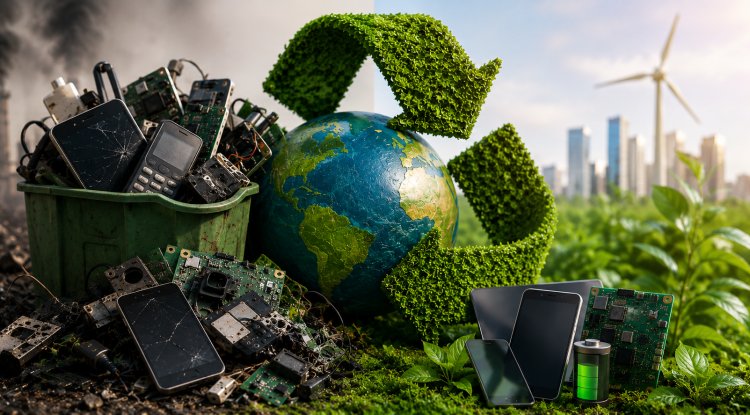
India is growing use of AI, and digital technologies is creating new opportunities but due to this e-waste is becoming a huge issue in the nation. More tech means more dumped gadgets and batteries, but we lack proper recycling methods. So, handling and recovering resources from all this trash is getting tougher.
On World Environment Day, industry bigwigs stressed boosting recycling, bettering waste pickup, and revving up a circular economy to reuse stuff longer. Here’s their take on it, right after that announcement.
Rajesh Gupta, Founder and Managing Director, Recyclekaro, said: "The world is becoming more electronic by the day. Every new AI model, every new connected device, every electric vehicle on the road adds to a mountain of e-waste that is growing faster than our capacity to handle it responsibly. On this World Environment Day, I urge every Indian to take a simple but profound pledge: to never let an old phone, a spent battery or a discarded appliance end up in a landfill or with an informal scrap dealer. These are not just waste. They are concentrated deposits of lithium, cobalt, nickel and rare earth elements, minerals that are fundamental to our nation's energy security, our digital infrastructure and our industrial future."
"When we irresponsibly discard e-waste, we are not just harming the planet, we are throwing away the very building blocks of nation building. The critical minerals locked inside old batteries and circuit boards can reduce our dependence on imports, strengthen our manufacturing base and power our green transition. But when they are burnt in open yards or dissolved in acid by unregulated operators, they poison our soil, contaminate our groundwater and enter our food chain. The damage is irreparable and cumulative."
"World Environment Day is not a celebration. It is a reminder that the planet's patience is finite. The age of AI and ubiquitous electronics is not something that is coming. It is already here. Every Indian who owns a phone, a laptop, an EV is part of this story. The only question is whether we will be responsible authors of it or careless spectators to the damage it leaves behind. The pledge to recycle responsibly is among the most consequential commitments a citizen can make in 2026."
Beyond raising awareness about e-waste, industry experts are also focusing on the systems needed to manage it effectively. Nitin Gupta, CEO & Co-Founder, Attero, shared his views on recycling infrastructure, circular economy practices, and the future of resource recovery in India. He said, "Awareness around responsible disposal has improved over the years, but that alone is not enough today. The bigger challenge is ensuring that waste reaches formal recycling channels. A large portion of electronics and batteries still flows into informal networks where recovery is inefficient and often environmentally unsafe."
"It all begins with segregation at source. Unless waste is separated properly, even the most advanced recycling infrastructure cannot achieve its full potential. India already has a strong regulatory framework through Extended Producer Responsibility (EPR). The focus now should be on consistent enforcement, greater traceability, and accountability across the value chain."
"Building a circular economy requires collaboration across the entire value chain. Producers need to design products with circularity in mind, strengthen EPR implementation and increase the use of recycled materials in manufacturing. Consumers need to make responsible disposal a habit and support companies that are committed to sustainable end-of-life management."
Mukesh Arora, Head of ESG, SAEL Industries Limited, said "Heatwaves, erratic rainfall, and rising environmental stress are no longer distant concerns. They are part of a new reality that calls for urgent, consistent, and collective action."
"Sustainability can no longer remain a statement of intent. It must be reflected in the way we consume, conserve, and use resources. Across industries, businesses are increasingly placing sustainability at the centre of decision-making and long-term value creation."
"The future calls for a broader rethinking of progress, one where economic growth and environmental responsibility move together. True resilience will be defined by how effectively we align today’s decisions with our responsibility towards the environment and future generations."
Nitin Chitkara, CEO, MMCM, said, “India stands at a rare inflection point where environmental urgency and economic ambition point in the same direction. The next leap of sustainability will not come simply by generating awareness but leading with action to create an ecosystem that tracks, and rewards resource recovery. For tangible improvement, we have to view waste as a measurable economic asset rather than a disposal problem. The biggest challenge remains the lack of traceability and economic incentives across the recycling value chain. A circular economy means keeping materials in productive use for as long as possible through collaboration between producers, consumers, recyclers, and policymakers. Looking ahead, digital traceability, formalised recycling ecosystems, and environmental credit markets will be key to unlocking both environmental and economic value from waste."
What's Your Reaction?


















