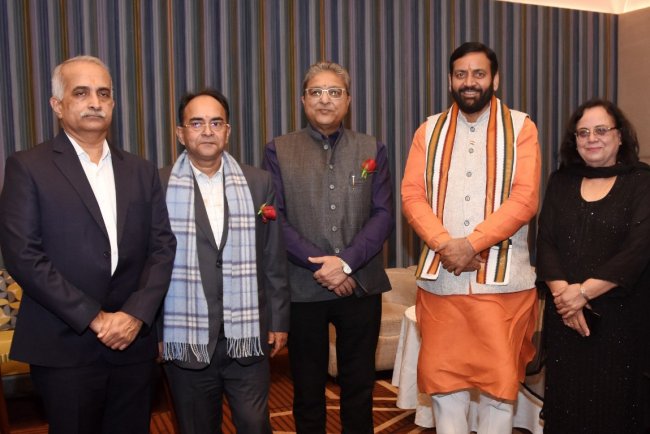
Minister of Jal Shakti, Shri C.R. Patil, inaugurated the 6th Nadi Utsav at IGNCA

The minister of Jal Shakti C.R. Patil has inaugurated the 6th edition of Nadi Utsav which is organised by the Indira Gandhi National Centre for the Arts (IGNCA), Ministry of Culture, Government of India at Janpath, New Delhi.
Celebrating rivers as vital ecological lifelines and cultural reservoirs, the festival opened to an enthusiastic gathering of scholars, artists, practitioners, and students.

In his inaugural address, C.R. Patil highlighted the significance of rivers in sustaining communities and shaping India’s cultural ethos. He emphasised collective responsibility in preserving rivers for future generations. He remarked, “India is a land of rivers. The world’s finest river, the Ganga, flows in India. It is our duty not to pollute our rivers.” He stated that conservation work is being carried out at three levels—short-term, mid-term, and long-term—under the leadership of Prime Minister Narendra Modi through Water Vision@2047.
Patil added that rivers are not merely resources but currents of emotions and culture. He warned that human intervention has caused immense damage and called conservation a shared responsibility. He also commended IGNCA for organising Nadi Utsav consistently.
Speaking at the event, Gaurang Das said rivers symbolise strength, energy, and life’s progress. Comparing them to the Ganga flowing from Gangotri to the Bay of Bengal despite obstacles, he stressed the importance of resilience and direction in life. He expressed concern over the Yamuna’s condition and emphasised shared responsibility in river conservation.
Sadhvi Vishudhanand Bharti Thakur shared her experiences with rivers from Northeast India to Kanyakumari. She urged people to engage in dialogue with rivers, recognising their wealth, and called for serious study of their ecological diversity.

Rambahadur Rai said rivers embody culture, faith, and responsibility. Recalling a Yamuna journey in the 1980s, he noted that 26 drains were already flowing into the river, underlining the crisis. He expressed optimism about current initiatives for cleaning and embankments and cited leaders like Pandit Madan Mohan Malaviya and Sunderlal Bahuguna in urging society to safeguard rivers. He stressed that Nadi Utsav should be a reminder of duties, not just a celebration.
Sachchidanand Joshi, in his welcome, said river culture profoundly impacts society. He noted that urban lifestyles have weakened bonds with rivers, turning relationships with nature into consumerist ones. He said Nadi Utsav seeks to inspire reverence, devotion, and faith towards rivers.
The first day of the three-day festival featured a National Seminar on “Riverscape Dynamics: Changes and Continuity”, with more than 300 papers received and 45 selected for presentation. The seminar is held in collaboration with the English Department of the University of Delhi.
Running parallel, the “My River Story” Documentary Film Festival opened with screenings of films such as Gotakhors: Disappearing Diving Communities, River Man of India, Arth Ganga, Yamuna’s Sewage Treatment Plant, and Cauvery – River of Life. These highlighted ecological concerns, traditional practices, and the human connection with rivers.
The day ended with cultural performances, including classical renditions on rivers by Guru Sudha Raghuraman and team.
The festival will continue until 27 September 2025, with cultural programmes, exhibitions, and discussions aimed at reaffirming the interconnections between rivers, ecology, and culture.
What's Your Reaction?