Sand and Dust Storm Disrupts Life Across Southern Peru
A powerful sand and dust storm disrupted southern Peru, halting traffic, affecting tourism, and lowering air quality in Ica, Arequipa, Moquegua, Tacna, and Lima. Triggered by a South Pacific anticyclone, winds reached 50 km/h and are expected to continue through the weekend.
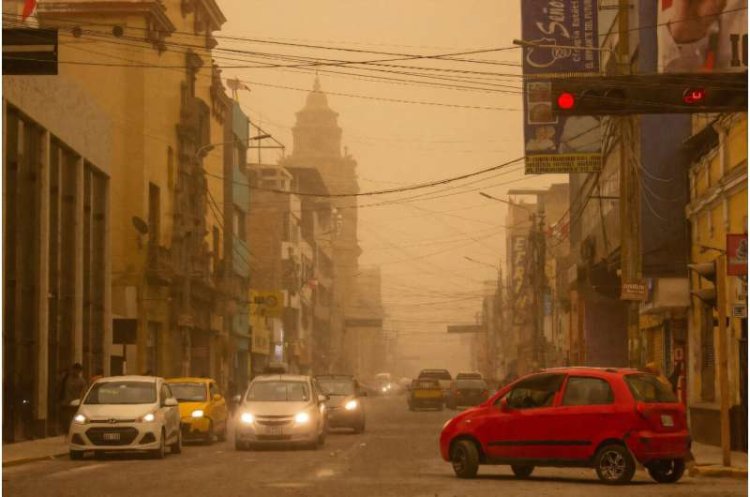
Thursday's major sand and dust storm swept across southern Peru, greatly disrupting everyday life in many areas including Lima, Ica, Arequipa, Moquegua, and Tacna. Strong winds brought on by increased atmospheric conditions over the South Pacific caused decreased visibility, interfered with transportation, and impacted coastal region tourism.
Perus national weather service reports the strongest winds in the Ica area, about 400 kilometers south of Lima, the capital. In Ica, gusts up to 50 kilometers per hour caused officials to briefly close down main roads and stop tourism for several hours. Many people and tourists were surprised by the sudden storm, which stopped traffic and kept people from going to the affected areas.
Nearby regions including Arequipa, Moquegua, and Tacna also had significant winds, with gusts as high as 32 km/h. Strong winds caused some trees to fall in Lima, the capital city, therefore increasing the already-existing disturbance everywhere.
The national weather service linked the event to a strengthened South Pacific anticyclone. At the surface, this high-pressure system, which is now close to the South American continent, caused an odd surge in wind speeds. Together with Perus parched desert terrain, the ensuing downdrafts produced a rapid uplift of dust and sand. The phenomenon considerably lowered visibility and air quality in the impacted areas.
The Ica region was especially bad since dust covered roadways made travel unsafe. In some sections, visibility was said to be close to none, so vehicles pulled over and waited for conditions to improve. Due to the storm, several popular tourist locations that draw both local and foreign visitors were forced to close their doors.
Besides the immediate influence on travel and tourism, local governments were motivated to evaluate damage and offer assistance in regions impacted by collapsing infrastructure or falling debris. Emergency teams were dispatched to keep an eye on things and help with cleanup where needed.
The weather service has cautioned that the strong wind conditions are expected to continue along the Peruvian coast until at least Sunday. Continued vigilance is advised, especially for those travelling or living in open and desert-prone regions.
This weather phenomenon draws attention to the sensitivity of the area to abrupt environmental changes. Southern Peru is naturally dry, but storms of this magnitude and intensity are quite unusual, especially in populated areas. Further developments are now being tracked by the authorities, who are urging locals to heed safety advisories, abstain from pointless travel, and stay inside during peak wind activity.
Officials are also researching long-term solutions to prevent such events in the future as the nation still grapples with the aftermath. This covers reinforcing emergency readiness in areas most vulnerable to abrupt temperature variations and upgrading early warning systems.
The sand and dust storm, on the whole, has created major issues for local infrastructure and highlighted unpreparedness for rare climatic phenomena in desert-adjacent areas. Authorities are on high alert to react to any more interruptions as strong wind conditions are forecast to last for several days.
Source:
2025 AFP
What's Your Reaction?