UK's Mission Zero Develops CO₂-Based Construction Materials
UK-based Mission Zero launches a carbon capture plant converting atmospheric CO₂ into sustainable construction materials, demonstrating a scalable climate solution integrating direct air capture with industrial reuse
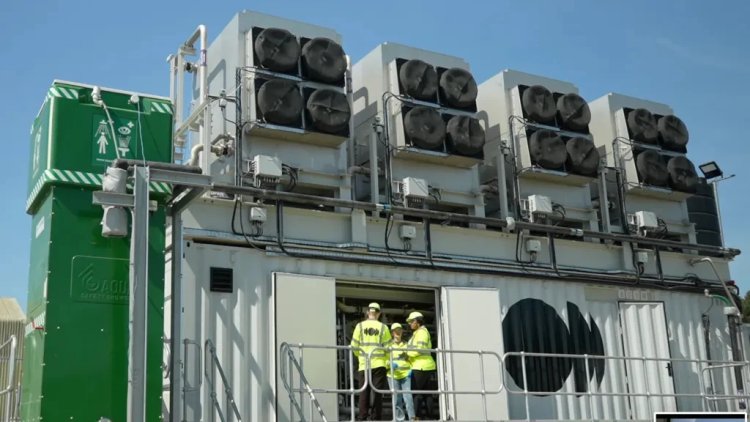
Mission Zero, a UK carbon capture expert, has commenced a pioneering project in Norfolk, Wretham that takes CO₂ out of the atmosphere to produce sustainable building materials. It is the UK's first direct carbon capture project to also produce material on-site, an industrial activity shift for lower carbon emissions using technology. The plant directly extracts carbon dioxide from the air and feeds it to O.C.O. Technology, where the CO₂ is employed to create eco-friendly aggregate material for construction and road building. O.C.O. previously sourced carbon dioxide but now has a captive source that drives a low-emission closed-loop production.
Mission Zero's collaboration with O.C.O. Technology is one of a kind in carbon capture business. By integrating CO₂ capture with on-site manufacture of the building material, the scheme demonstrates the carbon management's potential in driving climate ambition and industry growth. In spite of the fact that the factory utilized during Mission Zero emits already 250 tonnes per year—nominal against UK-wide yearly emissions over 400 million tonnes—it's being utilized as a starting experimental phase for tryouts with scope to develop further into a mature future potential. The long-term ambition of the project is to scale up the model, growing more economical and cost-effective, and enhancing its contribution to national emission reduction aims.
The applicability of direct air capture (DAC) to mitigating climate change grows, especially with rising atmospheric levels of carbon dioxide. The levels of CO₂ in the world since 1900 have increased by approximately 40%, putting more pressure on scalable technologies to deal with carbon. The solution suggested by Mission Zero is the utilisation of such ambient carbon into useful products such as limestone-based aggregates. Infrastructure projects demand these products and offer the ability to replace material with high carbon content that typically goes into building.
In addition to its environmental objectives, the project also focuses on economic development through the creation of green jobs. Mission Zero puts significant emphasis on the induction of professional specialists into the carbon capture industry, creating jobs in the areas of chemical engineering, operations, and production of green materials. These jobs are expected to play an even greater part in the future as the UK transitions to a low-carbon economy and builds indigenous capability for net-zero infrastructure.
The blending of DAC with local industrial application is consistent with overall carbon management direction, where in addition to emission capture, recycling carbon into higher-value uses is also prioritized. By supplying locally produced CO₂ to O.C.O. Technology, Mission Zero reduces reliance on fossil-based or imported sources of carbon, improving supply chain resilience with negligible environmental impact.
The project falls in line with the continuing drive for climate mitigation through technology. Despite small scale, successful operation of the Wretham plant can pave the way for large scale use of the same in other regions of the UK and globally. Such plants will complement national efforts against climate change through provision of carbon capture services as well as green construction material.
Even at this stage, the project has a reproducible model which can be scaled up as and when future policy commitment, public finance, and private sector interest make it possible. Coupled with circular material utilization, the DAC technology is gaining momentum globally, and the UK project is part of an expanding list of sensible answers to reversing industrially managed carbon.
Proportionally to the constantly increasing demand for climate-resilient infrastructure, the potential to produce atmospheric CO₂ into reusable aggregates to build buildings and roads is a viable solution. The technology provides space for decarbonization of the built world, one of the most emitting industries, along with compatibility with larger ecological and employment priorities. As greentech technology advances more, these multisectoral strategies will form the bulk of national and global carbon neutral schemes.
Mission Zero project also aims to reflect broader European and global policy directions since investment in CCU technology is on the rise. With greater knowledge about the environment, and growing investor appetite for green technologies, such projects would most likely be able to secure funding and partnerships for full-scale rollout and further technological advancement.
Conclusion
The Norfolk Mission Zero project is one in integrating the capture of carbon with sustainable production of materials and economic as well as environmental benefit. Though on a small scale at the moment, it is a pilot that could influence the development and deployment of such factories in the future. By incorporating CO₂ removal into industry end-use at a local scale, the project demonstrates a circular, low-emissions trajectory for the built environment and establishes the role of pioneering climate technology in the UK's decarbonization pathway.
Source/Credits:
KnowESG | Original Reporting from BBC
What's Your Reaction?