India is pushing to raise cotton productivity through improved farming practices, higher MSPs and a Rs 5,659-crore Mission for Cotton Productivity, as the sector supports millions of livelihoods and feeds the country's growing textile industry
In Gujarat's Rajkot district, Vinodbhai Virjibhai Vadodriya used to plant cotton the way his family always had — rows spaced 135 cm apart, plants 45 cm apart, wide gaps that felt like common sense on land that had grown cotton for generations. Under the government's Special Project on Cotton, he decided to try something that went against that instinct: packing his plants much closer together, at 90 cm by 15 cm.
More plants per acre, tighter competition for sunlight and soil — on paper, it sounded risky. In practice, his yield came in at 15 quintals per acre, a jump of roughly 30-35% over his old method. Because the crop matured faster under the denser spacing, Vadodriya also harvested earlier than usual, which meant less time in the field for pink bollworm — a pest that has quietly eaten into cotton farmers' margins across Gujarat for years — to do its damage. The extra income was hard to argue with, and it wasn't long before neighbouring farmers started asking him how he'd done it.
Nearly a thousand kilometres away, in Maharashtra's Jalgaon district, Bhaskar Tapiram Chaudhary was running his own version of the same experiment. He moved to closer spacing too — 90 cm by 30 cm — but paired it with tighter agronomy: recommended fertiliser doses, integrated pest management, careful nutrient scheduling. That season brought dry spells that usually punish cotton hard, but his crop held its ground. Where his old method yielded 8 quintals per acre, the new one delivered 11 — a 37.5% increase, and a real bump in profitability for a farmer who'd been doing things the same way for a long time.
Two fields, two states, one underlying story: some of the biggest gains left in Indian cotton aren't going to come from finding new land to plant. They're going to come from farmers being persuaded — plot by plot, season by season — to plant differently on the land they already have.
A crop unlike any other in the world
That's the quiet, granular end of a much bigger picture. India is the only country on earth that grows all four recognised species of cotton — Asian varieties like G. Arboreum and G. Herbaceum, Egyptian cotton (G. Barbadense), and American upland cotton (G. Hirsutum). That last one, Hirsutum, now dominates Indian fields, accounting for close to 90% of hybrid cotton grown here. Nearly all of it is Bt cotton — genetically modified using genes from a naturally occurring soil bacterium, Bacillus thuringiensis, that makes the plant resistant to bollworms. Since it arrived commercially in 2002, Bt cotton has meant fewer pesticide sprays, less crop loss, and, over time, real gains in farm income.
India leads the world in area under cotton cultivation — 114.84 lakh hectares, or roughly 38% of all cotton land on the planet. But size isn't everything: about 62% of that land depends entirely on rainfall, with the rest under irrigation. That single fact explains a lot about why yields vary so wildly from state to state, and why productivity — not just acreage — has become the government's central obsession.
In terms of output, India sits second globally, both in how much cotton it grows and how much it uses. The 2025-26 season (still provisional) pegs production at 290.91 lakh bales, with domestic consumption running well ahead at 328 lakh bales — a gap that says something about how hungry India's textile mills have become. A bale, for context, is 170 kg of cotton; the math behind these numbers translates to roughly 4.95 million tonnes produced against 5.58 million tonnes consumed in a single year.
The people behind the numbers
Strip away the statistics and cotton is, at its core, a livelihood story. Around 6 million farmers grow it directly, and another 40-50 million people find work around it — ginning, spinning, weaving, trading. It's a crop that touches nearly a fifth of the world's fibre production, and in India, it's stitched into economic history going back thousands of years, back to when cotton cloth itself functioned as currency in trade networks stretching into Europe.
The industrial story is more recent but no less dramatic. Textile mills sprang up in Kolkata, Mumbai and Ahmedabad through the 19th century — Ahmedabad earning itself the nickname "Manchester of India." The Swadeshi movement gave the sector a nationalist charge, encouraging homegrown mills to challenge British imports, and demand during the two World Wars pushed the industry further still. By Independence, the number of mills — and the volume of cloth rolling out of them — had grown substantially.
Where the plants actually grow
Cotton cultivation in India clusters into three broad zones: the north (Punjab, Haryana, Rajasthan), the centre (Gujarat, Maharashtra, Madhya Pradesh), and the south (Telangana, Andhra Pradesh, Karnataka), with Odisha and Tamil Nadu contributing outside these clusters. Each zone has its own rhythm, its own pest pressures, its own relationship with rainfall — which is exactly why farmers like Vadodriya and Chaudhary, working in different zones altogether, arrived at different but equally effective versions of the same idea: plant closer, manage smarter.
The price floor beneath it all
None of this experimentation would count for much if farmers couldn't count on a price. That's what the Minimum Support Price system is meant to guarantee — a floor that kicks in when market rates dip below what the Commission for Agricultural Costs and Prices recommends each cotton year. For 2025-26, that floor sat at Rs 7,710 per quintal for medium-staple cotton and Rs 8,110 for long-staple. It's since been raised for 2026-27, to Rs 8,267 and Rs 8,667 respectively — a bump of Rs 557 per quintal across both categories.
The Cotton Corporation of India carries out this procurement on the ground, and its footprint has been expanding: from 508 procurement centres in 2024-25 to 571 this season, spread across 152 districts in 11 states. In the 2025-26 season alone, CCI bought 105.09 lakh bales of cotton worth Rs 41,530 crore, through 24 lakh individual transactions with farmers — a scale that's easy to state in a sentence and hard to actually picture: that's roughly 24 lakh separate moments of a farmer selling his crop and walking away with a guaranteed price in hand.
Betting big on productivity
The government's longer bet is the newly launched Mission for Cotton Productivity, a five-year push backed by Rs 5,659.22 crore, aimed at dragging national output from around 297 lakh bales up to 498 lakh bales by 2031. That's not a modest target — it's close to a 68% jump — and it leans heavily on developing cotton varieties that can handle climate stress and resist pests better than what's currently in the ground, with particular attention to Extra Long Staple cotton, the premium fibre category that fetches the best prices internationally.
The mission is built around what officials are calling the '5F' vision — farm, fibre, factory, fashion, foreign — and it's designed to touch nearly 24 lakh hectares across 140 districts in 14 states, reaching an estimated 32 lakh farmers. Vadodriya's replanted field in Rajkot and Chaudhary's in Jalgaon are, in a sense, early previews of exactly this kind of mission at work — small trials that, if they scale, could move the needle on national output in a way that adding more acreage never really could.
Where the fibre finally lands
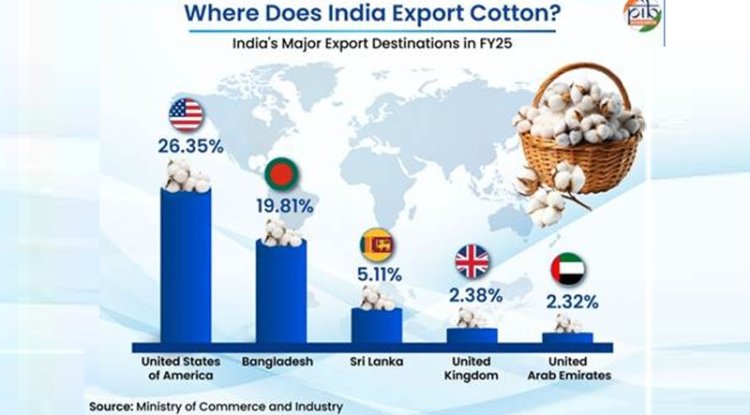
All this production eventually has to go somewhere, and increasingly, that somewhere is beyond India's borders. In 2024-25, the country exported around 18 lakh bales of raw cotton — a modest 3.37% share of the 541.69 lakh bales traded globally that year — but the bigger export story is in value-added products. Cotton fabrics and made-ups brought in US$11.49 billion in FY25, with the United States alone accounting for over a quarter of that (26.35%), followed by Bangladesh (19.81%) and Sri Lanka (5.11%). The UK and UAE round out the top markets, each holding a smaller but steady share.
It's a chain that starts with a farmer deciding how far apart to plant his rows, and ends, months later, with a shirt on a shelf on the other side of the world — which is, in the end, the whole story cotton has always told in India: agriculture and industry and trade, woven into one continuous thread.
What's Your Reaction?