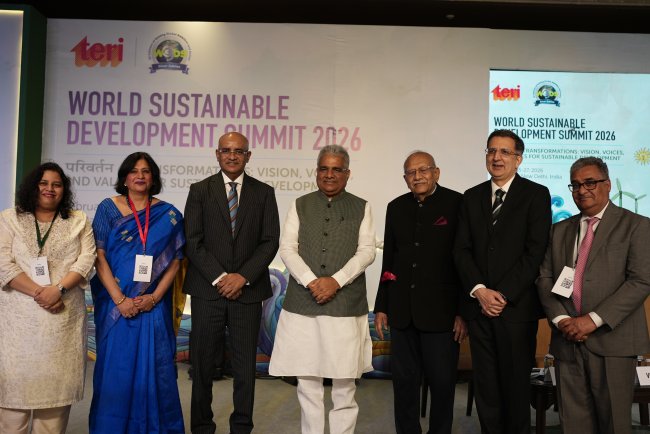
At the World Sustainable Development Summit 2026 in New Delhi, participants discussed the proposal for a Himalayan Coalition for Sustainable Development. The session examined environmental risks in the Himalayan region, approaches to cross-border coordination, and institutional considerations involved in developing a regional sustainability framework.
At the World Sustainable Development Summit (WSDS) 2026, policymakers and climate experts discussed the concept of a Himalayan Coalition for Sustainable Development, a proposed regional framework focused on climate resilience, ecosystem protection and coordinated governance across the Himalayan belt.
The discussion took place during a session that examined environmental pressures in the region and the limitations of fragmented national responses.
Vibha Dhawan, Director General of The Energy and Resources Institute (TERI), emphasised the ecological and hydrological importance of the Himalayas. She noted that the region supports major Asian river systems and underpins water, food and energy security for millions downstream. According to her, climate change is accelerating glacial retreat, altering river flows and increasing disaster risks, which she said underscores the case for coordinated planning.
Why the Himalayas Require Regional Cooperation
The Himalayan mountain system spans multiple countries, including India, Nepal, Bhutan, China and Pakistan. Ecological and hydrological processes in the region operate across political boundaries, limiting the effectiveness of policies implemented at the national level alone.
During the session, Anjal Prakash, climate policy expert and faculty member at the Indian School of Business, referred to scientific assessments indicating that warming trends in high-altitude ecosystems are occurring at rates above the global average. He cited increased occurrences of floods, landslides and glacial lake outburst events as indicators of heightened climate-related risks in the region.
Speakers noted that the implications extend beyond mountain communities. River basins originating in the Himalayas support large populations across South Asia. Changes in glacier-fed water systems may influence agricultural output, hydropower production and drinking water availability across national boundaries.
What the Proposed Coalition Would Do
As discussed during the session, the Himalayan Coalition for Sustainable Development would seek to formalise cooperation among governments, research institutions and civil society organisations. Proposed areas of focus include:
Cross-border environmental data sharing, particularly concerning glaciers, biodiversity and hydrological systems
Development of coordinated climate adaptation strategies tailored to mountain ecosystems
Strengthening disaster preparedness frameworks and early warning systems
Infrastructure planning approaches intended to minimise ecological impact
Identification and mobilisation of financing mechanisms for mountain-focused resilience initiatives
Anjali Acharya, Managing Director of The Nature Conservancy India, stated that conservation planning in the region may require approaches that consider entire landscapes rather than project-specific interventions. She referenced watershed management and biodiversity protection as areas where shared metrics and monitoring systems could support coordinated action.
Governance and Financing Challenges
Speakers noted that aligning development priorities, regulatory frameworks, and environmental standards across multiple countries would involve institutional and diplomatic processes.
Dhawan observed that aligning national development priorities, regulatory systems and policy frameworks across the Himalayan countries would require sustained diplomatic engagement. She also noted that financing structures would need clear design parameters to reduce duplication and ensure accountability.
Prakash added that differences in environmental monitoring methodologies across countries create challenges for comparative assessment. He stated that establishing common standards and data protocols could be an initial technical step in operationalising regional cooperation.
Current Status
The Himalayan Coalition proposal remains at a discussion stage. Suggested next steps include consultations among governments, formation of technical groups, and feasibility assessments to examine possible institutional arrangements and funding structures.
The session concluded with a review of environmental trends in the Himalayan region and discussion on whether greater regional coordination could contribute to future policy responses.
What's Your Reaction?