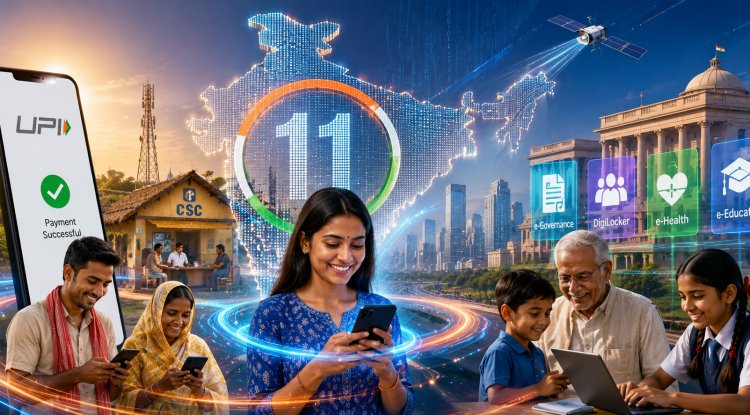
Digital India has completed 11 years, driving the country's digital transformation through UPI, improved public services, digital governance and greater access to technology.
11 Years of Digital India: How Technology Is Reshaping Everyday Life

On the launch of Digital India on July 1, 2015, almost all the activities of the country were conducted through the medium of cash – including carrying cash, finding change and having to wait for slow public services to respond. Today, after 11 years, Digital India has become a well-established digital public good, transforming the ways in which Indians pay, services are delivered and livelihoods are sustained in both urban and rural areas.

The Unified Payments Interface (UPI), which was launched in 2016-17, is at the centre of this change, and India has the world's largest real-time payments system, accounting for almost 49 per cent of the volume of real-time payments made in the world. The system is supported by an ecosystem of enablers like interoperable digital payment platforms, Aadhaar digital identity, low-cost internet, expanding 5G networks, optical fibre in rural India, and a robust infrastructure of user-friendly payment applications. India's digital payment ecosystem is also increasingly becoming globally recognised — Greece recently enabled UPI services, which will enable Indian tourists and businesses to make seamless digital transactions overseas.

In addition to payments, Digital India has also made an impact on maternal and child nutrition via the Poshan Tracker, an initiative by the Ministry of Women and Child Development under Mission Poshan 2.0. Anganwadi workers were using 11 manual registers earlier, which resulted in service gaps and delays. This has now been digitised on the platform, where, as of May 2026, 13.30 lakh Anganwadi workers are registered and 8.93 crore beneficiaries, including pregnant women, lactating mothers, children aged 0–6 years, and adolescent girls, are covered with 99.89 per cent Aadhaar verification. The platform now processes more than 22 crore daily transactions compared to less than 1 crore in 2021, and has a live database of nutrition indicators for more than 77 million children, allowing real-time dashboards and policy decision-making.

Over the years, artisans and weavers have relied on middlemen to sell their products, reducing their profits and increasing consumer costs. The Indiahandmade platform, built by the Digital India Corporation for the Ministry of Textiles, is transforming this by directly connecting more than 3,900 artisans and weavers with customers across the country, and listing over 21,000 handcrafted and handloom products. The platform has features such as AI-powered listings, integrated order management, secure payments and free logistics, ensuring that all revenues from sales go directly to artisans' bank accounts, boosting incomes and making handmade products accessible to more consumers.

Digital India has now completed 11 years, and its impact is not only reflected in policy documents. It is reflected every time a tea seller in Delhi receives a digital payment, a Jharkhand weaver sells a product online, or an Anganwadi worker records a child's health data in real time in Odisha — each individual instance of change contributing to a much larger transformation.

Share: