A Remarkable Rise in Women's Workforce Participation
Women in India are joining the workforce in record numbers, becoming entrepreneurs, and driving the nation’s growth.
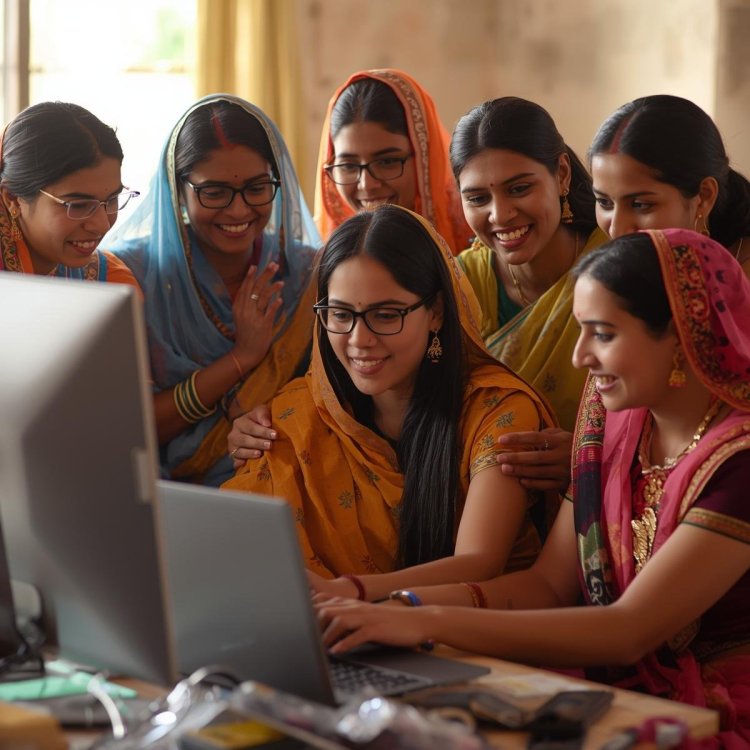
India is seeing a rise in the number of women who are involved in work force. The Ministry of Labour and Employment highlights that the Workforce Participation Rate (WPR) of women was 22% in the years 2017-18 and now rose to 40.3% in the years 2023-24, while the rate of unemployment (UR) decreased from 5.6% to 3.2% at the same time. This indicates that the opportunities are rising for women in all sectors.
This shift has been more pronounced in rural India, where employment among women has increased by 96%, as opposed to 43% in urban India. Women who are graduate are also gaining employability and now it has increased to 47.5% in 2024 compared to 42% in 2013, on the other hand female postgraduates have also seen a dramatic increase in employment rates. The India Skills Report 2025 estimates that almost 55% of Indian graduates will be employable all over the world by 2025, as compared to 51.2% in 2024.
EPFO payroll statistics indicate that 1.56 crore women entered the organized workforce in the past seven years. In addition, more than 16.69 crore women working in the unorganized sector have registered on the e-Shram portal, making them eligible for social security schemes.
Bharat Moving from Women's Development to Women-Led Development
The Indian Government has also changed its perspective from just helping women to empowering women-led development. Over 70 central schemes and 400 state schemes now target women entrepreneurs. Statistics in PLFS reveal that self-employment among women has increased by 30%, from 51.9% in 2017-18 to 67.4% in 2023-24, indicating that women are becoming self-reliant.
India's gender budget has also increased by 429% in the last ten years, from ₹0.85 lakh crore during 2013-14 to ₹4.49 lakh crore during 2025-26, demonstrating a high level of commitment towards empowering women through education, employment, and entrepreneurship.
The Startup India ecosystem is flourishing, with almost 50% of DPIIT-registered startups having a minimum one woman director. Approximately two crore women have become Lakhpati Didi, with the help of flagship initiatives such as Namo Drone Didi and Deendayal Antyodaya Yojana – NRLM.
Financial inclusion too has been a game changer. Through PM Mudra Yojana, women have benefited from 68% of total loans (more than 35 crore loans amounting to ₹14.7 lakh crore). Also, under PM SVANidhi, 44% of street vendors enabled are women, so that they can achieve resilience and self-reliance.
Women-owned MSMEs are fueling growth by creating 89 lakh new employment opportunities for women between FY21–FY23. Women-owned MSMEs have almost doubled in a decade from 1 crore in 2010-11 to 1.92 crore in 2023-24, pointing to women's increased contribution to India's economy.
New Dimensions of Women's Employment in India
Apart from conventional industries, women are progressively present in new-age industries like technology, fintech, e-commerce, electric vehicles, and renewable energy. IT and AI-based services companies are reporting a consistent increase in women engineers, developers, and analysts. India boasts one of the highest numbers of women in STEM education worldwide, and their inclusion in employment is defining digital India's future.
Emergence of the gig economy and work from home jobs has further provided opportunities for women. Food delivery apps, e-commerce logistics services, and freelancing digital services are generating flexible work opportunities for women who would like to coordinate work and family lives.
Digital inclusion has been revolutionary. Low-cost smartphones and UPI payments have empowered rural women to open bank accounts, initiate micro-enterprises, and join the digital economy. Women are not only consumers but entrepreneurs in India's rapidly expanding digital financial ecosystem.
Throughout the world, India's progress is being observed. The World Economic Forum's Gender Gap Report 2024 placed India higher on economic participation than in previous years, indicating an increase in women's labor force participation and leadership positions.
Nari Shakti Steering India Towards Viksit Bharat
Women are no longer just contributors to the economy but they are captains and game-changers. Their growing engagement is not only raising family incomes but also rewriting India's growth narrative. With favorable government initiatives, digital empowerment, and improving opportunities across new industries, women are steering India on the path to Viksit Bharat 2047.
The emphasis is shifting towards making an inclusive ecosystem where women are equally available for education, skills, finance, and opportunities. When women come forward as leaders, entrepreneurs, and innovators, Nari Shakti is emerging to be the pillar of change in India's progress to become a developed country.
What's Your Reaction?