Artificial Rain, Real Risks: Scientists Warn of Long-Term Impact
Cloud seeding can bring quick rain, but it may harm nature and isn’t a lasting solution to water shortage.
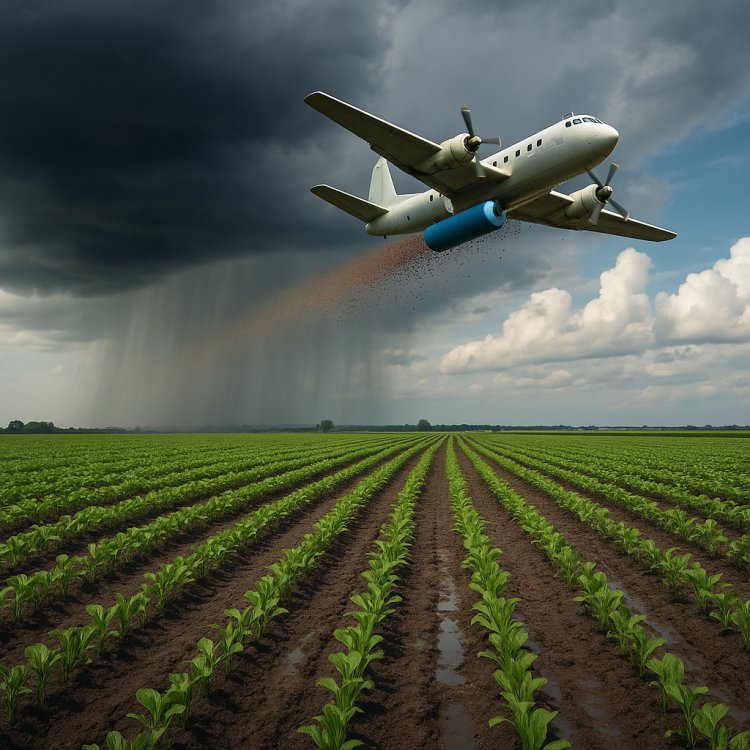
Cloud seeding has been seen as a quick and modern way to solve problems like drought or to control forest fires; it does work as an immediate relief if rain falls. Many governments have tried it — India, China, the United Arab Emirates, and the United States, among them. The concept is to add special chemicals to clouds (which are already there) to make it rain. It is not about forming clouds but seeding existing ones.
But behind this easy fix, is there a reason to be concerned? There are no hidden or deeper concerns related to it; however, there are chances of some hazards, as silver iodide is the most common seeding agent. It is regulated as a hazardous substance in some jurisdictions because silver is a heavy metal. Studies show that under typical cloud-seeding levels, silver concentrations remain below thresholds of immediate concern — but long-term accumulation in soil, water, and ecosystems is under-researched.
There are also health concerns, such as respiratory irritation, for vulnerable people in pilot programmes. For example, an Indian source notes that inhalation of fine silver iodide particles could aggravate asthma.
Let’s understand in detail.
What Cloud Seeding Is
Cloud seeding is a method to change the weather conditions by making it rain. The cloud seeding process involves spreading tiny particles like silver iodide, sodium chloride (table salt), or dry ice into clouds with the help of aeroplanes, drones, or rockets to induce water droplets to condense and precipitate as rain. But in certain situations, it can enhance rainfall by 10–20%, based on weather conditions.
The technology has been used to fight droughts, increase water supply for agriculture, and even reduce air pollution. It is a short-term helpful tool to get immediate relief; however, scientists are worried that it can harm the environment and can imbalance nature if this method is used on a regular basis.
Why Cloud Seeding Is Not Sustainable in Long Run
One of the major concerns is the use of silver iodide if artificial rain is a regular phenomenon, which is a type of chemical that can be poisonous if used in large amounts, so keeping the technicality and amount of the chemical is mandatory. While studies say that a small amount of silver iodide used is safe but if cloud seeding is done too much, the chemical can build up in soil and water. It is also said that this can later harm living organisms.
In countries like the UAE and China where cloud seeding is done frequently, scientists have already found amounts of silver residues in the water and soil. This is worrying because it can enter the food chain which will affect animals and people in long run.
Disrupting Natural Weather Cycles
Weather systems are interconnected. When scientists use cloud seeding to make it rain in one area, they may be using the moisture that would have naturally shifted to another place. For example, the cloud seeding was done in Delhi, but the rain poured in Uttar Pradesh. Some scientists call it “weather piracy,” where water resources are unintentionally taken from other regions.
Short-Term Relief, Long-term Dependence
Cloud seeding may only help for short period of time, but it doesn’t fix the real problem of water scarcity, such as poor water management, cutting down trees and global warming. If people start depending too much on artificial rain, they may stop focusing on long lasting solution to water problems. Instead of improving water management, constructing systems to store water, they may just wait for cloud seeding to solve their issues. But that is risky, because it only works sometimes.
Uncertain Success and High Costs
Cloud seeding is not always effective because it only works when there are sufficient clouds with moisture present in the sky. In conditions of extreme drought, when the sky is dry and clear, the process doesn’t work. Despite heavy spending, success rates vary drastically, from 5% to 30%, depending on atmospheric conditions. Most of the developing nations including India, have spent lot of money on cloud seeding but didn’t get expected result. This makes cloud seeding more costly and unreliable experiment. Scientists believe that instead of spending money on cloud seeding, money could be better spent on sustainable and long-term water solutions. For example, restoring lakes and rivers or building renewable water systems, which are effective and will surely give results.
Ethical and Geopolitical Risks
Cloud seeding may create moral and political problems because it changes natural rainfall patterns, and it raises ethical questions:
Who has the right to control clouds and rain?
Can one country’s rain be another’s drought?
If countries or regions believe their rain is being taken away or reduced by neighbouring regions' cloud seeding, it could lead to arguments or conflicts. There is also a fear of misuse of technology, manipulating weather conditions for political and military gain. Because of these risks, international environmental organisations are aware of how and where cloud seeding is used.
A Technology That Demands Caution
Cloud seeding is not completely bad; it can be useful in serious situation and in emergency case such as situation like wildfires and extreme droughts where cloud seeding is immediately needed. But it should be treated as a temporary solution, not a regular way to deal with the climate problems. Since the earth’s weather and climate systems are very complex and changing just one part of it can create unwanted side effects. As you know climate change is happening fast, people have become impatient and often look for quick and easy fixes like cloud seeding. But history shows that taking shortcut can take you to bigger and more dangerous problem later.
What's Your Reaction?