Sustainable rice cultivation is essential to ensure global food security while reducing methane emissions, conserving water resources, and protecting the planet's ecological balance.
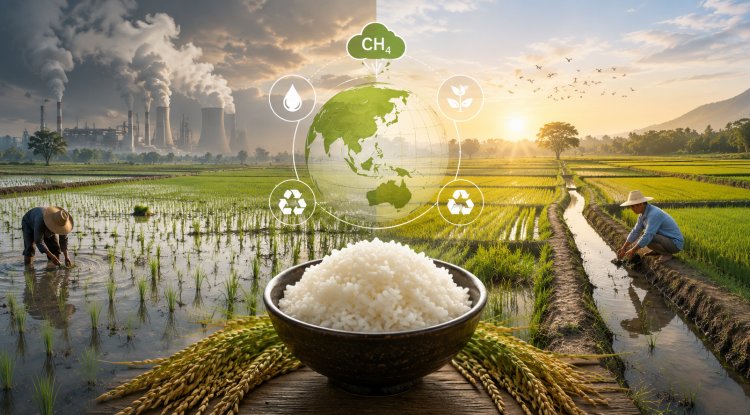
Rice is a fundamental foodstuff in human life, and more than half of the world's population depends on it as a staple food source. This simple grain is firmly entrenched in the cultural, economic, and culinary life of societies, from vibrant Asian cities to expanding communities around the globe, including Africa and Latin America. However, behind the reassuring image of a staple food is a disturbing environmental reality. Scientists at the University of Minnesota have conducted a comprehensive scientific assessment, which shows that the way humans cultivate rice is reaching critical planetary boundaries. All of these bowls of steaming rice are part of a delicate global balancing act, and they pose a direct threat to the long-term stability of the Earth's climate system, freshwater supplies, and natural nutrient cycles.
The impact of modern paddy cultivation on the environment is significant, accounting for up to 12% of human-caused methane emissions. Rice fields are regularly maintained and continuously flooded for months at a time, which provides ideal anaerobic soil conditions for specialised anaerobic microbes that continuously generate large volumes of highly potent methane gas, which is released into the atmosphere. It is a challenging paradox because the agriculture sector accounts for a significant share of global warming, even though it has a hidden environmental footprint. The very climate change induced by traditional rice production is leading to unpredictable monsoon cycles, extreme dry spells, and sudden shifts in temperature, which have a direct impact on future crops.
In addition to its massive contribution to worldwide greenhouse gas emissions, the amount of water used in conventional flooded paddies is placing critical freshwater resources under increasing pressure. Over one-third of all water used for irrigation of crops in the world is utilized for growing rice, depleting the old groundwater sources as well as fragile river systems. The levels of groundwater have fallen in places such as north-western India and some parts of China, where there is excessive extraction of water by farmers in order to keep their fields alive. This major hydrological stress is resulting in water insecurity zones, compelling people to make hard choices between short-term food security and long-term water security.
In addition to these problems created by climatic factors and inadequate access to water, the other problem is the huge disturbance caused to the global nutrient cycle due to the excessive usage of artificial fertilizers. In order to boost crop yield and production, farmers tend to put excessive amounts of nitrogen and phosphorus in their fields. These excess amounts of chemicals get washed away during the rainy season into streams, rivers, and oceans due to saturation of the soil and inability to hold these chemicals. This causes the formation of algae in these water sources which kill aquatic life.
In the face of these converging ecological challenges, agricultural research and innovative farming communities are moving quickly to implement new methods of production that can reduce the negative environmental impacts of food systems. One of the most popular systems being implemented around the world is the system of alternating wetting and drying, which involves the intentional drying of fields for a certain period of time. This change breaks up anaerobic soil conditions, reduces methane emissions by up to half, and reduces irrigation water use by up to one-quarter without compromising grain quality or yield.
However, these sustainable alternatives are not going to be viable at scale unless deep-rooted cultural practices change, and there are many economic challenges to address for smallholder farmers. Traditionally, a high-return, low-tech way to control weeds naturally has been to flood fields, so changing to drier fields would require farmers to invest in other weed management options or specialised precision machinery. In addition, government policies in many developing countries are still outdated, and they continue to subsidise electricity and water for farmers to pump water, which in turn promotes wasteful water-use practices and removes financial incentives for farmers to adopt water-saving technologies.
In conclusion, the worldwide challenge of rice farming underscores the basic issue of food security in the face of ever-increasing climate change. A global agricultural approach is needed to ensure that a staple food can nourish billions of people without threatening the foundational ecosystems that support life. If society overhauls irrigation systems in regions, reforms inappropriate irrigation subsidies, and makes significant investments in climate-smart varieties, rice cultivation can become sustainable. The concept of balancing the world's dinner bowl is no longer a dream of an ideal environmental future but a necessity to ensure that human life can continue on Earth while relying on fragile planetary systems.
What's Your Reaction?