TCI’s Safe Safar programme is helping truck drivers across India adopt safer driving practices, access health and digital services, and prepare for a rapidly changing transport sector
Every three and a half minutes, someone in India dies in a road accident. Over a year, that adds up to more than 1.5 lakh lives — roughly 422 families getting the worst possible news every single day. For most companies, a statistic like that stays a statistic. For Transport Corporation of India (TCI), one of the country's largest logistics players, it became something closer to a conscience check.
Rajkiran Kanagala, President & Chief Business Officer at TCI, spoke about how that shift happened, what it took to build TCI Safe Safar — the company's road safety programme — from scratch, and why he believes the work will never really be "done."
Where it started
According to Kanagala, the numbers around road deaths were never just external data for TCI — a company that runs its entire business on road freight. "A significant share of those fatalities involve heavy commercial vehicles," he said. "For a company whose entire business runs on road freight, those numbers are not external data; they are internal conscience."
What made it personal, he explained, was proximity. TCI's people are at truck terminals, highway corridors and loading docks every single day — places where drivers push through the night on brutal schedules, where there's nowhere to rest or even use a clean toilet, and where the nearest hospital could be hours away. Seen up close like that, he said, road safety stops feeling like a regulatory checkbox.
That's the backdrop against which TCI Safe Safar was launched in 2019 — built on the idea that a company with six decades on Indian roads, over a thousand offices across the country, and operations in seven countries had the reach to do more than just comply with rules. It had the responsibility to lead.
 Before ESG was a buzzword
It's worth remembering what 2019 looked like. ESG, as a term, mostly lived in the world of institutional investors. In logistics, "road safety" meant licenses, fitness certificates, and permits — paperwork, essentially. So when a transport company started putting on street plays at highway dhabas and running health camps at truck terminals, it raised eyebrows.
Kanagala says the idea didn't come from a strategy document. "The spark was not strategic, it was empathetic," he said. Truck drivers — the people TCI's entire business depends on — were essentially invisible in India's road safety conversation. Government policy focused on infrastructure. Public campaigns targeted car owners and pedestrians. The truck driver, despite being arguably the most important person on the highway, was the one nobody was talking to.
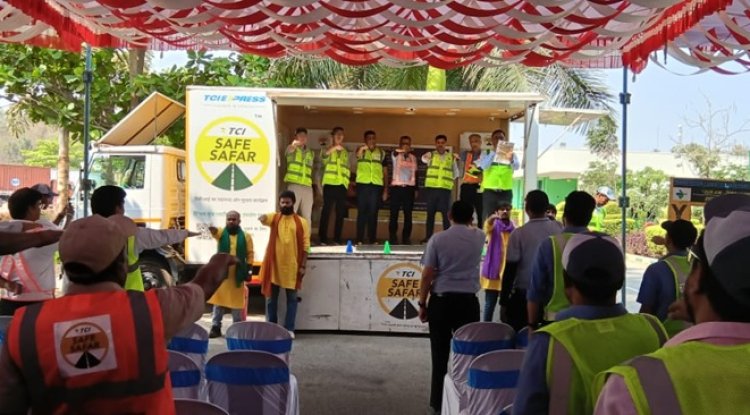
There was internal pushback too — fair questions about how you'd even measure something like this, how you'd reach people, and how you'd communicate across so many languages and literacy levels. TCI's answer was simple: instead of waiting for drivers to show up somewhere, go to them. Three dedicated outreach trucks were sent out across North, South-East and Central-West India, taking the programme directly to terminals and highway hubs. That mobility, Kanagala says, was what made the whole thing work.
To Drivers, Through Drivers
Safe Safar has now reached over 13 lakh people across 16 states — through street plays, workshops, and digital tools. For a trucking company, that's an unusual toolkit. But Kanagala says it comes down to one principle: "To Drivers, Through Drivers."
He reasons that real behaviour change inside any community comes from trust within that community, not from outside instruction. When a driver stands up in front of his peers and takes a safety pledge, it carries far more weight than any poster or pamphlet ever could.
That's why the Nukkad Natak — a traditional street play performed in local languages — became central to the programme. It's entertaining enough that drivers actually stick around, and it's delivered in a way people relate to. Quizzes, hands-on demonstrations and multilingual posters back up the message, and drivers are treated as participants rather than a passive audience.
Digital tools came in as practical add-ons rather than a tech showcase. For a lot of drivers, Safe Safar was their first real introduction to platforms like Sarathi Parivahan, Vahan, and Google Maps — tools that directly affect both safety and compliance. And the number Kanagala points to as proof the model is working isn't reach or attendance — it's the over 1.6 lakh pledges drivers have taken voluntarily, in public, in front of other drivers.
Measuring something that's hard to measure
Behaviour change is notoriously difficult to quantify, and Kanagala doesn't pretend otherwise. Counting events held or people reached, he says, is necessary — but it doesn't tell you whether anything actually changed. "The real measure is whether a driver does something differently on the road the next morning," he said.
To get closer to that answer, TCI has started using telematics to track speed, braking behaviour and hours spent driving in real time — turning safety from something you react to after an accident into something you can act on before one happens. A Digital Asset Management system now tracks participation and the quality of outreach across more than 1,200 programmes, so the data behind Safe Safar isn't just anecdotal. And those 1.6 lakh public pledges, he says, are themselves one of the strongest indicators that something is shifting — because nobody takes a pledge like that in front of their peers unless they mean it.
Why the truck driver gets left out
Trucks are involved in more fatal crashes than any other vehicle type in India, yet the driver is often the last person anyone thinks about when discussing road safety. Kanagala says that the gap is both economic and cultural.
Road safety conversations in India, he points out, have largely been shaped around the private vehicle owner — a group with political voice and visibility. The truck driver, despite being the most consequential person on the highway, is also the most economically marginal and the least organised.
There's also a framing problem, he says. When a truck is involved in a fatal accident, the driver is usually blamed outright — fatigue, speeding, or negligence. What rarely gets mentioned is that he may have been driving for 20 straight hours on an impossible delivery deadline, with no rest stop, no clinic, and no proper meal anywhere along the way. "Individual blame is easier than systemic accountability," Kanagala said.
TCI Safe Safar tries to flip that framing on its head. The "Dhanyawaad Drivers" campaign starts from a place of gratitude rather than instruction. Khushi Clinics bring basic medical access to drivers who would otherwise have none. And stress management sessions acknowledge something that rarely gets discussed — the toll of spending months away from family.
What happens when the trucks themselves change
With electric trucks, AI-powered fleet management, and zero-emission mandates all arriving more or less at once, it's a fair question whether road safety even means the same thing anymore. Kanagala's answer is straightforward: "The technology changes. The human element stays."
EVs will change what's under the hood, AI will reshape how routes are planned and fatigue is tracked, and ADAS systems will reduce how badly things go wrong when a driver makes a mistake. TCI is already moving in this direction — CNG and electric vehicles are in operation, telematics is live, and the company is working with IIM Bangalore's Supply Chain Sustainability Lab on how decarbonisation and efficiency intersect.
But none of that removes the human factor — it just redefines it, Kanagala says. As vehicles get smarter, a driver's job shifts toward monitoring systems, handling exceptions, and using digital tools — which requires a different kind of training altogether. "A driver who has never used a smartphone meaningfully cannot engage with an AI-assisted dash system," he said. The digital literacy Safe Safar is building today, in his view, is really preparation for the fleet India will be running tomorrow.
There's also a connection that doesn't get talked about enough, he adds: calm, disciplined driving — steady speeds, smooth braking — happens to be both the safest way to drive and the most fuel-efficient. Safe Safar's behaviour change work and TCI's target of cutting greenhouse gas emissions by 30% by 2030 aren't two separate efforts. They come down to the same habits.
What "mission accomplished" actually looks like
Safe Safar picked up the FICCI Road Safety Award in 2024, and Kanagala says it meant a great deal to the team — not just as recognition, but as a signal that the wider ecosystem is starting to shift. The British Safety Council's James Tye Award, awarded internationally, sent a similar message. Together, he says, they show that empathy-led, grassroots programmes like this one are credible — and more importantly, replicable across an entire industry.
But awards, he's quick to add, raise the bar rather than lower it. So what would "mission accomplished" actually look like?
For Kanagala, it isn't a number on a dashboard. "It is a truck driver in Rajasthan adjusting his speed on a foggy highway because that discipline is simply second nature, not because anyone is watching," he said. It's a logistics company anywhere in India running driver health camps as a matter of routine, not as a CSR project. It's a child in Delhi growing up understanding that the person delivering groceries to their home deserves the same respect as anyone else doing a job.
More concretely, he lists three markers: a verified drop in accident rates within the communities Safe Safar has worked with; driver welfare becoming part of India's ESG and procurement standards by default, rather than depending on whether an individual company chooses to care; and Safe Safar growing from being a TCI initiative into something the country at large takes ownership of.
The next steps include more outreach trucks, additional school vans in districts with high accident rates, and expanded digital campaigns. But the piece Kanagala seems most invested in is something still in the works — a dedicated Driver Training School. The thinking behind it is simple: safety should be built into a driver before he ever gets behind the wheel, not patched in after something goes wrong. The school is being designed to cover defensive driving, fatigue management, emergency response, and what Kanagala calls the rights and responsibilities of the profession. TCI is actively working towards getting it off the ground.
Asked if there's an endgame, Kanagala doesn't hesitate. "No. Not until every driver comes home safely," he said. "The work does not finish. It compounds."
What's Your Reaction?