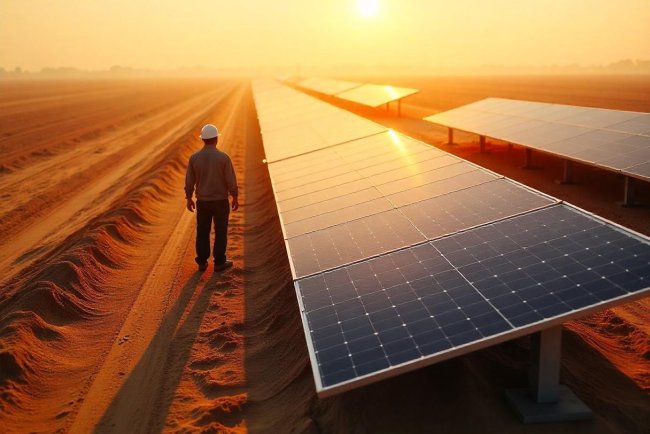
For the first time, China is projected to surpass coal-fired power in installed solar capacity in 2026, representing a historic milestone for the world’s largest electricity consumer. This represents a historic turning point in the energy system as depicted in The 2025–26 National Power Supply Demand Analysis and Forecast from the China Electricity Council (CEC).
The report states that China will have installed more than 400 gigawatts of new generation resources in 2026 and that wind and solar will account for approximately 75% (over 300 GW) of these new additions. At the end of 2026, total installed generating capacity is expected to be 4.3 terawatts (TW), and solar is projected to become the single largest source of installed power capacity, overtaking coal.
Non-fossil energy sources, including solar, wind, nuclear, and hydropower, are expected to account for about 2.7 TW, or 63% of China’s total installed capacity. Coal’s share, by contrast, is forecast to fall to a record low of roughly 31%, ending its long-standing dominance of the country’s power infrastructure.
Rising electricity demand continues to underpin this expansion. China’s power consumption reached a record 10.37 trillion kilowatt-hours (kWh) in 2025—more than twice the annual electricity consumption of the United States. Demand is projected to grow by 5–6% in 2026, approaching 11 trillion kWh, driven largely by electric vehicles, lithium-ion battery production, and photovoltaic manufacturing.
Electric vehicle charging and battery-swapping demand rose nearly 49% last year, while electricity use in the information technology sector, including data centres, increased by over 30%, the report noted.
Hao Yingjie, a spokesperson for the China Electricity Council, addressed the press in Beijing and said that new generating capacity is expected to exceed 400 GW in 2026, with an unprecedented scale of clean energy capacity being deployed in China.
In a separate interview, Xing Yiteng, deputy director general of the National Energy Administration, indicated that for the first time, China made energy investments exceeding 3.5 trillion yuan ($503.6 billion) last year and that these investments have grown at a rate faster than any other portion of the economy.
However, the report cautioned that coal remains critical to system stability. While wind and solar will account for about half of installed capacity by late 2026, they currently contribute less than 43% of actual electricity generation due to intermittency. Coal-fired power continues to play a key role during peak demand and extreme weather events.
The CEC concluded that improving grid flexibility and storage capacity will be essential to managing the rapid growth of weather-dependent power sources.