Florida Wildlife Corridor Marks 15 Years as Conservation Expands
The Florida Wildlife Corridor celebrates 15 years of progress, with 10 million of its 18 million acres now protected through public and private conservation. As Florida’s population grows, the state increases funding and policy efforts to preserve natural areas and support wildlife movement.
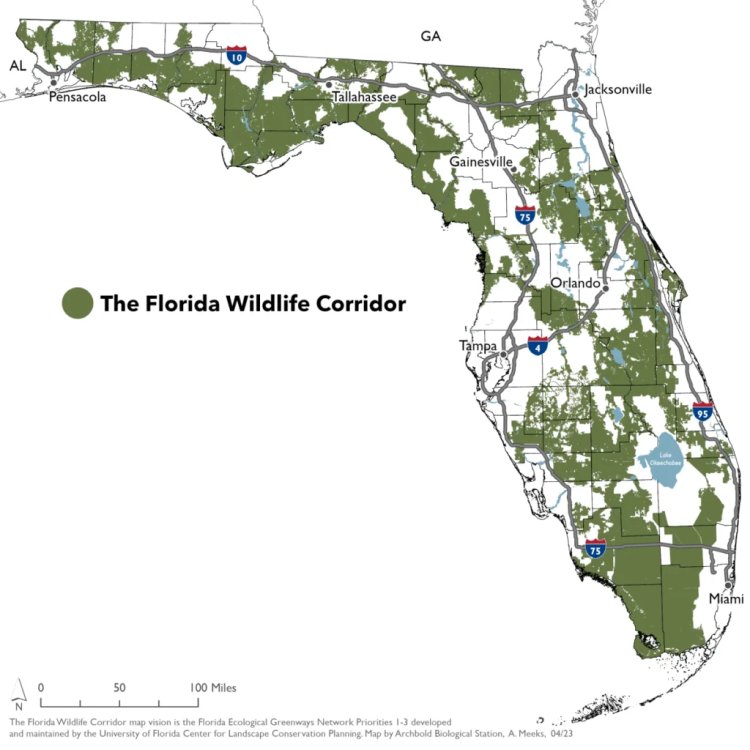
With state authorities stepping up conservation initiatives to safeguard natural habitats under strain from quick population growth and construction, the Florida Wildlife Corridor has passed a 15-year milestone. The corridor presently covers 18 million acres throughout the state; 10 million of those are already safeguarded by private land deals and public conservation areas. Maintaining habitat connectivity for animals like the Florida panther and black bear depends on these regions.
To offer secure, linked habitats for animals, the Florida Wildlife Corridor was created. Of the 10 million acres safeguarded, land is protected either through state and national parks or via private conservation easements. These easements enable landowners to continue using their land for low-impact activities including ranching and forestry while forbidding future development. Eight million acres are still unprotected and vulnerable for development, though. In response, the state is negotiating budgets that could allocate between $300 million and $450 million for land protection in the 20252026 cycle.
Decades of population increase and urban development have put Florida's natural regions under ever-increasing pressure. The rise of air conditioning and the creation of tourist destinations such Disney World following World War II sparked a population explosion. With roughly 300,000 new people added annually, Florida is now the third-most-populous state in the US. Consequently, every year around 60,000 acres of natural habitat, the size of Miami, are lost. Much of this growth has happened along the coasts and in central Florida, thereby endangering still-unprotected territory.
Florida has put in place several conservation laws over the past few decades to address these threats. Programs like the Florida Preservation 2000 Act of 1990, Florida Forever of 2001, and the Rural and Family Lands Protection Program of 2001 have let the state preserve millions of acres of land. By concentrating on important ecological areas required for wildlife movement and long-term ecosystem health, the Florida Wildlife Corridor builds on this base.
Many species, especially huge mammals like panthers and bears, need vast, linked territories to live, reproduce, and move around. Maintaining these routes helps to lower the possibility of animals wandering into urban areas, where the likelihood of harm grows, or crossing roads. Benefitting both inhabitants and wildlife, the corridor also helps vital ecosystem services including water filtration, flood control, and clean air.
Studies from the University of Florida in the 1990s using satellite imagery and mapping software helped to inform the corridors design to find the most important natural sites for connectivity. This started the Florida Ecological Greenways Network (FEGN), which is now incorporated into the state's larger Greenways and Trails System. FEGN still steers land protection decisions with current geographical information systems used to monitor land use and pinpoint priority areas.
Public knowledge of the corridor grew dramatically in 2010 when environmentalists started a campaign using storytelling, photography, and media outreach to emphasize its significance. The campaign drew focus to the difficulties species such the Florida grasshopper sparrow face and underlined how the corridor aids clean water, outside recreation, and sustainable land use.
The Florida Legislature approved the Florida Wildlife Corridor Act in 2021, formally acknowledging the corridor's relevance for the state's environment and economy. The Act gave especially through easements on private ground more money and assistance for land preservation. Bipartisan support for this law signaled a fresh dedication to conserving Floridas natural resources.
Recognizing the importance of corridors as essential green infrastructure, the Florida Senate approved a resolution on 23 April 2025 to declare 22 April Florida Wildlife Corridor Day. The need for land preservation becomes more pressing as Florida's population rises. By making sure that animals may continue to move freely across the state, the corridor provides a means of balancing urban expansion with environmental conservation.
Key concerns for conservationists and state authorities include preserving the remaining 8 million acres of unprotected land. Ensuring Florida's wildlife and ecosystems' long-term future depends on continuous financing, policy development, and public engagement. Offering a model of how to include conservation into contemporary development planning, the Florida Wildlife Corridor is more and more regarded as an example for other states facing comparable land use issues.
Source:
Adapted from original reporting by Jamie D'Souza, Nature / North America, Tue 29 Jul 2025.
What's Your Reaction?