Goldi Solar Unveils World’s Largest Solar Module in Tribute to Indian Prime Minister
Goldi Solar has created the world's largest solar PV module, named NaMo Saur Samrat, to honour PM Modi's 75th birthday. The 1750 Wp module uses TOPCon technology and symbolises India's renewable energy ambitions.
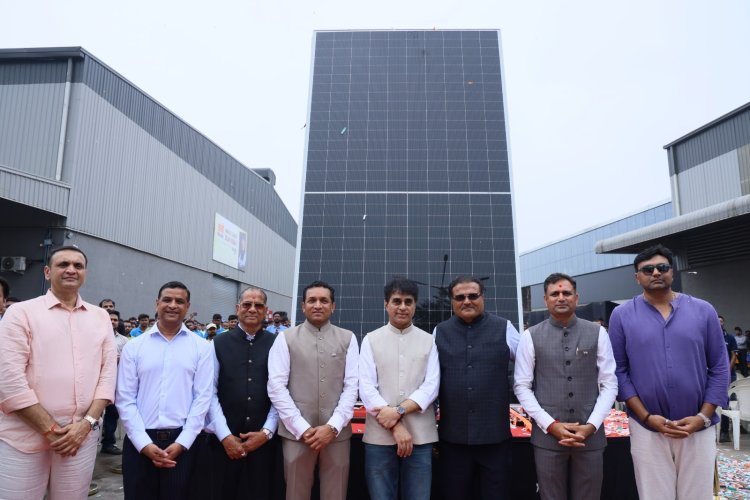
Goldi Solar, a solar manufacturer based in Gujarat, has presented what it refers to as the world's largest solar photovoltaic module, an initiative launched to commemorate the Prime Minister of India's 75th birthday—Narendra Modi. The module has been dubbed the 'NaMo Saur Samrat.' The company has produced the module in their factory in Kosamba, Surat, as a representation of India strengthening its capabilities in renewable energy manufacturing and the goal of achieving self-reliance.
The company indicated the initiative will serve as a recognition of the Prime Minister's leadership and that his government has prioritised India expanding its renewable energy capacity. The project is framed as part of the national 'Atmanirbhar Bharat' (Self-Reliant India) campaign to establish India as a global manufacturing hub. While China has traditionally led solar panel manufacturing, Goldi Solar stated the project illustrates India's capacity for innovation and large-scale manufacturing.
The module's measurements are designed to hold symbolic meaning, producing a measurement of 75 inches wide by 150 inches long in commemoration of the Prime Minister's 75th year. With a power rating of 1750 watts peak (Wp), this performance defines a new standard for size and output in the global solar industry. The company emphasized that creating a module of this dimension required significant accuracy and next-generation production methods to produce a structurally sound and high-performing module.
From a technology perspective, the module features TOPCon (Tunnel Oxide Passivated Contact) cell design, which is known for producing higher efficiencies opposed to general solar cells since it reduces electronic losses within the solar cell. This means better energy conversion rates at high temperatures - a common occurrence in India - and this technology exemplifies a shift for new value-added manufacturing in India with a focus towards higher value and more efficient technology versus cost only competition in solar production.
The launch aligns with a period of rapid growth for Goldi Solar, which has recently increased its capacity to 14.7 GW, with the intent to keep growing. Ishver Dholakia, the founder and managing director of the business, attributed its success to the government's policy direction. ”India has already crossed over half of the 2030 target of 500 GW of renewable energy capacity,” he stated, “which is generating a strong domestic market for manufactuers."
Market experts see the projects as providing both a technical demonstration and promotion tool, with the record-breaking module gaining publicity - aimed at building the company's name - creating a company name that may garner appeal and open new doors to business or partnership. The activity builds a company's name against national pride and the objectives of the government, which should pay particular dividends in a market more reliant on policy form and support.
The initiative forms part of India's overall energy transition plan. India is among the largest greenhouse gases emitters in the world and is also among the most vulnerable to climate effects. A rapid transition to renewables is critical for addressing increasing energy demand sustainably, increasing energy security through reduced dependence on fossil fuel imports and accomplishing international climate targets.
Establishing a domestic manufacturing ecosystem for solar components has been a major pillar of this shift. Government programmes to promote domestic solar modules production and component manufacturing, such as the Production Linked Incentive (PLI) scheme, have provided financial support to companies to bolster manufacturing capability for high-performance solar panels at scale. The proposition is to create an increasingly robust supply chain that is less exposed to global supply chain disruption and price volatility, which has previously been an issue for India's solar project developers.
The trend towards larger format modules in the solar sector is largely driven by lower levelled cost of energy (LCOE). The larger panels allow a solar power plant to have fewer component components (mounts, connectors, etc.) can also reduce installation time and labor relating to installation. Larger panels present additional new engineering challenges, such as increased weight and wind load, requiring stronger mounts and consideration of handling in excess of typical transportation and installation considerations.
The introduction of the NaMo Saur Samrat module will likely be regarded as a declaration of intention by the solar manufacturing industry in India. Even at this stage in the pre-commercial phase, it shows that industry players have the technical capacity to innovate design and engineering to allow construction of the next technology within the solar module space, and step away from simply assembling imported solar components. Ultimately, the commercial success and proliferation of these large format modules will be dictated by their operational performance, reliability and cost effective nature when used to create actual utility-scale projects over their operational life period.
This project emphasizes the growing intersection of industrial policy, national branding, and technological innovation in the global renewable energy space. As countries compete for leadership in the clean energy transition, there will likely be more of these symbolic demonstrations of capability, which signal a country’s, or company’s, desire to define the future of energy.
What's Your Reaction?