The MoEFCC High-Level Committee reviewed the Great Nicobar Island project, focusing on environmental safeguards, tribal welfare and infrastructure development.
Andaman and Nicobar Islands Lt. Governor Admiral D. K. Joshi (Retd.) met with Chandra Prakash Goyal, Chairman of the High-Level Committee of the Union Ministry of Environment, Forest and Climate Change (MoEFCC), and discussed the sustainable development of Great Nicobar Island in detail.
Goyal and the committee's Permanent Member, Dr. Satya Prakash Yadav, discussed with the Lt. Governor issues related to the Environmental Impact Assessment (EIA) and Coastal Regulation Zone (CRZ) regulatory framework, diversion of forest land, compensatory afforestation, and ensuring that indigenous tribal communities are not displaced on Great Nicobar Island.
One of the important points of the meeting was the need for the project to take appropriate mitigation measures during both the construction and operational phases to prevent any environmental damage and to protect the wildlife and socio-cultural ecosystems of Great Nicobar Island.
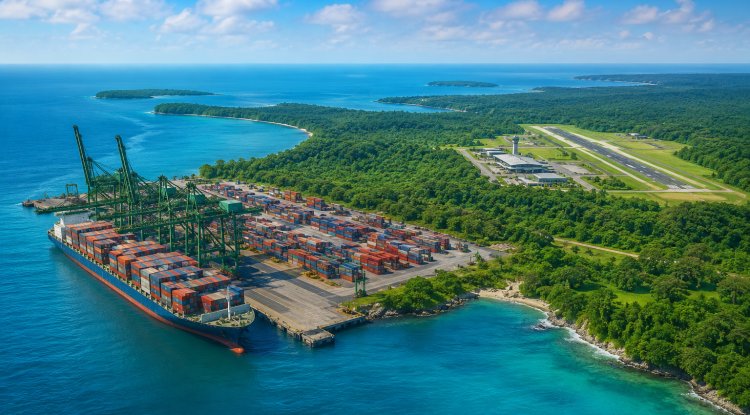
The Lt. Governor pointed out that the environmental clearance procedure along with the legal clearances for the Great Nicobar Island development will transform Andaman & Nicobar Islands into a key maritime and logistic centre in the Indo-Pacific region. This is because the container transshipment port is likely to become an important hub in the international shipping industry due to its strategic location near Malacca Strait, one of the busiest shipping routes in the world.
The initial phase of this terminal is estimated to cost ₹20,000 crore and will be completed in three years after the commencement of its construction. After the full development of the ICTT, it will have a total capacity of handling 14.2 million TEUs (Twenty-foot Equivalent Units). This will make it one of the biggest container transshipment ports in India and Indo-Pacific region.
The project will be implemented through the public-private partnership (PPP) model using the landlord-port model, where the government will make major investments in the core infrastructure, while connectivity and terminal operations will consist largely of investments by private players.
In addition to the port, a new international airport is also being built, with one runway expected to become operational within three years. Further, the current runway at the Indian Naval Air Station at Campbell Bay is being expanded to nearly three kilometres to accommodate larger aircraft, thus bolstering the strategic and logistical capabilities of the island territory.
What's Your Reaction?