Although the block is an ordinary brick structure, the classrooms constructed by the grassroots have been transformed into a new approach to early childhood education
A transformation is quietly taking place in the education system all over the rural landscape in Wardha district in Maharashtra. Creative Galileo, a leading Edtech company in early childhood education, is launching a scaled-up grassroots movement to make a difference for over 1,600 Anganwadi centres. It is introducing purpose-designed educational ‘Smart Kits' to the educational frontlines, incorporating digital learning into everyday lessons, and implementing an extensive teacher-training programme. The proliferation was the result of a big contribution by the private sector in filling this learning gap between community centres in rural areas and well-funded classrooms in cities.
Anganwadis have always been an integral part of the support system in rural areas, playing a crucial role in feeding and providing basic care to millions of young children. The challenge of bringing these centres to life as venues for cognitive development and early literacy has always been formidable, however, because of a severe lack of learning resources and learning materials, which are tailored and specific to children's development. The problem of setting these centres into effective cognitive development centres and early literacy has always been a big problem because the problem of their lack of learning resources and learning materials that are tailored and specific to children's development. To directly meet this challenge, the new initiative has been incorporating physical educational smart kits to develop early literacy, basic numeracy and cognitive abilities, from the early years of childhood. The materials are not based on a repetitive memorisation structure, but are based on interactive play-based concepts that speak to the imagination of young learners.
This rollout is particularly sustainable because it focuses on improving both the tools used in the classroom and investing heavily in human capital. The company has also invited all 1,600 Anganwadi centres to be run by the teachers who will receive structured, continuous professional training from the company to do so. The training provides community teachers with useful resources and a systematic framework to move the learning outcomes at the village level to great heights. The program's holistic approach allows for the effective use of the new resources, as it takes into account both the engagement of children and the capacity of teachers, promoting a lasting impact on the local community.
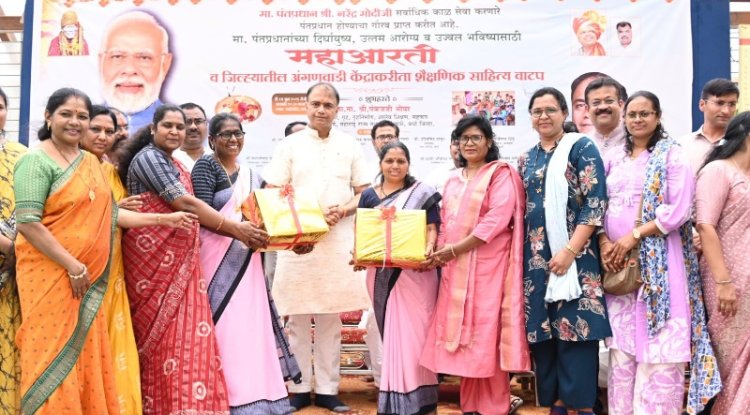
The programme was officially inaugurated in Wardha with community mobilisation, where the Minister of State, Dr Pankaj Bhoyar, along with government officials, officers of the Women and Child Welfare Department and the community members attended the programme. On the deeper meaning of the project, Prerna Jhunjhunwala, the Founder and CEO of Creative Galileo, said that learning environments in kids' early years lay the foundation for their success. She added that millions of children in India start that journey from Anganwadis, and the company is a strong believer that good learning content and well-trained teachers are equally important at Anganwadis as they are in any school in cities. By selecting Wardha, the organisation will be in a stronger position to reinforce that pledge in areas that need it the most.
The push is focused on areas and is integral to the vision of the NIPUN Bharat mission and National Education Policy (NEP) 2020 of the Government of India. Both frameworks are highly focused on the importance of having candidates achieve excellence in the mastery of basic literacy and numeracy skills as the foundations of good teaching and learning, and an essential foundation for success in their future academic studies. The Wardha programme provides an excellent blueprint for the successful operation of private edtech companies in partnership with public child-care facilities to move these national goals forward at scale, proving that investing in expensive setups is not essential for early education to be highly impactful.
Presently, the edtech company collaborates with more than 4,000 schools worldwide and has served 5 lakh students across India, Singapore, the Middle East, and Africa with its comprehensive technology-based learning solutions. The aim of this massive rollout in the state's supported Anganwadi system, however, is a conscious shift towards absolute inclusivity, making sure the advantages of modern educational technology are available to children, irrespective of whether they belong to a poor or rich family. The project is an effective reminder that the future of global education starts with simple, playful and nurturing spaces here in the heart of rural communities, and that is where the shape of teaching and learning is formed, the foundations are laid. As the newly trained teachers begin to use the smart kits and digital tools over the coming weeks, the project is a powerful reminder that the shape of global education is being formed in the simplest of ways, with play and a nurturing approach, starting with simple, playful, nurturing spaces in the heart of rural communities.
A transformation is quietly taking place in the education system all over the rural landscape in Wardha district in Maharashtra. Creative Galileo, a leading Edtech company in early childhood education, is rolling out a scaled-up grassroots movement to make a difference for over 1600 Anganwadi centres. It is introducing purpose-designed educational ‘Smart Kits' to the educational frontlines, incorporating digital learning into everyday lessons, and implementing an extensive teacher-training programme. The proliferation was the result of a big contribution by the private sector in filling this learning gap between community centres in rural areas and well-funded classrooms in cities.
Anganwadis have always been an integral part of the support system in rural areas and have been playing a crucial role in feeding and providing basic care to millions of young children. The challenge of bringing these centres to life as venues for cognitive development and early literacy has always been formidable, however, because of a severe lack of learning resources and learning materials, which are tailored and specific to children's development. The problem of setting these centres into effective cognitive development centres and early literacy has always been a big problem because the problem of their lack of learning resources and learning materials that are tailored and specific to children's development. To directly meet this challenge, the new initiative has been incorporating physical educational smart kits to develop early literacy, basic numeracy and cognitive abilities, from the early years of childhood. The materials are not based on a repetitive memorisation structure, but are based on interactive play-based concepts that speak to the imagination of young learners.
This rollout is particularly sustainable because it focuses on improving both the tools used in the classroom and investing heavily in human capital. The company has also invited all 1,600 Anganwadi centres to be run by the teachers who will receive structured, continuous professional training from the company to do so. The training provides community teachers with useful resources and a systematic framework to move the learning outcomes at the village level to great heights. The program's holistic approach allows for the effective use of the new resources, as it takes into account both the engagement of children and the capacity of teachers, promoting a lasting impact on the local community.
The programme was officially inaugurated in Wardha with community mobilisation, where the Minister of State Dr Pankaj Bhoyar, along with government officials, officers of the Women and Child Welfare Department and the community members attended the program. On the deeper meaning of the project, Prerna Jhunjhunwala, the Founder and CEO of Creative Galileo, said that learning environments in kids' early years lay the foundation for their success. She added that millions of children in India start that journey from Anganwadis, and the company is a strong believer that good learning content and well-trained teachers are equally important at Anganwadis as they are in any school in cities. By selecting Wardha, the organisation will be in a stronger position to reinforce that pledge in areas that need it the most.
The push is focused on areas and is integral to the vision of the NIPUN Bharat mission and National Education Policy (NEP) 2020 of the Government of India. Both frameworks are highly focused on the importance of having candidates achieve excellence in the mastery of basic literacy and numeracy skills as the foundations of good teaching and learning, and an essential foundation for success in their future academic studies. The Wardha programme provides an excellent blueprint for the successful operation of private edtech companies in partnership with public child-care facilities to move these national goals forward at scale, proving that investing in expensive setups is not essential for early education to be highly impactful.
Presently, the edtech company collaborates with more than 4,000 schools worldwide and has served 5 lakh students across India, Singapore, the Middle East, and Africa with its comprehensive technology-based learning solutions. The aim of this massive rollout in the state's supported Anganwadi system, however, is a conscious shift towards absolute inclusivity, making sure the advantages of modern educational technology are available to children, irrespective of whether they belong to a poor or rich family. The project is an effective reminder that the future of global education starts with simple, playful and nurturing spaces here in the heart of rural communities, and that is where the shape of teaching and learning is formed, the foundations are laid. As the newly trained teachers begin to use the smart kits and digital tools over the coming weeks, the project is a powerful reminder that the shape of global education is being formed in the simplest of ways, with play and a nurturing approach, starting with simple, playful, nurturing spaces in the heart of rural communities.
What's Your Reaction?