India Calls for Global Mountain Conservation at Sagarmatha Sambaad 2025
India took a strong stand for Himalayan and mountain ecosystem protection at Sagarmatha Sambaad 2025, a global climate dialogue held in Kathmandu, Nepal. Union Environment Minister Bhupender Yadav emphasized India’s leadership in addressing climate change, high-altitude biodiversity conservation, and the importance of international cooperation. He presented a five-point climate strategy focused on scientific research, resilient infrastructure, community engagement, green finance, and global recognition for mountain regions. Key Indian initiatives discussed included the National Mission on Sustaining the Himalayan Ecosystem, SECURE Himalaya project, and collaboration with ICIMOD. Yadav also advocated for wildlife protection through the International Big Cats Alliance, highlighting species like the snow leopard and tiger. Aligned with India’s broader goals under Mission LiFE, Ek Ped Maa Ke Naam, and the Green Credit Programme, the summit marked a step forward in India-Nepal climate
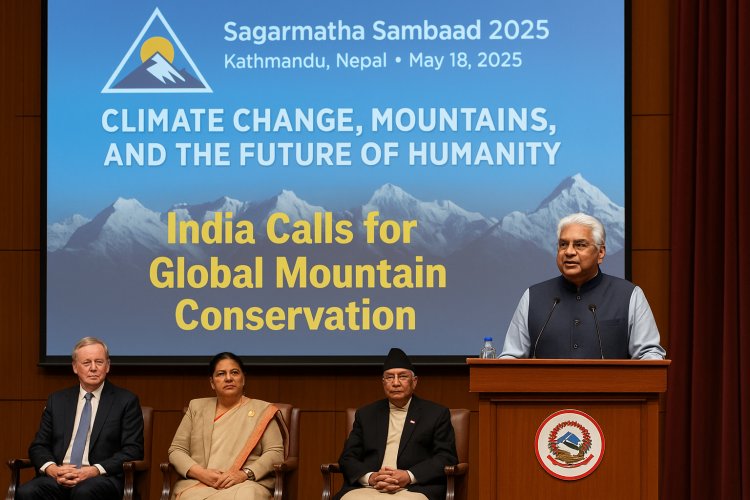

Union Minister for Environment, Forest, and Climate Change, Shri Bhupender Yadav, participated in the inaugural session of Sagarmatha Sambaad 2025, a high-level international dialogue hosted by the Government of Nepal. Themed “Climate Change, Mountains, and the Future of Humanity,” the summit brought together ministers, environmental leaders, and experts from across the globe to address the urgent environmental challenges threatening mountain ecosystems.
In his keynote address, Minister Yadav reaffirmed India’s strong commitment to the protection of the Himalayas and other mountain landscapes. Emphasizing the critical role of global collaboration, he noted that while South Asia contributes only 4% of global CO₂ emissions, the region houses 25% of the world’s population and remains highly vulnerable to climate-induced disasters.
“India stands ready to partner with Nepal and all mountain nations to protect our shared ecological heritage. In the spirit of Vasudhaiva Kutumbakam—the world is one family—we must ensure that our sacred mountains continue to stand tall as beacons of hope and sustainability,” said Yadav.
Five-Point Action Plan
Minister Yadav presented a comprehensive five-point strategy for addressing climate risks in mountainous regions:
Climate Resilience – Investing in adaptive infrastructure to protect mountain communities.
Community Empowerment – Involving local people in conservation and policy-making.
Green Finance – Mobilizing sustainable finance for conservation and climate adaptation.
Global Recognition – Ensuring mountain ecosystems are prioritized in global climate frameworks.
Initiatives taken to protect Himalayan mountain ecosystem
- National Mission on Sustaining the Himalayan Ecosystem: This initiative was introduced as a component of the National Action Plan on Climate Change (NAPCC) to focus on preserving the ecological health of the Himalayan region.
- SECURE Himalaya Project: Implemented as part of the Global Wildlife Program, this project supports wildlife conservation and efforts to prevent wildlife crime while promoting sustainable development in the Himalayan landscape.
- International Centre for Integrated Mountain Development (ICIMOD): An intergovernmental organization that serves as a hub for knowledge and learning, working for the well-being of people living in the Hindu Kush Himalayan (HKH) region.
Focus on Biodiversity and Big Cats
He also underscored the importance of high-altitude biodiversity, calling for stronger protection of species such as snow leopards and tigers under the International Big Cats Alliance. Yadav advocated for holistic policies that combine wildlife conservation with livelihood security for local communities.
Sagarmatha Sambaad: A Global Mountain Dialogue
Named after Mount Everest (Sagarmatha), the summit is Nepal’s flagship biennial global dialogue platform. The first edition was conceptualized in 2019 but delayed due to the pandemic, making 2025 its inaugural year. The dialogue aims to enhance international cooperation in addressing climate change, sustainable development, and ecological conservation, with a special focus on mountainous regions.
The summit featured prominent leaders including Nepal’s Prime Minister K.P. Sharma Oli, COP29 President Mukhtar Babayev, and delegates from China, the UN, and other mountain nations.
India’s Broader Environmental Initiatives
Minister Yadav’s participation aligns with India’s broader climate leadership through initiatives such as:
- Mission LiFE (Lifestyle for Environment) – Promoting sustainable living practices.
- Ek Ped Maa Ke Naam – A campaign encouraging tree plantation in honor of mothers.
- Green Credit Programme – Incentivizing eco-friendly business practices.
- International Big Cats Alliance – A global platform to conserve big cat species.
- National Adaptation Plans – Strengthening climate resilience in vulnerable zones.
Yadav also reiterated the need for developed nations to honor their climate finance commitments, especially in supporting developing countries through technology transfer and capacity building.
Strengthening India-Nepal Climate Cooperation
During his visit, the Minister held bilateral meetings with Nepalese officials, including the Ministers of Forests and Environment, and Foreign Affairs. Discussions focused on deepening India-Nepal cooperation in climate action, biodiversity protection, and mountain sustainability.
What's Your Reaction?