Environment Minister Bhupender Yadav launched a national roadmap for tiger reintroduction, released key conservation reports, and highlighted Sariska's recovery as India focuses on science-based wildlife management.
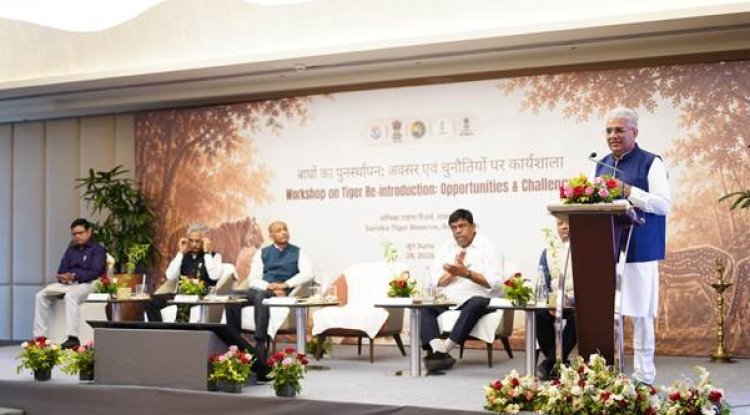
The Union Ministry of Environment, Forest and Climate Change has come up with a plan to help India manage its tigers, detailing ways of how to introduce, restore habitats, and manage tiger populations in various landscapes chosen for conservation.
The plan was released at the "Tiger Reintroduction: Opportunities and Challenges" workshop organized on Saturday in Rajasthan’s Sariska Tiger Reserve. This National Workshop was organized by the National Tiger Conservation Authority (NTCA) in collaboration with the Government of Rajasthan.
Environment Minister Bhupender Yadav stated that tiger conservation would also aid in preserving forests, watersheds, and wildlife dependent on the same ecosystems.
The minister highlighted Sariska's recovery after tigers disappeared from the reserve in 2005. Following a reintroduction programme, the reserve now has 56 tigers, according to the ministry. Officials said the experience has provided a reference for similar conservation efforts elsewhere.
The ministry also reviewed India's tiger conservation progress, stating that the number of tiger reserves has increased from 46 to 58 over the past decade. It added that India met the international target of doubling its wild tiger population by 2022.
Yadav said support from local communities played an important role in the tiger reintroduction programmes in Sariska and Panna. He said similar efforts in Odisha's Satkosia Tiger Reserve did not achieve the expected results because community participation remained limited. He also cited community involvement as an important element of Project Cheetah.
The minister released three publications during the workshop: the Road Map on Active Management of Tigers in India, the Booklet on Reintroduction and Recovery of Tigers in India, and the Annual Report of Project Cheetah (September 2024–December 2025). The publications cover tiger population management, habitat restoration, reintroduction practices, and the progress of the cheetah programme.
Technical sessions focused on habitat restoration, prey augmentation, wildlife translocation, landscape connectivity, and monitoring methods. Officials from tiger-deficient reserves also presented preparedness plans for future recovery programmes.
The workshop's recommendations will be used by the NTCA, state forest departments, and research institutions while planning future tiger conservation and reintroduction efforts across the country.
What's Your Reaction?