A new IESA-CES report projects India's EV components market to grow from ₹41,000 crore in 2025 to ₹3.55 lakh crore by 2032, driven by rising EV adoption and domestic manufacturing.
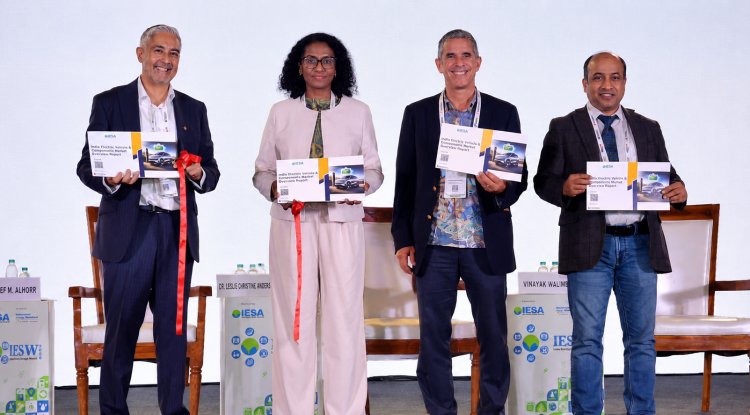
India's electric vehicle (EV) components market is projected to grow nearly eight-fold over the next seven years, increasing from ₹41,000 crore in 2025 to ₹3.55 lakh crore by 2032, according to the India Electric Vehicle & Components Market Overview Report released by the India Energy Storage Alliance (IESA) and Customised Energy Solutions (CES) during India Energy Storage Week (IESW) 2026 in New Delhi.
According to the report, the growth in India's market for EV components will continue at a rate of 38% per year from 2025 to 2032, backed by the increasing demand for electric vehicles and growing investment in their production. The report further suggests that the market may provide an extra opportunity to do business of value ₹3.14 lakh crore in the mentioned period.
Vinayak Walimbe, Managing Director, Customised Energy Solutions, said, "India's EV momentum is unmatched, powered by innovation and collaboration. Strengthening domestic supply chains will be central to our clean mobility success."
According to the report, battery packs are projected to take up more than half of the EV components market share in 2025, whereas motors, inverters, and power electronics are set to become increasingly important in the future. With increasing integration of the drivetrain by original equipment manufacturers (OEMs) and investments of Indian firms into high-tech subsystems, the importance of motors, inverters, and BMS systems is going to grow even more.
However, the report notes that battery packs and inverters remain the most import-dependent components, together accounting for nearly 60% of an EV's cost structure. In contrast, motors and battery management systems are witnessing faster localisation because of their software-driven nature and comparatively lower capital requirements.
Avanthika Satheesh, Director, Consulting, CES, said, "India's EV component market surge signals our readiness to lead in technology and manufacturing. Strategic investments now will secure India's place in the global EV value chain."
The report also notes that Indian companies, including Bharat Forge, Bosch India, Uno Minda and Tata AutoComp, are expanding investments in EV subsystems. However, it points out that technology capabilities and large-scale manufacturing capacity remain uneven across the industry.
According to the report, the long-term growth of India's EV industry will depend not only on vehicle sales but also on strengthening domestic technology ownership, local supply chains and intellectual property to support the country's mobility ecosystem over the coming decade.
The release of the report coincided with India Energy Storage Week (IESW) 2026, which was organized by the India Energy Storage Alliance at Yashobhoomi (IICC), New Delhi. The three-day conference attracted over 200 exhibitors and 10,000 delegates from the fields of energy storage, electric mobility and renewable energy.
During his speech at the conference, Dr. Ian Martinus, Investment and Trade Commissioner, India-Gulf, Government of Western Australia said, "Western Australia is prepared to be a partner for India not just as a provider of critical minerals, but also as an innovation partner in the evolution of the EV revolution. The future of electric mobility and large-scale storage will be determined through international collaboration and not alone."
Apart from that, the event was attended by representatives from 15 nations across the globe like Germany, Sweden, Australia, Norway, America, Japan, Singapore, France, and South Korea. Various topics were discussed at the event such as electric vehicles, energy storage solutions, charging solutions, green hydrogen, digitalisation, safety, skills, and international cooperation.
What's Your Reaction?