Korea’s Platinum-Free Hydrogen System Revolutionizes Clean Fuel
Seoul’s platinum-free hydrogen system, with 95% efficiency, cuts costs by 50%, offering a scalable solution for India’s green hydrogen goals.Korea’s platinum-free hydrogen system, 95% efficient, halves costs, aiding India’s 5 million tonne green hydrogen target by 2030.
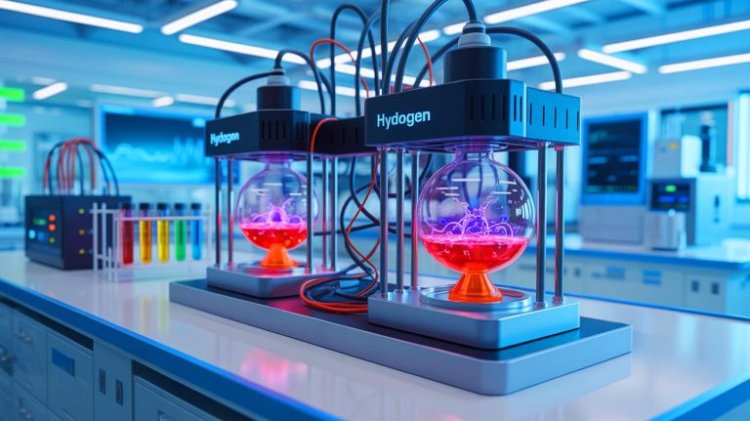
Seoul National University’s platinum-free hydrogen production system, unveiled in 2025, achieves 95% efficiency using cobalt-based catalysts. Costing 50% less than traditional electrolyzers, it disrupts industrial hydrogen production, offering a scalable solution for India’s green hydrogen ambitions.
The system uses a cobalt-tungsten-phosphorus (Co-W-P) catalyst in an alkaline water electrolyzer, producing 1 kg of hydrogen per 40 kWh, compared to 50 kWh for platinum-based systems. Published in Energy & Environmental Science, it maintains stability over 1,000 hours, with a 0.1% efficiency drop. The catalyst, costing $5/kg versus $1,000/kg for platinum, reduces system costs from $2,000/kW to $1,000/kW.
Global hydrogen demand, at 95 million tonnes in 2023, is 90% fossil fuel-based, emitting 900 million tonnes of CO2. Green hydrogen, at 1% of supply, costs $5/kg versus $2/kg for gray hydrogen. The Co-W-P system lowers green hydrogen costs to $3/kg, competitive with fossil-based alternatives. South Korea’s 15 GW electrolyzer capacity supports scaling, targeting 10% green hydrogen by 2030.
India’s National Green Hydrogen Mission aims for 5 million tonnes by 2030, requiring 125 GW of renewable capacity. The Co-W-P system could reduce electrolyzer costs by $10 billion, leveraging India’s 159.5 GW renewables. Pilot projects in Gujarat, with 100 kW systems, produce 2 tonnes daily at $3.5/kg. However, India’s 70% reliance on imported catalysts increases costs by 30%. Domestic production, supported by the 2025 Budget’s $1 billion for hydrogen, could address this.
Challenges include lower current density (0.5 A/cm² versus 1 A/cm² for platinum) and scaling to MW-level systems. Grid instability in India, with 10% renewable curtailment, limits efficiency. Innovations like AI-based power management and modular electrolyzers could improve performance by 20%. South Korea’s $500 million investment in catalyst research offers a model for India’s R&D efforts.
Conclusion
Seoul National University’s platinum-free hydrogen system offers a cost-effective, efficient solution for green hydrogen production. India could adopt this technology to meet its 2030 targets, but scaling and local manufacturing are critical to overcoming barriers.
Source: Sustainability Times
What's Your Reaction?