Microsoft has partnered with Indian startup Alt Carbon to support enhanced rock weathering, a carbon-removal technology that captures atmospheric CO₂ while improving soil health and supporting sustainable agriculture.
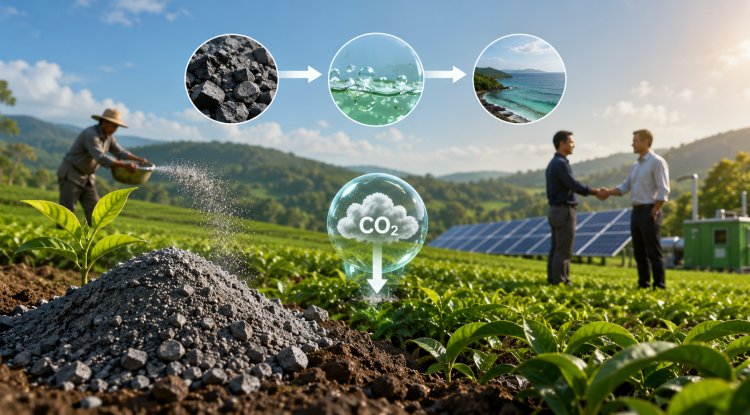
Climate action strategies are increasingly moving beyond traditional tree-planting carbon offset programmes of tree planting and towards high-tech engineering solutions, deep within the earth. A significant step for the green-tech industry, Microsoft has inked an agreement with Alt Carbon, a green-tech startup based in India. In one of India's first major enhanced rock weathering carbon-removal agreements, this partnership delivers enhanced rock weathering carbon removal credits, purchased by Microsoft. The tech giant is not just paying for a creative way to offset its carbon footprint, but also creating a new market for substantial, quantifiable climate solutions in South Asia through the innovative project to spread finely crushed volcanic rock across agricultural fields.
The technology behind this partnership accelerates a natural geological process, which could take millions of years to complete. Enhanced rock weathering entails the use of silicate rocks like basalt, crushing them into a fine powder to maximise the surface area available for chemical reactions, and then covering huge areas of land with this dust. Rainwater absorbs CO2 from the air, making it slightly acidic. When this rain comes into contact with the crushed basalt in the soil, a chemical reaction takes place that converts atmospheric carbon into stable bicarbonate ions. The dissolved bicarbonate is gradually transported into the oceans through rivers and groundwater, safely storing carbon in stable dissolved forms that can remain locked away for thousands to millions of years without the chance of escaping up into the air again.
The deal is a very calculated move in Microsoft's broader corporate climate strategy. The company has one of the boldest climate action plans in the corporate sector: It will be fully carbon negative by 2030, and aims to neutralise its total carbon footprint since its inception by 2050. These goals are a challenge to achieve, particularly with the current growth of data centres and AI computing infrastructures worldwide that are putting corporate power supplies to the test. Microsoft is investing in a project that focuses on actively removing and storing carbon rather than relying on avoidance-based carbon credits.
The true power of the model being developed by Alt Carbon is how it seamlessly integrates the use of heavy carbon removal in the day-to-day operations of rural Indian farmers. The startup collaborates directly with the local tea planters and farming communities in various areas, such as Assam, eventually making the use of basalt a normal part of soil management practices. This crushed rock, when it weathers, releases important nutrients such as magnesium, calcium and silica into the soil, such as magnesium, calcium, and silica, back into the soil. This natural mineral amendment can help improve highly acidic soils, which helps retain water and improve root development and crop growth, while also providing a financial and farm lifeline to farmers facing uncertain crop production triggered by climate change.
But deploying this type of environmental engineering solution is expensive and technologically challenging, hence the financial involvement of Microsoft is very important. One of the biggest challenges facing the enhanced rock weathering industry is measurement, reporting and verification (MRV). Accurately measuring the amount of carbon removed demands fine sampling of the many scattered hectares of farmland, geochemical modelling and ongoing digital tracking. Capital raised from this contract will enable Alt Carbon to expand its own dedicated laboratory networks, install high[1]tech sensor technology in the fields and perfect its data tracking to satisfy the rigorous requirements of international carbon registries.
More significantly, this ground-breaking offer is reverberating in India's local green economy. Traditional nature-based carbon credits are a well-known source of carbon credits in India, but engineered carbon credits with high permanence are hardly known and have not been in the market due to a high entry barrier and a lack of local buyers.
Microsoft is contributing the on-the-ground market validation that Alt Carbon requires, to convince investors to fund its development and to convince it that its geological carbon removal is viable commercially as well as within developing countries.
Overall, this collaboration is a testament to the fact that addressing global climate change is about more than just smart, local solutions; it requires a strategic partnership between global corporations and innovative solutions at the local level. Traditional carbon capture equipment consumes a tremendous amount of electricity to operate, but enhanced rock weathering takes advantage of “natural power”, which is rain and soil. This project will be an important test for whether or not the world can substantially transform the chemistry of the earth, and thereby save the chemistry of the atmosphere, using methods that have been employed for centuries.
What's Your Reaction?