Navitas Solar and Caelux partner to manufacture 5 GW of high-efficiency Hybrid Tandem solar modules in India.
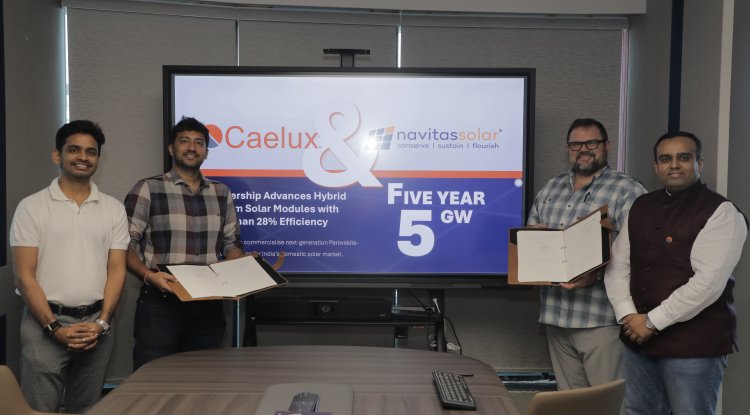
Navitas Solar Private Limited, India, and US-based Caelux Corporation have announced a five-year agreement to commercialise 5 GW of next-generation ‘Hybrid Tandem' solar modules in India, one of the world's largest partnerships between India and the US involving perovskite solar tech, TOPCon solar modules, Hybrid Tandem solar modules, solar manufacturing in India, and renewable energy.
The partnership seeks to integrate Caelux' proprietary perovskite energy-producing glass technology with Navitas Solar' N-Type TOPCon module technology to create high-efficiency solar modules to achieve expected efficiencies up to 28% or higher. The companies said that commercial production is expected to start by 2028. The agreement comes at a time when the solar manufacturing sector is getting the push it needs in India, with perovskite solar technology, TOPCon solar modules and Hybrid Tandem solar modules holding the spotlight as the efficiency of solar modules is a priority and the solar manufacturing industry is growing stronger.
Joint partnership to integrate the perovskite and TOPCon technologies
Navitas Solar will incorporate Caelux's perovskite energy-producing glass into its existing N-Type TOPCon solar modules to create Hybrid Tandem modules that are more capable of generating electricity from the same installation space as conventional silicon-only solar modules.
The tech is based on two layers of power generation in a single module, enabling higher energy generation with less footprint, the companies said. The targeted module efficiencies of up to 28% will be higher than the current commercially available module efficiencies, which are around 25%, the companies say.
The partnership will aim to enable the widespread use of high-efficiency modules in utility-scale, commercial and industrial (C&I) and distributed solar projects.
Aiding India's vision of clean energy and manufacturing
This is part of India's ongoing efforts to increase its renewable energy capacity. The nation has surpassed 150 GW of installed solar PV capacity and has targeted 500 GW of non-fossil fuel power generation capacity by 2030, with solar capacity expected to make a big contribution to future additions.
To reach these goals, industry commentators have said that "not only will there need to be a huge deployment of solar projects, but there will also need to be more efficiency in the modules, manufacturing locally, and making the supply chain more robust.
The joint venture is in line with India's push to boost domestic value addition under the Approved List of Models and Manufacturers (ALMM) and a push for localisation of advanced solar technology, the companies said.
Commercial production by 2028.
Navitas Solar has today multi-gigawatt manufacturing plants in operation and has established an integrated platform, encompassing the production of solar modules, production of solar encapsulants and engineering, procurement and construction (EPC) services.
The introduction of perovskite technology is expected to further broaden the company's manufacturing scope to next generation Hybrid Tandem modules. The companies claimed that they aim to reach commercial scale production by 2028.
Caelux, a perovskite solar technology specialist, will supply its own proprietary glass that can generate energy to be integrated into Navitas Solar's manufacturing process.
Industry leaders on the collaboration
Scott Graybeal, CEO, Caelux Corporation, said: “We are pleased to partner with Navitas Solar, a true visionary dedicated to scaling this important energy technology in India, one of the world’s fastest-growing renewable energy markets. By integrating our technology into its module, Navitas Solar is taking the lead in India’s ambitious clean energy goals, both in terms of domestic production and deployment. Together, we aim to deliver advanced solar solutions that support India’s clean energy transition while strengthening its domestic manufacturing capabilities.”
Ankit Singhania, Co-Founder and Director, Navitas Solar, said: “As India enters the next phase of its renewable energy journey, the focus must extend beyond capacity expansion to manufacturing globally competitive, high-efficiency technologies within the country. Our partnership with Caelux marks an important milestone in that journey. By combining our manufacturing expertise with Caelux’s pioneering perovskite technology, we are creating one of India’s earliest pathways for large-scale production of Hybrid Tandem solar modules. Crucially, this leap in world-class technology and scale will serve as a powerful engine to fuel the Government of India’s ambitious vision of achieving 500 GW of non-fossil fuel power capacity by 2030. This collaboration reinforces our commitment to innovation, market leadership, and self-reliance.”
Vish Iyer, Managing Director, India & West Asia, Caelux Corporation, said: “Navitas Solar is living proof that India’s energy transition will be won by coupling advanced technology with Indian supply chains, and Indian jobs. By integrating Caelux’s energy producing glass to create high-efficiency modules, Navitas is helping India leap forward towards its clean energy goals.”
Expanding domestic manufacturing capability
Founded in 2013 and headquartered in Surat, Gujarat, Navitas Solar manufactures Mono PERC and N-Type TOPCon solar modules with capacities of up to 720W. The company also operates across solar encapsulant manufacturing, EPC services and an independent power producer (IPP) portfolio.
The partnership represents an effort to introduce large-scale manufacturing of Hybrid Tandem solar modules in India using perovskite technology. As demand grows for higher-efficiency solar modules, collaborations that combine advanced technologies with domestic manufacturing are expected to play an increasingly important role in supporting India’s clean energy transition while strengthening the country’s solar manufacturing ecosystem.
What's Your Reaction?