The government and industry are now stepping from the policy phase to implementation in India’s National Green Hydrogen Mission, highlighting the importance of creating a competitive ecosystem to enable India to emerge as a global supplier of green hydrogen and its derivatives. Scaling production, building up domestic demand, establishing supply chains and strengthening international cooperation for industrial decarbonisation are now in focus.
India is aiming to become a global leader in the hydrogen economy by leveraging its renewable energy resources, manufacturing capabilities and policy support to build a competitive green hydrogen ecosystem.
India wants to become world leader in hydrogen energy
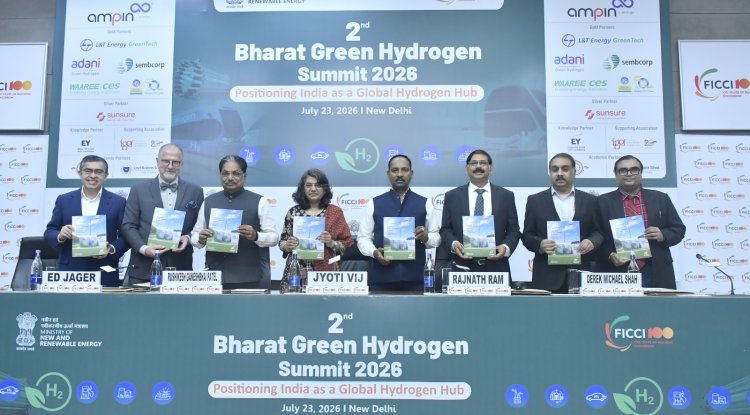
Shripad Yesso Naik, Minister of State for Power and New & Renewable Energy, made the remarks while addressing the second edition of Bharat Green Hydrogen Summit 2026 organised by the Federation of Indian Chambers of Commerce and Industry (FICCI).
India had the potential to become a leader in the hydrogen economy with its policy framework, manufacturing capacities and renewable energy resources, he said.
“The global energy transition has entered a new phase. The question today is no longer whether Green Hydrogen will become a cornerstone of industrial decarbonisation, but which nations will lead this transformation. India is uniquely positioned to emerge as a global leader in the hydrogen economy. Let us work together to make ‘Made in India Green Hydrogen’ the world’s trusted symbol of clean energy, technological excellence and sustainable industrial growth,” Naik said.
Mission goes into implementation
The National Green Hydrogen Mission has helped establish a future-ready green hydrogen ecosystem by providing production incentives, promoting indigenous production of electrolysers, incentivising demand in sectors such as refineries and fertilisers, supporting pilot projects in mobility, shipping and steel, and creating an enabling regulatory framework, Naik said.
Green hydrogen is no longer just a long-term vision but a rapidly growing economic opportunity, he added.
“Green Hydrogen in India is no longer an idea of the future; it is becoming a fast-growing economic opportunity. From commercial-scale production to recently inaugurated India’s first indigenously developed hydrogen-powered train, our progress reflects the breadth of capabilities needed to position India as a global hydrogen hub,” he said.
For hydrogen to become a global hub, innovation, competitiveness, robust supply chains, internationally accepted standards, skilled human resources and long-term collaboration between governments, industry, start-ups, academia, financial institutions and international partners would be needed, he added.
Gujarat emphasises investment ecosystem
Renewable energy resources, industrial infrastructure and ports make Gujarat a key player in India’s green hydrogen movement, the state’s minister said.
“Gujarat is committed to becoming India’s green hydrogen growth engine. With abundant renewable energy resources, world-class ports, robust industrial infrastructure and a progressive Green Hydrogen Policy, the state offers an integrated ecosystem for production, innovation and exports. We invite industry to partner with Gujarat in building a globally competitive green hydrogen economy,” said Rushikesh Ganeshbhai Patel, Minister of State for Energy, Government of Gujarat.
He also said green hydrogen represented both an energy transition opportunity and an industrial transformation opportunity.
“Gujarat is moving decisively from policy formulation to implementation by creating an enabling ecosystem that will attract investments, generate employment and position India as a global hub for green hydrogen and green ammonia,” he said.
International cooperation seen as critical
Emphasising the importance of international cooperation, Ed Jager, Minister (Commercial), High Commission of Canada in India, said partnerships would play a crucial role in building global hydrogen value chains.
“India’s ambition to become a global green hydrogen hub is both credible and achievable. Canada is committed to partnering with India through research, innovation, technology collaboration, standards, certification and financing to help build resilient global hydrogen value chains. Green hydrogen will succeed through long-term partnerships built on trust, predictable policy frameworks and bankable commercial projects,” Jager said.
NITI Aayog calls for speeding up execution
NITI Aayog Adviser (Energy) Rajnath Ram said the Green Hydrogen Mission had entered the implementation stage, with policy support, demand aggregation, electrolyser manufacturing incentives and industry participation laying the groundwork for a competitive ecosystem.
“India’s Green Hydrogen Mission has entered the implementation phase. Strong policy support, demand aggregation, electrolyser manufacturing incentives and industry participation have laid the foundation for building a globally competitive green hydrogen ecosystem that will drive India’s clean energy future,” Ram said.
The next step should be accelerating projects, increasing domestic demand, enabling bankable offtake agreements and strengthening supply chains, he added.
“Together, these efforts will establish India as a trusted global supplier of green hydrogen and its derivatives,” Ram added.
Industry stresses integrated ecosystem
Coordinated development across the hydrogen value chain would be needed to support future growth, industry leaders said.
Green hydrogen was one of the biggest industrial opportunities of the decade, according to Derek Michael Shah, Chair of the FICCI Green Hydrogen Committee and CEO & MD, L&T Energy GreenTech.
“Green hydrogen represents one of the most significant industrial opportunities of this decade. India’s competitiveness in renewable energy, manufacturing capability and policy support provides a strong foundation for becoming a global leader in clean hydrogen production and exports. The future of India’s hydrogen economy will depend on building integrated ecosystems where renewable energy, hydrogen production, logistics, storage, manufacturing and end-use industries evolve together. Collaboration across government, industry and global partners will be the key to scaling this opportunity,” Shah said.
Vipul Tuli, Chair of the FICCI Renewable Energy CEOs Committee and President & CEO, Renewables West, Sembcorp Industries, said:
“Green hydrogen will power India’s next phase of industrial growth by strengthening energy security, accelerating decarbonisation and creating globally competitive manufacturing and export opportunities.”
Report outlines export roadmap
With a target to capture around 10 per cent of the global green hydrogen market by 2030, India plans to strengthen export infrastructure, build trusted supply chains and deepen strategic international partnerships, FICCI Director General Jyoti Vij said during the summit.
A joint FICCI-EY report, Towards a Green Hydrogen Economy: India’s Export Competitiveness and Strategic Outlook, was also released, outlining India’s roadmap to becoming a globally competitive exporter of green hydrogen and its derivatives.
What's Your Reaction?