A long-term study by researchers from IIT Guwahati, NIT Guwahati and IIT Gandhinagar has found that nearly half of India's lakes, ponds and reservoirs have shrunk over the past three decades, with small water bodies facing the greatest risk.
Nearly Half of India's Water Bodies Shrank Over Three Decades, Study Finds

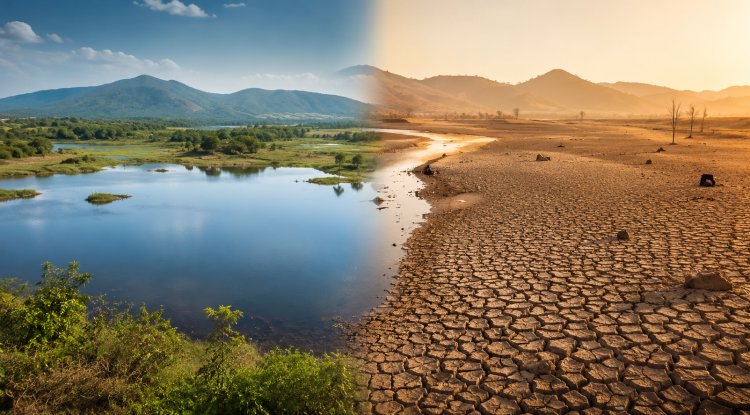
A new study by the Indian Institute of Technology, Guwahati, the National Institute of Technology, Guwahati and the Indian Institute of Technology, Gandhinagar has revealed that almost 50% of the lakes, ponds and reservoirs monitored over 29 years in India have seen a loss in area, and that while isolated droughts might have a lower impact, consecutive dry seasons have had a significant effect. Small water bodies were found to be the most vulnerable, and recover more slowly than they decline.

The study relied on long-term observations using satellite data of surface water storage changes, along with climate variables related to drought. The researchers analysed 10,476 inland water bodies in India from 1990 to 2017 and found that 44.8% had lost significant area; 28.7% had increased in area while 26.5% had not changed much.

A weak southwest monsoon was found to reduce the average extent of water bodies by approximately 5%, while researchers M. Niranjannaik and Vimal Mishra found that deficient winter rainfall caused a further reduction of 2.7%. The more immediate effect was when two dry seasons occurred consecutively: a weak monsoon season was followed by a dry winter, which resulted in an average water area decline almost three times greater than that caused by a single deficient winter, demonstrating how droughts exacerbate water-area losses if there is no recovery period between seasons. The study also discovered that even if the winter season after a weak monsoon is wetter than usual, ponds, lakes and reservoirs may not be able to recover as quickly as they diminish, which means that filling up may take longer than emptying.

The most severely affected were small water bodies (<1 km²), where depth was shallow, inflows were low, and evaporation and human use were high. They decreased by approximately 14% during drought years, while medium-sized water bodies declined by about 12% and large lakes and reservoirs by around 10%, suggesting that larger bodies had more storage resilience during extended drought years.

Reduced rainfall combined with intensive groundwater extraction and land-use change led to some of the highest rates of surface water decline in semi-arid central India, the Ganga plains, and the river basins of the Krishna, Kaveri, and Pennar. Water bodies in certain areas of the Ganga plains decreased by over 60 per cent during the study period. In contrast, the Himalayan region exhibited a reverse pattern, with a few lakes growing due to increased snow and glacier melt associated with warming, although further glacier melting and retreat could increase hazards such as glacial lake outburst floods and the risk of water shortages in both mountain and downstream areas.

The researchers said planning should be based on the cumulative impact of multiple consecutive dry years, rather than on individual drought seasons, and existing small water bodies could be the most significant resource to be conserved, along with new construction. The study also highlighted the importance of improving the monitoring of small ponds and village reservoirs, which are commonly used for domestic water supply, irrigation, animal husbandry, and aquifer recharge, but are slowly lost during successive dry years, potentially allowing vulnerable small water bodies to be tracked using satellite data and helping direct restoration efforts at an early stage. The findings have direct implications for water conservation programmes such as the Jal Shakti Abhiyan and pond restoration initiatives under MGNREGA.

Share: