New Membranes Offer Sustainable Solution to Desalination Brine Waste
A new ultrahigh charge density membrane developed by the University of Michigan could revolutionize desalination by reducing brine waste and enabling efficient mineral extraction, offering a sustainable solution to freshwater production in dry regions.
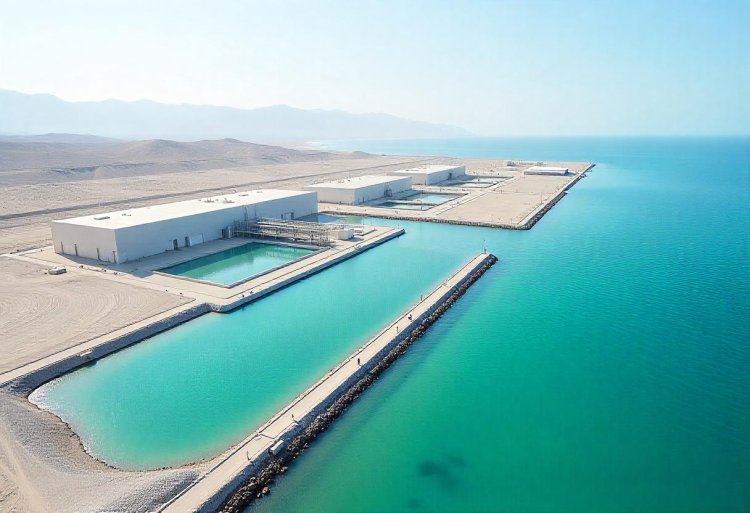
Desalination is a method increasingly needed for fresh water supply in arid regions, but with one serious disadvantage—brine waste. For each liter of freshwater it produces, desalination plants generate 1.5 liters of brine. This very salty water, typically stored in evaporation ponds or discharged into oceans, causes serious environmental problems. However, new research at the University of Michigan reveals a breakthrough that might make desalination far less wasteful and viable than before. The researchers have made a discovery in applying ultrahigh charge density membranes to enable a more efficient transfer of ions in n electrodialysis, a power-conserving process of salt-water separation.
The majority of desalination plants are currently founded on reverse osmosis or evaporation, for the treatment of brine. Less efficient at high salt levels, reverse osmosis requires an enormous amount of space and energy for evaporation. Electrodialysis uses electricity to force positive and negative ions through specially constructed membranes to create streams of purified water and dense brine. The process, however, has been limited at high salt concentrations by the limitation that available membranes spill ions or consume too much power. The researchers at the University of Michigan circumvented these problems by tightly packing charged molecules into the membranes, greatly increasing their leakage resistance and ion conductivity. Their innovation enables brine up to six times saltier than normal seawater to be treated without high energy use.
These novel membranes are effective in that they incorporate carbon connectors that entrap the charged molecules so they won't swell as they absorb water. This allows the membranes to have high charge density, directly enhancing their ion-selective characteristics. The researchers also introduced a feature of tunability in that the membranes would be made such that they can be adjusted according to water salinity to be treated. In performance experiments, the membranes showed ten times greater conductivity than what is offered by current leak-proof membranes, enabling more rapid ion transport with less energy input. The greater conductivity, coupled with membrane manufacturing scalability and tunability potential, makes them suitable for the existing desalination systems.
Another benefit of this technology is that it can potentially be used to recover minerals. With desalination becoming widespread globally, more activity is taking place in the recovery of precious minerals from sea water, including lithium, magnesium, and potassium. These chemicals are crucial to the electronics to agriculture industry. Salt concentration to high-efficiency crystallizable state using electrodialysis membranes may be able to enable the separation of pure water for recycling as well as solid mineral recovery from brine. By converting brine into a useful source of compounds from waste, the technology has the potential to revolutionize the economics and geography of desalination.
Brine waste produced in desalination has been a logistical and environmental problem over the past decades, especially in areas with limited space for evaporation ponds. If not disposed of, the saltwater can potentially become groundwater or destroy marine life when discharged to oceans. This system based on membranes reduces evaporation requirements, minimizes environmental risks, and offers potential for zero-liquid discharge operation, where all desalination byproducts are recycled or safely stored.
The research appeared in Nature Chemical Engineering as "Fast and Selective Ion Transport in Ultrahigh Charge Density Membranes" (DOI: 10.1038/s44286-025-00205-x). The research was conducted with support from the U.S. Department of Energy by a team led by Jovan Kamcev and first author David Kitto. They also used National Science Foundation-supported X-ray facilities at the University of Pennsylvania. Patent protection of the technology is underway through U-M Innovation Partnerships.
With increasing water shortages in the majority of the globe gaining traction, calls for effective and green desalination have been rising. Advanced high-performanceUserId membrane technology with high-performance capabilities to reduce waste and conserve energy is one step further towards making desalination a viable and sustainable tool to bring an end to the global water shortage menace. Not only is the technology a milestone but also an environmentally friendly means of meeting future water requirements without contaminating the environment.
Source and Credits:
Content recreated from United States University of Michigan Engineering. Original research appeared in Nature Chemical Engineering. Research by Jovan Kamcev, in collaboration with David Kitto. Photographs courtesy of Marcin Szczepanski and Jeremy Little.
What's Your Reaction?